A Start to AN Independent Investigation
(open to revision)
June 19, 2020
adds June 21, edits June 24
Background: Mali in Crisis
I haven't followed the situation in Mali, a landlocked west African nation of 20 million,. In general, Mali has been in a low-key insurgency since 2012,
following the the NATO-led Jihadist takeover of Libya. This took a turn for the worse on Sunday (June 14th)
with a disastrous ambush of Malian troops (Forces Armées Maliennes - FAMa) near the village of Boki-Wéré in the volatile Mopti region (see map below). Of the 64 troops in the convoy,
AFP reports,
"about 20" were able to return from the mission, while
24 are believed killed, and the rest listed as missing, most likely captured
(along with their weapons, vehicles, and uniforms). This comes as two Egyptian soldiers with the UN peacekeeping force MINUSMA were killed when their convoy came under attack
on the 13th in northwestern Mali (same link), and not long after French forces working with the government in Mali claimed credit
for
killing Abdelmalek Droukdel, the Algerian leader of Al-Qaeda in the Islamic Maghreb (AQIM), in an operation on June 3.
 |
| How JNIM fighters sometimes look |
Islamic State (ISIS, Daesh) has been active there and surrounding counties, frequently fighting for influence with the other,
"moderate" Islamists - including AQIM. Among the latter, a
Jamaat Nasr al-Islam Wal Muslimin (JNIM -
Wikipedia) has emerged, as a Syria-style regional re-branding of the local Al-Qaeda franchise: initially "Nusrat al-Islam," they were founded on an allegiance to al-Qaeda Emir Ayman al-Zawahiri, AQIM's Emir Droukdel, the Taliban's Emir, Osama Bin Laden, and Abu Musab al-Zarqawi. That was followed with a direct merger with AQIM to become Al-Qaeda's official branch in the area. JNIM seem to be a leading force now, graciously
offering to negotiate peace
with the Malian government on some terms, including at least that French forces assisting them and killing their terrorist bosses had to leave.
The JNIM statement noted that recent popular protests agreed on the point about former colonial power France. Indeed, a quick Twitter search shows recent protests have
demanded French forces must leave, and also that the serving president Keita
needs to resign.
People also
want opposition leader Soumaila Cissé released, directing demands at the government. (He was kidnapped in March while campaigning in central Mali, and wound up
held by Jihadists somewhere in the desert.) Other protests in recent months demanded
the UN special mission (MINUSMA)
must leave Mali. Another time, rockets were launched on a MINUSMA camp in the Timbuktu region,
where "protesters" were killed by security forces, as a police officer was "taken and killed
by demonstrators, police station destroyed & arms seized at Niono, Segou Région." (
Sept. 19, 2019)
Protesters, peaceful and otherwise, human rights monitors and others have increasingly criticized Mali's military over
alleged violations of Human Rights, with abductions, summary execution, and recently even village massacres of the kind we'll consider. Last year, also in the Mopti region, a round of such violence seems to have been a tit-for-tat communal type, escalating to some 160 killed in the worst attack, on the Fulani village of Ogossagou on March 23, generally blamed on a Dogon militia (
WP).
Fulani militants and/or terrorists were blamed for other attacks, including on the Dogon village Sobane Da, killing 35, on June 10
(about 50 attackers, arriving on motorcycles, with a few trucks -
WP).
The serving Prime Minister and his whole government
resigned last April, seemingly over these allegations (reason not given, but it followed talk of
"a possible motion of no confidence in the government because of the massacre and failure to disarm militias or beat back Islamist militants.").
Human Rights Watch had concluded the problem (as it existed in 2018) stemmed from "the limited presence of Malian security forces," not so much its brutal presence (all the clashing communities - Bambara, Dogon, and Peuhl (Fulani) - "accuse the Malian security forces of failing to adequately protect their communities."). This direct implication of the military in the violence in newer, if not exactly brand-new as of the June allegations (an area I may look into more).
If I had followed or investigated these allegations, I might be more inclined to
accept the latest charges, or less so, depending what I had learned.
But what I've learned elsewhere, combined with what I see here, leads me to suspect the story as it's been lodged, and I feel those questions are at least worth raising for others to consider.
Background: Recent Attacks on the Map
The area of focus here is the south-central Mopti region - south of Timbuktu, east of Segou and the capitol Bamako, It's far from where AQIM's Droukdel was reportedly killed in Tessalit in the country's north (
Arab News), having recently crossed over from Algeria, where he'd been hiding for years. It's worth wondering why he did that - big plans in Mali? My own basic map is inset at right (Mopti region roughly marked in orange). It's this central area, a possible choke-point between the desert north and the populated south, that's shown in
a handy map of some deadly ISIS-JNIM attacks on military forces over the last couple of years, most of them across the border in Niger and Burkina Faso.
More recent attacks not included there, on May 29 and 30:
June 1 tweet: "This weekend there have been three jihadist attacks in Burkina Faso that have left 52 dead." On the 30th, "two attacks against a market and a military convoy took place in Kompiembiga and Foube" and "an attack on the border with Mali took place on Friday (May 29)."
Next and likely of direct relevance:
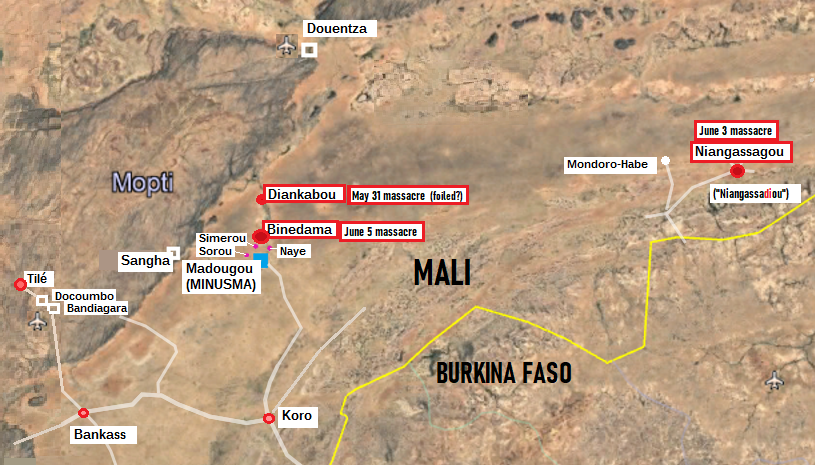
A Malian army (FaMa) patrol was ambushed on May 31 "between #Simerou and #Binedama (circle of #Koro)." Two wounded soldiers "received first aid at the MINUSMA temporary operational base in #Madougou. #Mali🇲🇱#A4P#ServingForPeace " (
MINUSMA June 4 tweet)
Another source (includes the stock photo of a FAMa pickup truck patrol below) says it was around 3 p.m. on the 31st that an army patrol (engaged? "accroché") an armed group "near the town of #Souroundé in the borough of #Diankabou." They also heard "a FaMa vehicle was set on fire and the soldiers retreated."
(See map below - Binedama, Diankabou, and Simerou located. As for Sourounde, not sure: a "Sorou" is a bit SW of Simerou,
even further from Diankabou.
May 31 MENASTREAM tweeted on "#Mali: Series of clashes between #FAMa & militants in #Mopti & #Ségou." It was
"presumed #JNIM" that "repulsed FAMa and burned vehicle in Binedama (Koro)" or around there. Also on this day:
- FAMa national guard routed militants in Mondoro
-
JNIM claimed attack on FAMa in Ké-Macina, seized 2 vehicles, arms, equipment (map: well west of Binedama area, but worth adding in the wider map below - just a few kilometers from Boki-Wéré where the deadly ambush of a FAMa patrol happened 2 weeks later, perhaps using these stolen tools to help steal even more, to help ... do whatever they try next.)
https://twitter.com/MENASTREAM/status/1267302650325991425
New village massacres allegedly began on that same day, May 31, or at least tried to. In fact Fulani opposition sources claim it was
at Diankabou, some 15-20 km north of that ambush, or somewhere nearby (like 15-20 km south?) that a "similar" operation
to the ones to come was somehow prevented by "numerous interventions."
And presumably JNIM sent a "patrol" running ... in what might be two versions of the same incident.
That coincidence is obviously interesting. We'll come back to that.
There would be a successful massacre June 3 a ways to the
east at "Niangassadiou" killing 14 - as it happens, near Mondoro, where militants were routed the 31st, but not that we hear of on the 3rd.
Then came the deadliest one right in Binedama on the 5th, killing
a reported 29 civilians, including at least two women, one young girl and one teenage boy. The first word on these incidents came only on June 5 and mostly on the 6th, regarding both Binedama and the days-old and possibly avoided massacres. Added on June 6 wee reports of nine killed at Massabougou, some ways to the west, not far from Ke Macina, where JNIM had shown and improved their capabilities a week earlier (see second map, and note two villages of the same name, so placement's not certain).
I found Mapcarta had this area very well-covered, letting me find every town named (some only because nearby towns were also named) - here it is set to Binedama for starters:
https://mapcarta.com/17265766
I took some time to make this map of my own starting with those (red boxes), as reports got the middle name wrong (or spelled unusually) - NiangassaDIou. (the other red dots refer to the other alleged massacres of Dogon civilians - which I'll explain below - while purple and blue
are for other relevant locales, and other locales are in white just for reference, along with some roads.)
I finally decided to make a wider map to include later discoveries that's also better in most ways. Having both of these doesn't seem that useful, but then neither does deleting the one.
The Western, Activist-Informed View
The French AFP news agency's widely-cited report heard from 4 government/elected officials, all anonymous, allegiances uncertain:
"A local government official in Koro" said that
the raid occurred on Friday afternoon, killing 29.
"Two other local officials" gave a lower death toll of 26,
"adding that the village was torched and its chief killed."
"An elected official from the area" was the source for the claim "men dressed
in Malian army fatigues" had carried out the raid, and that "they had burned down buildings and killed the village chief."
As told to AFP, two women and a nine-year-old girl were among those killed. Tabital Pulaaku, a Fulani association, "released a statement later on Saturday saying that
29 people had died and called for an independent probe led by the United Nations. The government didn't deny or confirm, but pledged to investigate.
https://www.france24.com/en/20200606-militant-attack-kills-more-than-two-dozen-in-central-mali
https://maliactu.net/malimassacre-a-binedama-larmee-pointee-du-doigt-amnesty-demande-une-enquete-credible/
https://www.msn.com/en-us/news/world/twenty-six-killed-village-torched-in-central-mali-attack/ar-BB157Wxx?ocid=msedgntp
Spain's government at least condemned the attacks, welcomed the government's promise of an investigation, and urged locals to pursue peace and reconciliation.
http://www.exteriores.gob.es/Portal/en/SalaDePrensa/Comunicados/Paginas/2020_COMUNICADOS/20200610_COMU043.aspx
Ousmane Diallo, researcher for West Africa at Amnesty International is quoted as saying
"The Malian authorities must conduct independent and credible investigations in order to punish those responsible for these abuses"
which he suggests happened during "military operations."
https://www.studiotamani.org/index.php/themes/politique/23741-massacre-a-binedama-l-armee-pointee-du-doigt-amnesty-demande-une-enquete-credible
Late on June 5 (4:06pm my time) #Mali : Army suspected of abusing civilians today. More than 20 people killed this afternoon Friday,
June 05, 2020 in #Binedama commune Madougou circle of #Koro region of #Mopti. ( Tabital Pulaaku).
https://twitter.com/Baba_A_/status/1269043058148081669
Burned village aftermath video from ocisse691
Masta Yattassaye (translated): "#Binedama Peulh village in the circle of #Koro , region of #Mopti after the passage of
a detachment of the Malian army. Malian soldiers killed at least 30 people. The victims
were all slaughtered. This is the work of the Malian army in the center of #Mali."
(Includes graphic photo I'll show below.)
https://twitter.com/kaartanke/status/1269022875777990664
"#Mali : 43 women and children executed on June 3 and 5 in Niangassadiou and Binedama. Our condolences to the relatives and families of the victims"
https://twitter.com/segadiarrah/status/1269934802679054336
A written statement from Tabital Pulaaku association:
https://twitter.com/kaartanke/status/1269308789792145410
translatuing some copied text, I can make out this as saying:
* 5 June 40 pickup massacre Binedama commune of Madougou, circle of Koro. 29 killed, including 2 women,
aged 70 and 63
* 3 June Niangassadiou dans la Commune de Mondoro, killing 14? (8 Peul/Fulani, 6 Tuaregs) (map: Mondoro didn't come up directly, even though mapcarta has "Mondoro-Habe" with "Niangassagou" close by)
* 31 May at Diankabou, circle of Koro: "a similar operation had been attempted against the Peul
neighborhood of the village of Diakbabou ... it failed thanks to numerous interventions. (elle a échoué grâce â de nombreuses intervention. Si rien n'est fait ...) If nothing is done the infernal spiral of violence will continue."
June 6 - Nine more killed by FaMa in Massabougou, near Dogofori, Niono, Segou. Victim list attached.
https://twitter.com/kaartanke/status/1269360119223123970/photo/1 Map: Massabougou, near a "Dogofryba" and a "Dagabory", close to Niono,
Segou, and just a ways north of Ke Macina and Boki-Wéré. At the last minute I ealized there are two Masabougos close by, one with two Ss. I had marked the wrong one, changed it to be the one closer to said towns. This is some 100km + off the west edge of my oiginal map, added to the wider one - not likely to be done by the same fighters, but quite likely connected.
It is near the siezed weapons at Ke Macina, and the successful ambush at Boki Were - an area of capable militant activity.
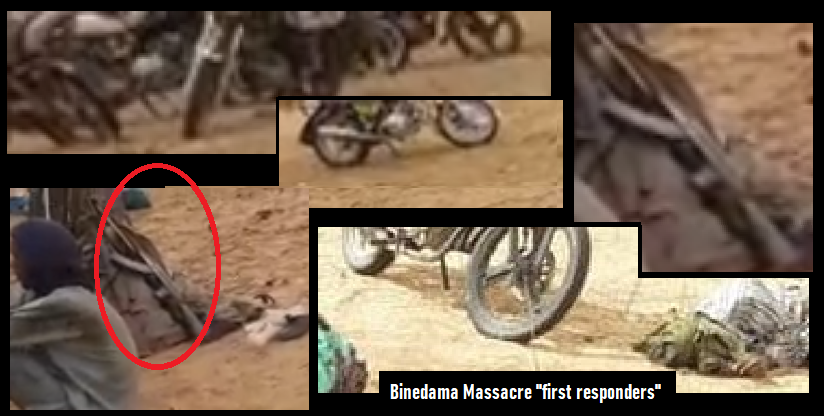
Witnesses say they saw the killers wearing Malian army fatigues and/or arriving at Binedama in 40 army trucks. It's said there's visual
proof of this, and while I haven't seen it yet, I wouldn't be surprised.
Statement by "Abou Sow" president of the Tabital Pulaaku association: “It is a column of army vehicle. There are photos, pictures.
They arrested many people whom they summarily shot. And among those slaughtered were women and children.
We received a first list of 29 people on which I counted 18 people between 56 and 78 years old, ”
M. Yattassaye: "A mission of the general inspection of the armies went today to the bereaved village of #Binedama . As they approached, the inhabitants deserted the village as if to boycott them. They went to get them." (??)
https://twitter.com/kaartanke/status/1270460308654641152
A Critical Review
1) Takfiris in Costume?
First, no one claimed responsibility - everyone has or would deny doing this. So if Malian troops were the culprits, would they be seen in broad daylight in their own trucks, wearing their own uniforms, as claimed by some? Possibly, but not intelligently. They might instead go in civilian clothes, or even disguised as Jihadists, to
keep the blame on their enemy. Conversely, JNIM-AQIM-ISIS types, if they wanted to do the same, might commit the crime in
army fatigues, in broad daylight, and wind up seen in alleged opposition photo and video proof.
That's just what these guys allegedly did, and that rings suspect.
I haven't even seen this evidence, but I wouldn't be surprised if it exists. If so, it could mean the killers were FaMa soldiers. But then militants can steal uniforms from soldiers they kill or kidnap or bases they overrun, have them handed over by defectors. The killers wearing uniforms (if they truly did) is no proof who hired them. In fact, it may as likely point
to their enemies.
The same can be true of military vehicles, sometimes ... and here, JNIM admits to seizing two FaMa "vehicles" (field trucks?) just a few days earlier at Ke Macina, besides any others they'd gotten earlier and might still have (note that uniforms could have been seized too at Ke Macina). Otherwise, the same model trucks, maybe with a paint job and fake decals - could be used for some video "proof." that would require access to a garage or a shed... To use them in the field requires an ability to evade security forces. In the restive, lawless Mopti region, that seems likely enough. But I'm not convinced that column of army trucks even existed at the right time and place. Aly Berry: “It is a column of army vehicle. There are photos, pictures" - of the same convoy, or in a recycled video they pretend is connected?
Iranian Press TV cited the figure 26 dead at Binedama and
called it a "suspected Takfiri militant attack."
Takfiri means sectarian or genocidal, mainly referring to Sunni extremist groups like Al Qaeda, especially where they fixate on
destroying some religious enemy group. Why and by whom it was "suspected" these might be behind Binedama
is not explained in the article, but the Iranians at large (Press TV, etc.) have widely documented that kind of thing in Syria and elsewhere,
and I agree we may be seeing it again here.
Christian news source BosNewsLife heard from aid workers in Mali how
"Heavily armed suspected Islamic jihadists on motorcycles have targeted mainly Christian
Dogon farming villages in central Mali, killing at least 27 people" not in this incident but in
a strong of incidents in "recent weeks" and in the vicinity. "Seven were killed, some burned alive, in the village of Tillé. Another 20 ethnic Dogon villagers
were shot or burned to death in neighboring Bankass and Koro,” confirmed Christian aid group Barnabas Fund citing local officials. The latest murders of mostly Christian farmers in central Mali began May 26 and lasted till the next day, according to regional authorities."
https://www.bosnewslife.com/2020/06/08/islamists-kill-dozens-of-christians-in-mali/
Yacouba Kassogué, the deputy mayor of nearby Doucombo: "We were surprised by the attack on the village of Tillé. Seven were killed, all Dogons, some of them burned alive."
https://www1.cbn.com/cbnnews/2020/june/36-reported-dead-as-attacks-on-christian-villages-in-mali-and-nigeria-continue/
(map: Bankass and especially Koro are semi-central towns south of the Binedama area, possibly used as shorthand for villages near them. Tillé was located later, placed roughly, along with the towns it's close to.)
 |
| How JNIM fighters sometimes look |
At the top of the article was an image of heavily-armed Jihadists on motorcycles, being with the Al-Qaeda franchise JNIM. Here it is again. I don't suppose these reports are any more proven true than the claims against the Malian army, nor against local Dogon militias. But they're well worth considering, just from these basic reports, and there may be more to discover in this area. And of course many kinds of armed groups can go about on motorcycles ... terrorizing Christian villages in JNIM's emerging Malian emirate. That does sound like a jihadist activity, and the witnesses will have had more specific evidence, probably pointing the same way, suggesting these roving killers are real, and could carry out massacres like those in June, if they had the motive (it's presumed they wouldn't, but see below, sections 4, 5).
 |
| burned (grain storage bins?) at Binedama |
2) Visual Record of the Binedama Massacre
There are a few videos and images of the village aftermath in general, as at right, and a few others that seem to show a 2019 incident instead. Here it's mainly about the victims and how they died. There may be more on it, but I'm citing one photo and one video.
The photo right below
is graphic, but not the worst that way, and important as primary evidence. I don't know of any other photos of any quality. Any reader who does could let me know in a comment. Source:
M.Yattassaye on Twitter
At least 11 or 12 people are seen complete in this pile, the feet of another on the right (joining into another array not seen here),
and another body is laying obliquely off to the side, right where that motorcycle parked.
I can't tell what women's clothing is for sure, in Mali (let alone Fulani vs. Dogon), but this might include one or both of the women
said killed, or might be all men.
These seem like fit older men who appear younger than they are, aside from at least one clearly young guy with more hair.
One (front left) has a severe wound to the back of the head - bullet exit, probably. Otherwise the manner of killing isn't clear. The bodies were arranged in this pile, some time after death, but they display no rigor mortis - they were killed no more than a few hours before this photo
A video shows what must be the same bodies mostly covered up with sheets and such. This pans to the right to show
the guy connected to those feet, and another 3-4 covered bodies with more feet visible, and several sets of peacefully removed footwear nearby.
It's customary for some people - Islamists, not sure who else - to remove peoples' shoes before executing them.
two other bodies in white are seen a ways apart (one probably being the one noted by the motorcycle), and a seemingly smaller body
covered in blue is seen further off the a side (maybe the one child mentioned as dying - a 9-year-old girl). A composite view below tries to show them all, mostly continuously.
Source: M. Yattassaye: https://twitter.com/kaartanke/status/1269023265080606720
I think that's a total seen of 18-20 bodies. I presume they're right about the widely-agreed 26 tally, and maybe the 29 tally.
That depends on why the discrepancy. There were no reported abductions, but a disputed death toll can become suspicious in that light.
It's said 2 women were killed, maybe it's 3, and all older. Just one young girl was said to be killed. The fate of any females of intermediary age may be of some interest.
We hear the soldiers used their authority to "arrest" these people and execute them -
(Aly Barry: "They arrested many people [whom they] summarily shot." )
But these victims don't appear to have been arrested peacefully. None of them clearly have their hands bound - at least one might, but others clearly don't.
* I see on the man in the front, right, dark clothing
torn in the back, clearly punctured as if by bullets lining up now with the left thigh, back side,
but his inner right knee seems to shot through.
* Back right in green and white seems to have bullet holes to the right side legs,
* and I see two men each with one foot
blown off, and a blood-filled left shoe that doesn't match either of them (at least 3 people with a foot shot off).
Most of these people were gunned down, even having their feet literally shot out from under them, as they tried to flee. You might flee from army troops coming to arrest you, and you'd pretty surely run from criminals come to kill you. As told, the soldiers arrived in their 40 trucks, but didn't use them to remove the evidence of their crime,
leaving at least this major half of the bodies behind to be found by ...
men on motorcycles, with AK-47s.
We've heard about armed Islamists "on motorcycles" gunning people down in nearby villages at this time. Nothing I see here clarifies these are the same, but nothing suggests otherwise either.
As noted above, in the reverse psychology of a false-flag operation, a jihadist appearance might as well point to army guys posing as jihadists. Except this was seen on the fringes, not advertised, it's not clearly jihadist, and has contrary stories advanced. Whatever this appearance says is more likely genuine.
3) JNIM Reported Interventions in the Area, and Lack Thereof
The general trend is that JNIM is now capable of beating the army in attacks and ambushes, routing patrols, stealing weapons, and most recently killing or capturing some 44 of them at once at Boki Were.
They're clearly capable of raiding any village they wanted, if that suited their purposes. And they'd be capable of preventing a government attempt, given the right circumstances. They seemingly claim to have done just this.
The ambush of the FaMa patrol at Simerou on May 31 killed no one but burned a vehicle, wounded two soldiers, and
interrupted their security work in the area.
That same day at Diankabou, some 15-20 km north of that ambush, an "opération similaire" to the coming massacres reportedly
"failed thanks to numerous interventions." (
T.P. statement) What kind?
M. Yattassaye
tells me another attack
after Binedama was prevented after someone called the military brass, who apparently ordered their subordinates to call off the attack. ("Encore plus intéressant, après le massacre de Binedama, les mêmes soldats se sont dirigés vers un autre village fulani mais heureusement Tabital Pulaaku, grande association fulani a vite alerter la hiérarchie militaire qui a permis de sauver ce village") That's one kind of "intervention," but a strange one. It implies an ambiguous military role - able to order a massacre stopped when pressed, but then either unable or unwilling to stop the next three.
But that would be two foiled massacres. I think he's confused; it was the earlier alleged attempt that was allegedly foiled somehow. And a military intervention is more likely than "alerting the heierarchy." Most likely, that would be JNIM, and they refer to the same ambush of a small patrol, exaggerating it to a massacre force of 40 tucks (if it was very "similaire" to Binedama). Mr. Yattassaye might have presumed it was later, because
that helps explain why they knew how urgent it was to step in somehow; coming before the massacres at Binedama and Niangassagou, it could be recognized as similar in hindsight, not at the time of "intervention." And it also raises the question
why whoever would intervene however when they didn't even know what was coming, but then fail to do so on the next three occasions when people were murdered. JNIM didn't manage to intervene the same way on the 5th at Binedama, right between their successful ambush and the foiled massacre, nor at Massabougo on the 6th - they can attack the army all they want in those areas, but they can't seem to prevent their devious massacres. That rings suspect, as these crimes then feed conveniently into the Jihadist narrative.
I would suggest
the "intervention" that prevented bloodshed at Diankabou was by the Islamists, who called off their own plans for a "similar operation" they
intended to pin on the army; their tip-off to the plan was hatching it themselves.
They could guess the ambush would be reported and might look bad; if they were shown to be the winning military force
in the area that day, they might actually get blamed for the nearby "FAMa massacre," so wisely, they called it off.
It might have been smarter to not mention that plan they sensed, but once you have evil planned for your enemy, you were ready to spill some blood
in their name, it may be hard to call that back entirely just because it didn't get to HAPPEN. You might still claim they had planned to do that, but luckily you stopped them.
We'll return to this concept, combining it with the next one.
Anyway, claims aside, what this ambush-intervention shows is
there were organized militants active in this area on both sides. The army was not on top May 31 at Bindeama, but might have ruled the field on June 5.
Or not. If someone storms a village, it's worth keeping an open mind as to who and why, despite those alleged uniforms. In fact, maybe because of them. To decide who it most likely was, we'd need to consider motives and the available evidence, as we're doing.
4) Family Targeting / Man of Peace
The victims at Binedama were reportedly all Fulani (Peul), pastoral Muslims with some sympathy for JNIM and their ilk, and therefore
it should be non-Muslims who killed them, as most might reason even without the assurances FAMa did it.
But it wasn't just against the community at random; an elected official and two other officials told AFP the attackers killed the village chief of Binedama
That may be a mix-up, or they may have killed a second chief of another village, as one source (and just the one) claimed:
"more than 40 people had been coldly killed by FAMA elements, including two village chiefs who had their throats cut." (
Maliweb.net)
An informed-seeming source (Masta Yattassaye)
tells me The chief's name
was Idrissa Barry. He also
posted a photo (at right) with his explanation (from French):
"The village chief of #Ouro_Naye who moved to #Binedama with the inhabitants of his village
and where he saw his home village entrusted is one of the victims of #Binedama. Influential man, actor of peace, he always fought for a return of peace between Fulani & Dogons."
In
another tweet, it's explained Barry was the village chief of Ouro Naye but after the attack on his village by "Dozos," he and his family moved to take refuge in Binedama where he was appointed chief [in Binedama] by the former chief. Odd story. Was Ouro-Naye left without a chief after that? Did anyone even live there? Dozos = Dogon hunters, app. a nickname, perhaps like "Shabiha" in Syria, or "African mercenaries" in Libya, 2011. I found a Naye on the map just SE of Binedama, likely the place referred to (top / smaller map: purple dot).
In incidents like this, I've often found signs of family targeting. Here,
of the 29 fatalities at Binedama, all of them are named Barry except for one: Nouh Yero Djibo Tamboura, age 60. (see list below, from https://twitter.com/fuutaanke19/status/1269265641728544770) But that might be so meaningful;
Yattassaye says Barry is so common it's almost the regional name: "The majority of the Fulani in this area are Barry and Tamboura (who are a bit in the minority)." Aly Barry, a presumably unrelated official from Tabital Pulaaku, was a prime source informing AFP. There's
a video where another source sounds like his son, by name (same last name, middle name Aly).
The accomplished chief is listed by Tabital Pulaaku as victim #22: Idrissa Amirou Barry, age 63. (inset: a sharpened version of the provided list). #24. Yousoubou Idrissa Barry, 36 sounds like a probable son.
Therefore 23. Hassana Mobbo Barry, 58 might be the wife-mother... if Arabic tradition, she'd keep her father's name, but it sounds likely enough it was the same name to beging with.
But the "two women" listed are older (63 and 70), listed at the end. Hassana sure sounds like a female name - a known one Arabic one.
(Idrissa sounded feminine too, and not a name I've seen - but checking: it's an Arabic male name). But then, Hassana appears as a middle name for another victim with
the man's name Hamidou (and suggesting that his father was named Hassana), as well as a likely bother,
Aminata Hassana Barry. So maybe it is just the two women that were killed. I leave that point.
There are no names I've noticed given for the victims at Niangassagou. The second slaughtered chief, if thee was one, may have been the chief of that village.
Massabougou has all 9 named, including another Barry victim (outside the area where it's so common = a bit more likely to be relevant) - Demba Barry, no middle name given. Two are named Cissé (a father named Mamma? and son named Kola - connected the the detained opposition leader?), 6 named Bah, 1 Diallo.
It seems likely to be accepted that the army guys killed Chief Barry and all of his family members they could find, maybe to intimidate Muslims into surrender, or provoke them into greater rebellion, or something foolish or sinister like that.
motive; Masta Yattassaye
suggests:
"Des habitants de cette zone accusent souvent les militaires de s'opposer a la réconciliation entre fulani et dogons.
Une paix entre les deux communautés majoritaires les mettraient seuls face à leur responsabilité face aux terroristes."
As I read it, keep the locals fighting so the government can (ignore? collude with?) the real problem of the jihadists.
That doesn't strike me as a likely motive. He might add the Fulani side is NOT the Jihadist one, but I'd suggest the that line runs
through the Fulani community, not magically around it.
An "actor of peace" who had moved to Binedama only to die there logically did so because he
was threatened at home and felt safer in Binedama. The prior attacks and threats were almost surely by
whoever finally killed him, or allies of theirs. It was allegedly Dogon fighters, then the Malian army.
But perhaps it was by JNIM.
Peace can come in many ways, not all of them just. I haven't seen specifically what Chief Idrissa Barry proposed to achieve reconciliation between the Dogon and Fulani communities, but he sounds kind of in-sync with the official
Malian government position: "The Government invites, despite these tragic and regrettable events, the populations of the localities concerned
to continue the mediation efforts initiated by the notables to achieve reconciliation and social cohesion between all communities in the country." (
source) It seems quite possible he was one of those same notables, killed to frustrate the government's reconciliation project. Would Al-Qaeda types bent on
overturning another infidel regime to implement another Islamic State want to terrorize the peacemakers with such an example?
Yes.
Government "collaborators" or "informers" or "agents of Shaytan" - opponents of escalating conflict, engineered crisis, and regime change disaster
are sometimes killed by "their own" who favor discord ad radical change. There are countless cases of
this known of worldwide, especially in the Muslim world but everywhere else too. Some such incidents are widely and some barely noted or left unreported. Some are noted upside-down after being successfully blamed
on the other side, as I fear this story seeks to be. So let's consider an example of that that succeeded, an example to avoid.
5) Al-Bayda, Syria, and another Man of ... Not the Takfiris
At least 70 Sunni Muslim civilians were massacred, in early May 2013, in Syria's mostly peaceful, Alawite-majority Tartous province. But it happened
at the all-Sunni village of Al-Bayda, and initial reports blamed Alawite and Christian "Shabiha" militias from the surrounding villages,
with government support, for the brutal slaying of men, women, and children. Those claims were generally accepted, adding to the growing but largely fake record of "Assad regime" brutality against its own people. At right: a photo I'm pretty sure was taken around dawn, some time before the second army detachment even aived.

It turns out at least half of those Sunnis killed were from one extended family, related to influential local cleric sheikh Omar Biassi. A retired Imam
of one of the town's mosques, he was a government supporter, ultimately a man of peace and interfaith dialog, but increasingly vocal in opposing
the insurgency, demanding it be crushed. He had personally endured threats including a burned car before, the night on May 1/2, a secret cell of terrorists had been found in al-Bayda - al-Nusra or what, I'm not sure - one of those Takfiri outfits. It seems they were alerted and managed to ambush an army unit sent to arrest them in the pre-dawn hours, killing some soldiers and capturing the rest. The details remain murky; some reports had Sheikh Biassi stepping in to help negotiate the soldier's release. But in the end it seems to soldiers were killed, along with Sheikh Biassi and his wife, several grown children, grandchildren, siblings, and in-laws found in their homes across town, gathered, and brutally murdered - some 3 dozen total. (the rest of the victims are a few smaller families, and a number of men, perhaps including the kidnapped soldiers passed off as civilians.)
https://libyancivilwar.blogspot.com/2015/05/syrias-al-bayda-baniyas-massacres-and.html
They say the "Shabiha" ripped the fetus from a woman in advanced pregnancy, even showing a tiny fetus as a victim, but the only pregnant woman known in the pool (Safaa Ali Biassi, IIRC) was seen intact on rebel video, after her alleged murder but before any such cutting. That of course suggests that touch of mutilation - if not the murder itself - was added by people aligned with the "activists" deceptively documenting the crime.
So opposition forces in al-Bayda proved militarily predominant with an ambush, then in the lack of state security, they rove the town and kill "their own people" -
whom they actually consider enemies for being related to a man of peace. Then they blame security forces and/or their allies, playing the "we'd never kill our own" card. That's a precedent. It's what
didn't quite happen in Diankabou on the 31st, but they think it had been planned. Binedama could be the same story, on a smaller scale and without the proof of Islamist militant supremacy, But it seems to have a lot of the same elements, and you don't need proof to know they
could take over some homes in a town, after they've chased off the national army on other days.
Continuing in Syria, May 2013. It seems the militants hopped on their own motorcycles and fled al-Bayda after the killings, letting the town be filmed under government control
later the following day. The "activists" tried to fudge all the killings to the night after, but it's pretty clear most or all of it happened the night before,
in the hours after that ambush. Where did the militants go next? A couple days later came a huge massacre in nearby Baniyas, at the outlying Sunni-majority Ras al-Nabe district
(where insurgents had been killing soldiers in ambushes since
April 10, 2011!)
Blamed on the same "Shabiha" villains, this was murkier, seemingly deadlier and more gruesome yet, including some more relatives and in-laws of Sheikh Biassi,
along with a bunch of other people - whole families of them. It was muddled by the fact that Alawi (Alawites) also lived in Baniyas just blocks away. And it was odd how some 30+ of them all wound up
hacked and tossed from the roof of one building they came to be living at. The important event in the "Al-Bayda and Baniyas Massacres" story
was the first one that killed for sure only Sunnis, to help prove who was behind it.
So ... Jamaat Nasr al-Islam Wal Muslimin surely wouldn't kill their own Muslim, Fulani people? They just might, depending who they are. I'm not saying that's what happened here, but can we be sure it's
not what happened?
Postscript, June 21:
@MENASTREAM Jun 12 "#Sahel: #AQ's Thabat News Agency published a map claiming to depict areas under #JNIM control & the group's movements, as well as government controlled areas in #Mali, #BurkinaFaso, and #Niger. Obviously arbitrary and exaggerated, still interesting in terms of perception"
I made my own map with the incidents discussed above superimposed on these areas, to interesting effect (taking a guess now on where the May 31 border clash might be). "Contested" means the army is still present in force (around the area's central cities (Timuktu, Mopti, Segou), the general population center, and linking highways) but challenged in force, including the Ke Macina raid and the Boki Were ambush. No massacres of civilians are reported here. Areas of JNIM claimed control include all the slayings blamed on them and on FAMa. Maybe they mean they control those areas now, but not quite in those days? Maybe FAMA does their massacres there to implicate JNIM? They just forgot to ditch their own uniforms?

Above I mentioned the protests, which have continued. I don't mean to defend a government that genuinely is corrupt and incompetent, perhaps even colluding with Al-Qaeda, where a change in leadership might improve things. That's entirely possible, if not my suspicion, and I don't know the details. But last year a government resigned over allegations I don't think had been proven yet, if ever. Now on the back of alleged massacres of Muslims by Mali's army, they insist "IBK" is the problem and must "demission." Four Supreme court justices (conservative Muslim ones?) have resigned to protest Keita's refusal to resign. A "charismatic" Salafist preacher, Mahmoud Dicko, is leading the protests. Is he the one that could stop Al-Qaeda, or the one who could make peace by letting them take over 2/3 of Mali?
Consider two Malian newspapers, one pro-Dicko, one pro-Keita. By the hyperbole on the covers, one gets the sense the truth must be somewhere between these poles. But most likely one view is more authentic, home-grown, and reality-based. Which one? That's for the Malian people to decide, and not just the ones herded into these protests.
https://twitter.com/Baba_A_/status/1274862351523643393/photo/2
Now that Al-Qaeda is beating the national army out of half of Mali, Sheikh Dicko and others could perhaps muster their charisma to suggest a genuine compromise solution that lets everyone stand united enough to raise army recruits, boost public support for them, anything to help turn back the tide on what they all claim to be the core problem. Instead, they increase the pressure for regime change as top priority. They had damn well better be right about that. Of course Dicko et al. want al-Qaeda gone, but first another government must fall just as the problem worsens, in fact taking advantage of that. And they insist French forces must leave (because they're killing the Al-Qaeda leadership setting up shop in Mali?). And while Islamists are killing UN peacekeepers in the field and "protesters" fire rockets on their camps, the peoples' demands include MINUSMA monitors must leave (to keep them from investigating things like the Binedama massacre, as
they're seen here doing?) The protesters might even insist the Malian army needs to be reformed and purged,
now that they're directly accused of sectarian massacres like Binedama. But they don't need to include this in their chants; hopefully it'll follow in the wake of the regime change they seek.
And so I'm not entirely sure the Malian people out in the streets against their president have their heads on straight. Maybe they do, but compare to Syria ... Sheikh Biassi (as mentioned above) and some 90% of all Syrians always supported their government and the Syrian Arab Army (SAA)
against the Islamist takeover effort there. Some "protesters" insisted on blaming Assad and an Iranian-Shi'ite conspiracy for everything, from shooting the first peaceful protesters to creating and controlling ISIS. But some among them were the ones shooting policemen and fellow citizens, then killing and kidnapping soldiers, with massive support from various governments, fighters and arms smuggled in from Turkey, and would join ISIS as soon as it existed. A bunch of Islamists initially called "Fee Syrrian Army" then took control of whole areas, claiming it was "to protect the protesters," but soon they were suppressing protests themselves, imposing strict sharia law, and freely massacring and kidnapping citizens and foreigners along both religious and political lines, while managing to have Assad and his forces blamed for killing tens of thousands of civilians on thin to no evidence, blaming barrel bombs, chemical weapons, and more. But the state and the people at large kept an eye on the reality of their situation and held firm and finally, with assistance from Russia and Iran, turned back the tide and reclaimed nearly all of their occupied territory.
Now, could they have done that if they had kept blaming and changing one government after another over the constant allegations? No. The Islamists of Jaysh al-Islam and Jabhat al-Nusra would have taken Damascus and installed an "emir." In Syria, holding firm like that was the right course. If it really is different in Mali and they need to switch horses in mid-stream, best do it quickly. Otherwise, I suggest skip the horse-changing entirely, skip it quickly, and get right to the team effort of saving Mali.
Side-note: these mass protests defy the government's COVID19 lockdown orders. The protesters will say those were an excuse to bar protests, and that could be. But these measures are used by nearly all world and regional governments regardless of any protest plans, because they also have the effect
of slowing transmission of a highly contagious and fairly fatal pathogen. Such huge gatherings of mostly-unmasked people in close proximity is sure to increase cases and deaths from COVID19 - I'll be watching for the reported segment of that (but so far, it doesn't look as bad as it could be - 20-50 cases/day, less than 2,00 total, and just 111 confirmed dead.)
I also saw at least two MINUSMA monitors who contacted the virus working in Mali managed to die there from it. With that and the killings, they probably want to leave, so protesters take heart.