Warning

Warning: This site contains images and graphic descriptions of extreme violence and/or its effects. It's not as bad as it could be, but is meant to be shocking. Readers should be 18+ or a mature 17 or so. There is also some foul language occasionally, and potential for general upsetting of comforting conventional wisdom. Please view with discretion.

Friday, March 16, 2012

Status Request: Hala Misrati

March 16, 2012
last edits March 17

She was a tough-as-nails TV personality in Libya, a mouthpiece for the ideals of the Jamihiriya, calling it enemies names, and making them angry. I think she dismissed the pathological liar Eman al-Obeidi, rape victims and human toilet she said, in terms that were a bit rude.

Now Eman is hanging out in the US with Hillary Clinton, and Hala? Captured by rebels who wanted to show her how it felt to have your feelings hurt by mean names. I gather she was raped many times, was shown pregnant in a video, allegedly with a rebel hate child, and now, after some months, not quite nine, I just read that she is dead. Vijay Prashad writes for Counterpunch:
With NATO backing, it was clear that no one was going to either properly investigate the rebel behavior, and no-one was going to allow for a criminal prosecution of those crimes against humanity. Violence of this kind by one’s allies is never to be investigated as the Allies found out after World War 2 when there was no assessment of the criminal firebombing of, for example, Dresden. No wonder that the UN Report notes that the Commissioners are “deeply concerned that no independent investigation or prosecution appear to have been instigated into killings committed by thuwar.” None is likely. There are now over eight thousand pro-Qaddafi fighters in Libyan prisons. They have no charges framed against them. Many have been tortured, and several have died (including Halah al-Misrati, the Qaddafi era newscaster).

So, I've been meaning to post on her for a while now. I don't have the links handy at the moment. I've been bad about updating things later.

If this post is to have much, it may be in the comments, and up to the readers again.

Update 3/17: Whatever Prashad is talking about here (and he's right on in general), contributors say she's apparently alive, free, and in exile in Tunisia. More here perhaps later, more in the comments below already. To spur some, a passing thought question from someone who doesn'tknow the details: Is it possible the whole abduction-rape-pregnancy-then-??? scenario is some kind of PR hoax by the Green Resistance? (Run from Tunisia, I'd think not. Don't Tunis and Tripoli have some kind of Axis of Spring agreement?

Khamis Brigade Shed Massacre: Exterior Imagery Chronology

March 4, 2012
incomplete
last edits March 18


The timeline of journalists visually present at the shed massacre site is important enough to work this out.

Most news sources seemed to get there on the 27th. One photographer alone - Daniel Berehulak, Getty Images, has a set of pictures from the site dated August 26. Plenty of others were slow and got there on the 28th, and a few stragglers looking for a good-follow-up came through the end of the month and into September.

One of the earliest reports, as far as we know the first video one, was Sky News or, I had thought perhaps the Telegraph. As I'd earlier found:
Sky News: posted 10:29 pm August 27, filmed mid-day, with shadows short, light slightly from the southeast. [video] Telegraph Video, posted 9:13 pm, suggests an earlier filming yet, with the shed's southwest face still barely in shadow. [video and article] Video analysis of sunlight direction give a solar azimuth of about 113 degrees for the Telegraph's video, and 145-155 for Sky's. Using the rough coordinates 32.46.33N, 13.12.50E, the date, and the magic contained within NOAA's solar calculator, the Telegraph filmed at about 9am, and Sky at around 11am. Both had almost exactly a twelve-hour delay getting the videos up, and they became by and large the next day's news.

However, the Telegraph video might have been added later, filmed on the 28th. Petri noted:
The Telegraph video, filmed early in the morning, shows the blue prison transport van parked in front of the shed (1:24). It is seen in the exact same spot in the AFP video with Dr. Salem al-Farjani after 6 pm on Saturday, August 27th. The van is not present when Dr. al-Farjani is interviewed by Sky News around 11 am. This necessarily puts the Telegraph scene to the morning of Sunday, August 28th.
Indeed, the lot is empty of its hulking blue presence early on the 27th. This crucial aspect of the prison system, if it was used there as alleged, was moved, then brought baack, presumably by the rebels. (Unless they found where the loyalists had stashed it and brought it back).

Alternately, the truck was planted, around mid-day on the 27th, in the midst of a media feeding frenzy. F***in' slick.

Perhaps easier than the vehicles, which require a good view to get the layout and direction, I'll start by focusing on the front of the building, especially around the door. A few main things Petri, mostly, has mentioned, - when are they present

- red plastic item, apparently a gas can to my eye, right corner of the doorway, under the ladder
- the ladder, one end black (not burnt, as I had thought).
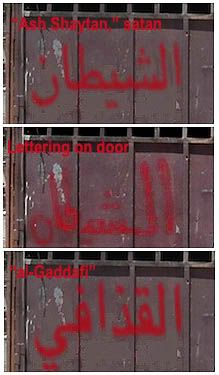
- red lettering saying,in Arabic, "satan (top line, bottom line unsure)"
- The crate with a burnt body wrapped in a blanket.
(that will help establish some internal shots, perhaps - body #7 is seen in some views missing from its spot, but for a bit of forearm).

So: Daniel Berehulak, August 26, possibly, 27 or later likely, afternoon.
Photo 2. Gas can there, perhaps ladder (seen from inside, so can't tell)

Aug. 27:
Seamus Murphy, Aug 27, app. 10:00 am.
photo 1 - 2 - 3
Ladder only. Gas can not visible, when it should be, no writing on the door. No crated body. This may be the interesting shot once again. See below.

Sky News, Aug. 27, around 11:00 am
Video 1: ladder, gas can, no writing
Video 2, with interior shots: Ladder, gas can, no writing, apparently no crated body. Right before entering, the guide walks through where it would later be. In the short span after Murphy's view, that red thing has been replaced there.

One clue between these on the Graffiti: We can't be sure how much of this is, or is supposed to be, written by the brigade soldiers. The UNHRC at least found it interesting one of the soldiers had spray-painted his name there, proving he'd been there. The 32s around are said to prove the 32nd Brigade ran it, since they're known to Graffiti places (like this), I guess, where they commit crimes against humanity.

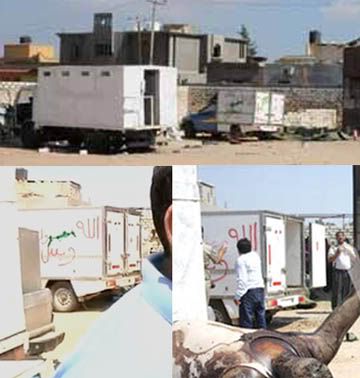
Okay, rebels can spray paint too. But the green lettering is especially likely to be by loyalists, since green is their color and hated by the rebels. Here at left is an image of the refrigerated trucks parked on the compound's west end. The smaller one is quite marked.

Beneath, left, the truck as Sky News first interviewed Dr. Salem al Farjani (as Salim Rajip). At right, the same spot just before that, in the same Seamus Murphy photo mentioned above. A glimpse of one of the brutalized bodies hauled off just before Sky arrived. Remember Arabs write from right to left.

France 24, late afternoon, Aug. 27:
The sun is getting very low, perhaps 7pm. link coming ... at 0:31 is visible the same as above, with added the red lettering on the west door. This isn't a great view, but it's verifiable, written sometime on the 27th, clearly not by its original inhabitants.


Contributor Felix is better than me with Arabic. I had gotten confused thinking this was supposed to say Muammar," but found it looked way more like the "Gaddafi" half of his name. Felix is right that it looks way more like Ash-Shaytan, or Satan. This is demonstrated at right, in the middle from a photo by... actually not sure who, red enhanced for clarity.

The Arabic samples above and below are per Google translate, faked in on a blanked-out door. I meant to just crop off the Gaddafi part proving I was wrong, but oh well, it's uploaded now. They lengthened the pause after the second vertical (reading right-to-left), so the three dotscome late. Then the hump before the last two verticals is late, with faintly visible dots beneath. The final hook is more a loop, but setright. I can't imagine many other Arabic words are such a fit, or so appropriate to the heinous crime, the evidence of which was charred inside.

Global Post's video was also apprently shot late afternoon on the 27th, what some would call early evening, but still before sunset. 6:30, 7:00. The lettering is clearly there from the close-up of two grief-stricken men at 0:20. As Felix confirms, the AFP video, again with Dr. al Farjani, also has the lettering shown near the beginning.

Aug. 28
Sergei Ponomarev photo, August 28, morning (9:30 am?)
at Al-Akhbar, halfway down the page
Gas can, ladder, and crated body all present now.

A Louafi Larbi photo of the 28th (high-res, bizarre caption) shows graffiti patterns on the adjoining (guard-house?), and the "mercenary" looking mattress victims nearby. Time of day, I added two hours to GMT, some sources say only one. It gives me solar noon (sun 180, due south) at 1:08 pm, like said here (1:09) and I think it lines up with what's usually reported aslocaltime: sunset on Aug. 23 was 7:44 pm, which lines up well in most accounts. By rights, real noon should be more like 12:09 on the clock, but whatever... Anyone want to double-check me? NOAA solar calculator. Mess with it five minutes and you'll get it.

On that scale, the angle of light, from the guardhouse edge shadow in the back, is between 106 and 120 degrees, translating almost exactly to 10:00-11:00. More precise is in the middle, maybe a bit under. 110-113, so about 10:20-10:35 am. If the other time zone reading is right, 9:20-9:35. If her other photos from Larbi's visit show the door situation, or anything else interesting for the timeline of clues, it'll be noted here or in comments, eventually.

Saad Basir photo, undated, apparently the 28th?
With his Warscapes article, direct image link
Writing, gas can, ladder, and crated body present

RT Arabic video, undated, morning, about 8:30 am?
All four present. Same footage, whoever shot it first, in high def. from Hungarian TV, showing all but the body box. see left


The Telegraph as linked above: 9am, crated body, ladder, gas can, all there. Lettering: unclear. There seems to be red there but too indistinct, perhaps partly scrubbed off. Could it be just the low light and low resolution? Possibly...

BBC Aug. 28, morning - 9am? Red plastic is there, crated body, and the same sort of indistinct red lettering. Possibly again resolution and low lighting.

CNN Aug 28, late afternoon
ladder and gas can there. (1:21, 2:02), crated body there but shoved aside a little bit. Covered area between the shed and the small building is torn up. Door seen only briefly, 2:58, from a distance. No lettering pops out.

Wednesday, March 14, 2012

Richard Spencer on Libya and Syria: Rebuttals?

March 2, 2012

Citing: Syria's rebels are not an al-Qaeda army. Richard Spencer. The Telegraph. February20, 2012.
http://blogs.telegraph.co.uk/news/richardspencer/100138473/syrias-rebels-are-not-an-al-qaeda-army/

I have just returned from spending some time with the rebel "army" in Syria, and if reports from around the world are to be believed I should be a fully-fledged jihadi warrior by now. 
Peter Oborne, in the Sunday Telegraph, is the latest and as you would expect most cogent commentator yet arguing that Western support for the opposition to President Assad is profoundly flawed. It has made us bedfellows with al-Qaeda, he says, and he cites the current violence in Libya as evidence of the disaster that could lie in wait. Not only al-Qaeda but other foreign extremist Islamist elements have probably already infiltrated Syria, he adds.

For evidence of al-Qaeda's involvement, he quotes the US Director of National Intelligence, James Clapper, who said recently that two bomb attacks in Damascus, widely claimed by rebels including recent defectors to have been staged by the regime, “had all the earmarks of an al-Qaeda attack”. All doubt has thus ended, Oborne says. "It’s official. Al-Qaeda is acknowledged as an ally of Britain and America in our desire to overturn the Syrian government."

But it's all pretty flimsy, isn't it? Leaving aside the intelligence, National or otherwise, of a Washington insider who doesn't know the difference between an earmark and a hallmark, just because something looks like an al-Qaeda attack doesn't mean it is one, particularly if the accusation is that the Syrian regime has dressed it up to look like one.

More importantly, as Oborne himself says later, these revolutions are complicated, and even if al-Qaeda is bombing Damascus it isn't necessarily the case that it is seeking the overthrow of President Assad. There has been plenty of cross-border flow of militants between Iraq and Syria over the years (as Clapper knows full well), which raises the question as to why al-Qaeda has only started attacking now?

Good question, no?

In Libya too, the evidence for actual, rather than incipient chaos is not as strong as it might appear – "if anything, the fighting appears to be getting worse, as the country breaks into hostile armed fractions – a fertile hunting ground for al-Qaeda," says Oborne. Yet this is demonstrably untrue. ...
It's what?
The absence, not presence, of al-Qaeda is the most startling aspect of the new Libya.
Why would that be the single most "startling" thing, if it were true? Why is Richard Spencer so frightened by an alleged lack of al Qaeda activity?
Amnesty International rightly pointed the other day to the barbarous behaviour of the once heroic Misrata brigade, and the prisoners they have tortured and, in 12 cases, killed. 
He goes on to cite this12 as a "figure," a total, when it's clearly an "at least" number.
That is damnable; but it is a figure that would be regarded as "great progress" in the case of our other Middle East ventures, and that is not as sick a thought as it seems to anyone who witnessed the horrors of Gaddafi and his brood. I will not quickly forget the sight of the remains of the scores killed and cremated by Khamis Gaddafi in a single incident in a shed-prison as he fled Tripoli in August.
Yeah, compared to that, what the Misrata Brigades are doing now is... oh, wait...

Monday, March 12, 2012

Khamis Brigade Shed Massacre: Believe Whom?

March 12/13 2012

The following, with minor changes, will be subsection 2.4, the beast, in the upcoming shed massacre report "A Question Mark Over Yarmouk: Re-Thinking the Khamis Brigade Shed Massacre." It's ready enough to share here, slightly rough, as our mostly-comprehensive analysis of why the witness record is so unreliable. This is general disagreements, with specific cases of the captive soldiers, and Dr. al Farjani, covered separately before and after this.

2.4.1: Broad Consensus on the Massacre of Aug. 22 or 23
The UN Human Rights Council, on March 2, 2012, released its advance unedited draft report on human rights violations in Libya up to that time. In it, they paid special attention to the massacre under study, finding “only 51”confirmed survivors from among the original prisoner population of, they found, 157. [UH p. 70] On examining the accounts of a number of witnesses, they decided “while there are small discrepancies […] the testimony from all parties who were at the warehouse at the time of the massacre is broadly consistent and corroborative.” [UH p. 71]

They do not share enough details to double-check the consistency of the witnesses they spoke to. But the CIWCL, in screening the dozens of accounts publicly available, finds major inconsistencies across the board on crucial details. When trying to believe the witnesses, a question arises frequently – which one do you believe when their accounts conflict with each other?

Hungarian journalist Al Ghaoui Hesna, who visited the site on August 29 and spoke to at least one witness, used a word that seems to quite apt in describing the record we see. Google translated, she said in part ”the reports have become a bit confusing and ellentmondóvá.” The last didn’t translate, but broken down, [ellent-mond-óvá] it says “contradictory and guarded” (mond óvá = “cautioned against saying”), twin signs of deception - or triple if added with “confusing.” [HB]

A curious feature of the widespread contradictions one finds is that hardly a single aberrant claim is unsupported. There is corroboration from other witnesses - usually one or two - on every distinct version of each detail. This resembles less the memories of a single event that it does people getting their stories straight in numerous small groups, but failing to coordinate between the groups. What emerges is a field of differing schools of thought about what they remember from that assault that nearly ended their lives. Interestingly, these groupings of agreement are frequently between those who spoke to the same reporters or investigators.

Both the date and the time of day of the killings are relatively uncontested, with a general consensus it occurred on August 23, just after sunset, which was 7:44 PM local time that day. [WC] [NO] Many reports say something roughly consistent with this: 8:00, after the evening call to prayer (sunset), and other things supportive of either true recall of an important event, or a well-coordinated cover story.

However, even this point of agreement has its exceptions. An August 22 massacre is supported by alleged escapee Bashir al-Sedik/Siddeq. He told the CBC’s reporter it happened “Monday night.” [CBC] Munir Massoud Own told CNN it happened “Monday.” [CNN3], PHR witness Omar specified the date August 22. [PHR p.31], and captive soldier I.S. Khalifa told AFP the same, August 22. [JD]. That’s four times corroborated, yet it can’t be true. It’s contradicted dozens of times.

The time of day is less challenged than the date, and that fact alone argues slightly in favor of the witnesses. The time of day, what the sun was doing, is visual, and more memorable than a number or name attached to the day. Therefore, even two contradictions stand out.

Amr Dau Algala (possibly a brother of Munir el Goula) spoke to Kim Sengupta for the Independent in September. He told her there were threats, the day before the killings, that the prisoners would be set free, and free meant killed. “The threat proved to be real the following morning when the murders began.” [KS]

17-year-old escapee TaherEl Bahbah, in an account translated from his Arabic language for the Facebook group Yarmouk Prison Massacre cited about 5:30pm for a warning to escape, followed by the massacre five minutes later. This is quite a distinct time from 7:45-8:00. [FB3]

Either of these could be simple errors, or aberrant reports of a different massacre time. But again, this is one of the strong points of agreement. We turn now to the remainder.

2.4.2: M. Bashir and the Hole in the Wall
52-year-old Mohammed Bashir is a particularly unreliable witness. Speaking to Martin Fricker of the UK Daily Mirror, he describes the shed wrong - a "container" with thin metal walls the detainees banged their fists against to demand water. They always needed more of that, as it was stifling hot in the container; he said men died from the heat. [MF]

In contrast, the photographic record shows these walls are lined with cinderblocks. These would make no banging noise when hit, wouldn't allow bullets, and shielded the inside from the sun's heat. Further, the decent ventilation all over the leaky shed would prevent heat build-up of the kind he cites.

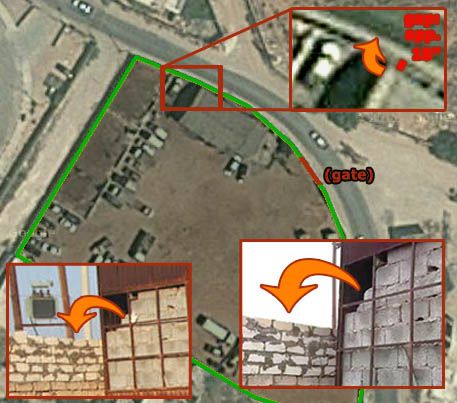
When it came time to finally escape, he says he bypassed the door. “My friends and I ran through a hole in the wall and tried to escape across the compound.” [MF] This is a strange choice for someone who had just “run” through the only exit he could mean. In the northwest corner of the building is a small hole in the cinderblock walls that would allow human passage. It’s at least five feet off the ground, and leads out trough the window of the outer metal shell.

After climbing out, one would be just inches from the top of the compound’s low outer wall. If one drops from there to the ground on the right side, out that hole means out of the compound, free and on the way to safety (see graphic, next page).
Image: Satellite imagery from Google Maps [GM] lower left inset, Human Rights Watch [RW], right, Free Generation Movement [FGM]

Only if one jumped left would the continuing danger and death Bashir encountered. "I know at least three men did not make it and were shot in the back by the Gaddafi soldiers," he told the Mirror, as they ran south across the compound. [MF]

Another witness describes it more logically. The unnamed host of the video “What Happened at Yarmouk” explained to the crew “I was one of the people who crawled out through this opening. (pointing, from outside) We went out through this opening, went to the wall and jumped down.” [FGM 3:56] That sounds like his entire escape. There is no running around inside the walls under fire from the guards.

But how the hole came to be is contested. Physicians for Human Rights witness Omar, who escaped unharmed and feels he is the longest-serving among the prisoners there, has the hole existing and playing an important role throughout his saga. One prisoner, some days prior to the massacre, “attempted to escape by climbing through a hole in the warehouse wall,” PHR reported. “[B]ut guards immediately shot and killed him,” Omar said, and then left his body “to rot in the sun.” [PHR p.32]

Late on August 22, PHR reports, secret ally guard Mustafa "came to the window before evening prayer" with food, water, and a warning: “You will either escape or die.” Bypassing the useless "window," Mustafa then unlocked the shed doors "so they could escape later that night.” But they were discovered and the massacre commenced. [PHR p.26]

If the hole in the wall, clearly a useful exit, had existed for long, it’s reasonable to wonder why didn’t they escape through it before, on any quiet night when the guards outside had dozed off. It would take nothing more than to reach up to that five-foot ledge, unseen in the light-free shed, climb up and crouch on the ledge. After getting one’s bearings, hopefully undetected and still in shadow, one could dart onto the wall’s crest and over in a matter of seconds.

An answer why so many chose not to escape this simple way, why 150were still sitting there helplessly on the 23rd, comes from two witnesses. They explain, in conflicting ways, that the opening never existed before the massacre day. Abdulatti Musbah Haleem told Andrew Gilligan of the Daily Telegraph how “after the firing stopped he and about 30 others ran out through a hole they had made in the hangar wall.” [DT] Presumably, they had made it just then, inspired by the terror and desperation of such a total attack, using some sort of technical means they never tried before. They picked an excellent spot, if so.

The video host of ”What happened at Yarmouk” disagrees, saying the hole that saved his life was made by the loyalists, on accident. He said, per the video’s subtitles, it “was the only opening created, as a result of the shaking after the grenades were thrown in. This was the only opening created, the only bricks that fell.” [FGM]

Which of those three witnesses, if any of them, is telling it like it was?

The stories of escape above tend to suggest the prison’s doors remained impassable, forcing reliance on this problematic alternative. But many other witnesses specify they simply fled out the doors. That too comes in many varieties. The doors have been reported as left unlocked as the guards left [??], rushed through in a mob with the guards still there [PHR, p.31], opened by guards to let them out (see below), blown open by the grenades [??], or kicked open by a fellow prisoner [OG].

There is no necessary conflict in the presence of both escape routes. It’s possible that some would flee by the doors and some climb out the hole. But it isn’t likely the hole was made three different ways, or the doors opened five different ways. Somewhere in this mess, some witness accounts must be considered unreliable on this detail.

2.4.3: Burning the Dead, or Burning Alive?
Returning to Mr. Bashir, who never did explain the hole’s origin, made one final unreliable claim of note, that he was still hiding in the shed, just minutes after the shooting on the evening of the 23rd, when the fire was started. He told the Mirror how, during a quiet moment:
“I ran to the other side of the container and hid behind an empty gas canister. That’s when they poured petrol in and set it alight. They were trying to hide evidence but people were still alive. I could hear them scream." [MF]

This agrees with soldier Khalifa, who says he did the burning alive, as explained in article 3.3. A few other witnesses, as presented, seem to say they also witnessed the shed being set alight at about the time of the massacre.

Bashir Sedik told French paper Le Matin how “hidden behind a wall, he heard the screams, shots, cries for help, before seeing the fire lit. Since then he has not regained all his senses. [LM] Similar implied supports come from others, like Amr Dau Algala. Speaking to Kim Sengupta of the Independent, he described how he and one brother escaped.
“They ran for their lives amid the flames, noise and confusion and escaped. A fourth, 25-year-old Abdullah, is missing. "The last time I saw Abdullah was there, sitting in that corner […] I looked back, but there was too much smoke, I could not see my brother.” [KS]
Abdulrahim Ibrahim Bashir (no known relation to M. Bashir) contradicts that notion. An astute witness who says he counted all 153 names called out in roll call that day, Bashir escaped with two brothers from Zliten and hid with them “in a house outside the compound for three days.” From here, he “saw that the guards were still there,” finishing people off. Keeping an eye on the compound over the following days, fire only came into his narrative at an ambiguous time near when the rebels arrived:

The [warehouse] was already burning when the rebels came, but I didn’t see how it happened. I just saw it when the rebels came; it was already burnt, and black smoke was coming out. I left around sunset yesterday [August 26]. [HR]

Furthermore, as explained in article 1.2, the fire had to have been started later than the 23rd of August. Captive soldier Laskhar says it was done later that week, the UNHRC decided the 25th, and many of the bodies were still smoldering enough to see rising plumes of smoke, even in low-resolution video, right through the 28th. [TV] [SN2] [VRT?]

So was the flesh-consuming fire started the same time as the killing, with the vast majority of witnesses simply failing to notice? Or was it only to hide the facts days later as A.I. Bashir, Laskhar, and logic suggest? One of these stories - at least - has to be wrong.

2.4.4: Sequence of Attack
Along with the time of day, the basic fact that guns and grenades were used is another common point nearly all witnesses clearly relate. What order they were used in, how many grenades, and other details all have different versions. Some variation is natural, and such minor discrepancies don’t seem to be as troubling as some of the other points CIWCL has looked at. However it’s well worth some consideration.

Physicians for Human Rights witness Mohammad relates how the massacre started: “[A] soldier (name withheld) then entered the warehouse and reportedly fired his nine-millimeter pistol at one of the new detainees from Misrata who was sitting near the door. He died instantly. Another man (name withheld) was also shot, but apparently not killed.” Following this, the same two men backed out, apparently shut the doors, and fired through at the prisoners though the metal with machine guns. After this, he saw grenades tossed in through the high grating. [PHR p.26]

9 mm bullets were found at the site by PHR investigators. [PHR p.22] These provide support for this story, and/or with the story of fellow PHR interviewee “Laskhar,” who told the group he used that caliber of a pistol to kill prisoners afterward, late that night. Laskhar admitted to Physicians for Human Rights that he summarily executed 12 detainees with his nine-millimeter pistol that night.” [PHR p.37] Their first pistol witness corroborates that, claiming he “saw the soldier named Laskhar hunt down survivors with a flashlight and execute them with his nine-millimeter pistol.” [PHR p 22]

No other witnesses aside from these two specify a nine-millimeter pistol, at either end of the incident. Mohammad did not specify how he as able to make these definitive identifications in the chaos of a massacre, or at a distance around midnight, in the backwash of a flashlight.

Others do mention a pistol, or rather pistols, being used. To the CIWCL’s knowledge there are at least two of them. French paper Le Figaro reported from Mabrouk Abdullah (translated).He said at dusk on the 23rd, a monk came to bring them water for the breaking of the Ramadan fast. “‘We were praying when suddenly they threw grenades and fired machine guns and pistols. It lasted about fifteen minutes,’ he testified. [LF] Abdel Salaam Ashour cited in a report from the New York Post, didn’t mention grenades, but did mention "Three soldiers threw open the doors just after dusk and started firing into us with Kalashnikovs and pistols […] Some of us dived to the floor, and some of us ran. They shot my leg. We were all screaming." [NYP]

Neither of these specifies the exact order of pistol usage, nor the caliber of those used. Both are given as teachers, both from Zliten, Ashour aged 42 and Abdullah 45, both among the few actually claiming to be shot.

Only one witness, to the CIWCL’s knowledge, implies no grenades were used in the attack. Abed Rizaq Ghazim Senussi spoke to Canadian CTV [CTV], and judging by the video, was the anonymous man who spoke, unnamed, to Hungarian journalist Al Ghaoui Hesna [HV].Her blog entry about it, roughly translated, says “guards opened fire inside the open door, but later … abandoned the men.” The anonymous man “and many companions then managed to escape. The guards, when they returned, presumably poured gasoline over the bodies and threw hand grenades on them.” [HB]

Here, grenades are presumed, along with the fire, apparently in fact linked. He seems to think there were no fragmentation (shrapnel-generating) grenades at all, only incendiary ones. Soldier Khalifa said the same as explained in article 2.3.3. But he contradicts Senussi by lobbing in fire before leaving the site. He also made sure to lock the door before leaving, mentioning no escapees at all, including Mr. Senussi.

Aside from this, most versions say explosive hand grenades – anywhere from one to eight – were tossed in. They came in either through the grates at the top of the closed and locked doors, or perhaps tossed in through the open doors. The grenades came first, in a majority of accounts, followed by gunfire.

Whatever the order, some said the guns and grenades was cyclical. Munir El Goula said “the mercenaries entered the jail and shot the prisoners in the legs. One took a grenade and threw it in. Five times they opened the door, shot inside, and threw a grenade.” [LH] The Independent Civil Society Fact-Finding Mission to Libya heard that guards “opened the door to the large room and opened fire with light machine guns, while a number of hand grenades were also thrown into the room. This procedure was repeated a number of times, apparently until the guards ran out of ammunition.” [CS p.?]

Just when during the attack the soldiers climbed up on top of the shed and fired down through the tin roof is also in dispute. This aspect of the attack, highlighted by Human Rights Watch [HR], has a very distinct effect on the nature of the killing, making all but impossible to hide “behind” a stack of tires [DT/AG], a gas canister [MF], or the bodies of fellow prisoners [AL].

Numerous witnesses would notice when that commenced, but only Abdulrahim Ibrahim Bashir, 25, reported this aspect at all. As HRW summarized: “[A]t sunset on August 23 guards of the Khamis Brigade opened fire on him and the other detainees from the roof, shooting through the roof’s tin sheeting, while another guard threw grenades in from the entrance.” [HR]

HRW did note the bullet holes in the roof, and these definitely exist. In photographs of the dim interior, they can be seen leaving the skeletons and the floor in between them decorated with polka dots of amber light. However, none of the other witnesses has mentioned anything about the act of these holes being torn through the top of their little world there. All the firepower they hid from and recalled so vividly came through the doors, open or closed.

In this case of conflict, Bashir (at least) should be discounted. This in turn leaves us with a problem of where the bullet holes in the roof did come from.

2.4.5: Escape Attempts, Hero Guards
Ominous promises of impending “freedom” are widely reported as presaging the shed massacre. Some, like Amr Dau Algala, said this was spoken of the day before. [KS] Others , like M. Bashir, said they were so warned on the day of the event. [MF] This is not necessarily a contradiction, as the same basic information could have been repeated.

Most of these have the soldiers then simply opening the doors as if to freedom, and for greatest contrast, started massacring them instead. Mounir Own says they were promised freedom at sundown on the fateful day, something that got them all talking. And then the guards opened the doors and "instead of setting them free, Muneer says they threw a grenade inside the warehouse and then they opened fire." [CNN1]

Many accounts, and increasingly the official narratives like that of the UNHRC, include an escape attempt or a released-to-die scenario involving more initiative on the part of the prisoners, coinciding with the onset of attack.

In one version, the prisoners noisily broke out on their own, and then the soldiers re-locked the door and started killing them through the closed doors. One unnamed escapee told the makers of the video What Happened at Yarmouk “they heard the breaking, and didn’t stop it. They allowed the first person to come out, then executed him on the spot and locked the doors.” [FGM, 0:28] The unnamed host of the video isn’t clear on the first part, but corroborates the unusual claim the soldiers first locked the open doors. “They locked us in. At first a grenade, then shooting.” [FGM 4:22 ]

Another school of recall has the guards themselves undoing the lock to let the prisoners out. One version of that has the latched undone in an evil trick by the guards. To the UK Telegraph, A. M. Haleem related:
One of the guards was from Zliten and I knew him. He said he would unlock the door and all we had to do was undo the latch and then we could escape.

"We undid the door. The first of us went out and were met with a hail of bullets. We ran back inside the hangar but they followed us and threw in six hand grenades. Then they started spraying us randomly with gunfire...
[DT]

Yet another set of versions has one humane guard or another unlocking the door to help. The first to be published came from escapee Mustafa Abdullah el-Hitri/el-Etri/Atiri.
this act of mercy came only after the bulk of the killing, as he related it to Alex Loyd.
“Abdul Razak was one of them but he seemed sickened by the killing and told us to flee […] He opened the barn doors and told anyone still alive to run for it.” [AL]

According to some witnesses, a different guard named “Mustafa” learned of the impending mass murder and offered to unlock the door before it could happen. This basic story is given by two witnesses, PHR’s escapees Omar and Mohammad, confirming each other where no one else does.

As Omar relates it, Mustafa brought the warning “you will either escape or die,” and unlocked the shed doors “so they could escape later that night.” [PHR p.26] The savior told the prisoners to wait thirty minutes to escape, but they were discovered and punished with the planned massacre. According to Mohammad, they were given away by chanting “God is great” too loud while waiting. [PHR p.26]

A strange melding of the two stories comes from the youthful escapee Taher el-Bahbah. He has Mustafa’s 30-minute escape plan being carried out by a guard with the name of Mustafa el Hitri’s hero, here given as “Abdul Razak Baroni.” [FB?]

It seems unlikely this is all the same guard, perhaps named Mustafa Abdul Razak Baroni. If there were two hero guards, one was remembered by some, the other by others, with at least some getting confused as to which of the two tried to open the doors early, and which one only after the shooting.

The UNHRC’s commission came up with an answer: both guards tried to help, and both before the massacre, tossing el-Hitri under the bus.
During the early evening (just after the mosques announced the start of the iftar others [066 and ‘Mustafa’ ] informed the detainees that he would leave the door of the warehouse open and turn the light off to allow the detainees to escape because “they wanted you all dead”. The guard then ran away, along with one of his colleagues [066]. The detainees did not flee, however, despite the open door. A number of other guards then came and demanded to know who had opened the door…[UH]
[066] must be Abdul Razak, collaborating somehow in Mustafa's simple plan. In all memories studied by the CIWCL so far, they were merged into either one person or zero. Here, they both ran way, long before the other soldiers were forced to do the same.

2.4.6: Soldiers Out, Soldiers In
Many witnesses agree some members of the Libyan military, some of them the guards in charge of them, wound up dying in the massacre. The exact number is unclear, but significant, perhaps as many as 20. And the sequence, again, is confused.

The slain soldiers were held prisoner in the shed along with the rest for some time, two witnesses agreed for the BBC. Reported survivors Ali Hamouda and Fathallah Abdullah al-Ashter say that on the 23rd, these men were then taken out first.
Both men said some of Col Gaddafi's own troops were not spared. They too were imprisoned in the warehouse, presumably for not following orders. "The soldiers were in the middle," Ali said. "They were sitting on blankets. They took them outside first. After that we heard gunshots. Maybe they executed them. Then they start to shoot us." [OG]

The largely-Arab Independent Civil Society Fact-Finding Mission to Libya heard, as summarized in their January report, all military-linked prisoners were taken out –17-20
Shortly after sunset, a number of guards entered the room and ordered all former members of the military to leave with them. Approximately 17-20 detainees were taken from the room; soon after, those remaining heard a number of shots, which they took to mark their execution. Guards then opened the door to the large room …[CS p.34]

Munir el-Goula is among the vast majority of other witnesses who makes no mention of that ominous prelude to the all-out attack on the rest of them. In its place, he added to the soldier total an unusual twist that, again, no one else noted. Some of the guards stillon duty, standing outside the shed, were pushed in at the last minute and killed. “When they opened the gate, mercenaries came and pushed the soldiers back into the jail. They shot an old man in the leg” and then started killing everyone. El Goula’s death toll, as Channel 4 passed it on, was 20 soldiers and “more than 100” civilian prisoners.[LH]

The CIWCL finds it unusual and noteworthy that none of the former soldiers, taken out first or pushed in last, managed to be among the roughly one in three that survived to tell their of the ordeal. That honor befell the untrained civilians who escaped unharmed.

2.4.7: Witnesses vs. Medical Common Sense
Many escapees, but not all, claim to have been uninjured. A. I. Bashir said “I was not wounded, hamdullah [praise God]. They just shot and killed us.” [HR] Some of them, especially the few seen at Tripoli Medical Center, described and/or showed wounds to the media. Most of these, however, were from “captivity in Zliten.” Consider A. M. Haleem, who spoke to the Daily Telegraph on the 25th:
While in captivity in Zliten, he was subjected to days of torture, with burns and the marks of shackles clearly visible as he lay at the Tripoli Medical Centre hospital.
[…]
Mr Haleem was hit by bullets and shrapnel but managed to run behind a stack of tires which offered some protection. [DT]

It should be noted that the shackle marks were clearly visible to reporter Andrew Gilligan, but the bullet and shrapnel wounds were only stated.

With those able to show injuries from their time at the Yarmouk shed, more problems arise. Mabrouk/Muftar Abdullah/Abdallah/Aslitni, of Zliten, spoke to numerous media outlets. He says he was crouching along a wall, but was still shot once, in his side. [KL] To support it, he showed his wound to the Daily Telegraph’s cameras early on the 28th, a deep, circular hole in flesh of his lower left side. [TV] No longer bandaged, we can see that in four and a half days the surrounding scar tissue had healed from just torn open to healed and not even pink anymore.

There’s no corroboration to support Mr.Abdullah’s shooting, and none is expected in the chaos of the reported attack. But another common-sense-defying survivor is harder to explain.

Speaking to Tracey Shelton of Global Post, 26-year-old Tripoli native Aamir Benowen, says he was arrested three months before the massacre, in May or June, for what offense he does not know. Shelton saw him in bed at “the ICU unit of Tripoli’s Central Hospital,” suffering “Numerous stab wounds, broken bones and severe bruising [which] covered his body.” Furthermore, “his neck had been sliced open.” [GPS] The account continues:

Benowen said the callous attack had occurred four days before the massacre of Aug. 23 when he saw an estimated 130 prisoners shot and blown apart by hand grenades. […] he survived only because guards had assumed he was dead already. Following the attack he had been left lying in his own blood without assistance for four days. [GPS]

The lack of assistance suggests not only the guards but the prisoners he was “killed” amongst, packed in tight by all accounts, also thought he was dead. Then after the shooting, he somehow woke up enough to witness the mass killing – but not enough to appear alive as they were attacking - and to then revive and escape the shed, in some unexplained way.

However much sense this account makes, no other witness known to the CIWCL mentions a man being beaten and stabbed to death in the middle of the shed and left dead for four days. That in itself should have been memorable, even if one did not witness Mr. Benowen’s miraculous, Lazarus-like escape.

There is no reason to doubt Shelton’s account of Mr. Benowen’s injuries. He was apparently tortured and brutalized severely by someone, shortly before telling this story of a Gaddafi atrocity to the foreign media. Precisely what the connection between these events is, and the current status of Mr. Benowen, the CIWCL does not and cannot know.

2.4.8: Points of Agreement Become Suspicious
The CIWCL’s reasonable doubts about the witnesses started on seeing too little agreement on what’s supposed to be one, singular event. The effect of that is cumulative as, gain and again, questions arise about which version is true, and perhaps if either or any version is true.

At some point, if that occurs regularly enough, it’s reasonable to adopt a default suspicion over the veracity of yet another witness claim. It becomes natural to expect the mis-matched details one can find between improvised narratives, and which we find in sheaves while assembling this report.

At that point, a switch occurs. It becomes nearly impossible for a witness to agree with everyone, with so much mutually-exclusive variety. As disagreement becomes the standard, the points where there is little or no divergence begin to stand out in contrast - not as signs of a real event, but as indicators of a hidden design. One could easily wonder how these two, or those five, or all those known, could wind up concocting their stories the same way unless they were reading, from the same script, key parts that were not left to the imaginations of the public witnesses.


The points they agree on, then, deserve some attention. They agree on their own general innocence of any violence or criminal behavior. Some had supported the rebellion, even contributing to the fight indirectly, but didn’t deserve to be locked up, abused, or killed. They agree their presence there was the doing of the Khamis Brigade they were handed to after arrest by the threatened and paranoid government. They agree on the brutality, torture, degradation, and deprivation routinely visited on them by their captors. This led to death frequent enough that quite a few say they personally witnessed at least one fellow prisoner perish there prior to the massacre.

Despite all the conflicts just reviewed, the self-described witnesses tend to agree on the basics of the massacre itself. The approximate date is clear – August 22 or 23,into early 24. That’s well before rebels arrived. They agree fairly uniformly it happened shortly after sunset, which has a certain symbolism for the dying days of the regime. They agree that grenades were used. This rare twist helps explain the severely mangled remains inside the shed (see article 3.2.4).

They don’t seem to have all witnessed the same event, but all the different versions were in 100% agreement on the most crucial point of all. The killings were carried out by the Gaddafi loyalist soldiers. The time is another thing they are suspiciously consistent on. In conjunction with the accepted rebel conquest 26, this clarifies and proves who was in charge on the 23rd and the burning days after.

We now have established adequate reason to put the witness record on hold and consider the remaining evidence in a new light. As Section three will explain, the time of rebel conquest seems to be the evening of the 23rd, something that zero witnesses mention.

Friday, March 9, 2012

Khamis Brigade Shed Massacre: Arab Rights Groups Report

March 9, 2012

A report I had missed before:
Report of the Independent Civil Society Fact-FindingMission to Libya, January 2012. Credited: Palestinian Centre for Human Rights, Arab Organization for Human Rights, International Legal Assistance Consortium.
http://www.scribd.com/doc/78822880/Report-of-the-Independent-Civil-Society-Fact-Finding-Mission-to-Libya
Section link: Mass-Killings-Yarmouk-Detention-Centre
Page 34.
5.1.7.2. Mass Killings: Yarmouk Detention Centre.
132. The Mission received a number of credible first-hand witness reports regarding anapparent mass killing at Yarmouk Detention Centre to the South of Tripoli, on 23August 2011. The Detention Centre was reportedly operated by the Khamis Brigade.

According to information received, approximately 150-160 individuals were detainedtogether in a large room at the Detention Centre. At approximately 9 am on 23 Augustthey were told they would be released that day. However, a number of witnessesreported receiving this news with a ‘bad feeling’, as they had not yet beeninterrogated. The subsequent arrival of 3 new detainees at noon appears to haveconfirmed these fears.

Shortly after sunset, a number of guards entered the room and ordered all former members of the military to leave with them. Approximately 17-20 detainees were taken from the room; soon after, those remaining heard a number of shots, which they took to mark their execution. Guards then opened the door to the large room and opened fire with light machine guns, while a number of hand grenades were also thrown into the room. This procedure was repeated a number of times, apparently until the guards ran out of ammunition. At this point a number of survivors attempted to flee, but were shot as they left the room.

Witnesses estimated the dead at approximately 100. The Mission was unable to verify this number, but did receive a list noting the death of 30 individuals from Zliten alone in this incident.

136. Similar mass killings perpetrated around the time that opposition forces seized control of Tripoli have been reported by Human Rights Watch.

137. The Mission believes that these allegations warrant further investigation.

Wednesday, March 7, 2012

Khamis Brigade Shed Massacre: Victims 16's "Collar"

March 7, 2012

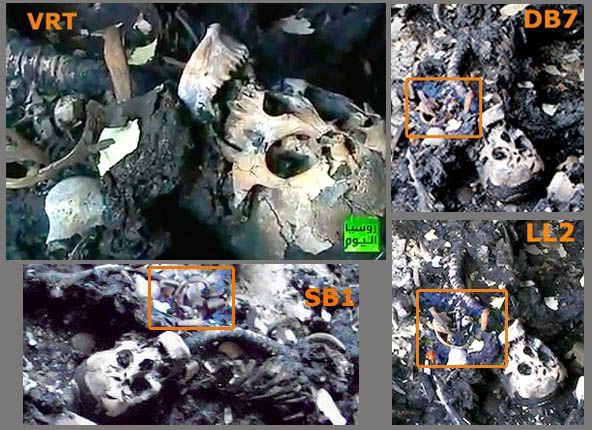
To tease out any comments people might have, I'll highlight this in its own post. This might be our smoking gun, or smoking RPG fragment... the mysterious metal parts sported byvictim #16 (re-numbered-was #14)

It's possibly just some debris benetah him his skeleton fell down amidst. But it really looks quite intimate with his upper left body, as if it had been forced to make space for the thing back when he was alive. Note the broken, off-angle left arm and shoulder. It's a semi-circular metal band with some additional elements attached, seeming stuck in the skeleton at its distrupted shoulder. Orange in hue, oxidized, (iron?). Possibly the remains of some kind of rocket or artillery? A piece of machinery or a complex tool jammed into his heart?


(picture refs, see charred victims imagery)

Or is it from one of the grenades the guards used? Maybe it blew up part of the door, curled it up, and blew it into this poor suspected disloyalist.

It's going in the shed massacre report, so how should it be put?

Benghazi, Barqa, and Federalism

March 7, 2011
(incomplete)

To start with, France 24.com reports"East Libyan leaders declare autonomy from Tripoli."
LATEST UPDATE: 07/03/2012. I'm on top of it. In part:
Tribal leaders and militia commanders declared a semiautonomous region in oil-rich eastern Libya on Tuesday, a unilateral move that opponents fear will be the first step toward outright dividing the country six months after the fall of Moammar Gadhafi.

The thousands of representatives of major tribal leaders, militia commanders and politicians who made the declaration at a conference in Benghazi said the move is not intended to divide the country and that they want their state to be part of a united Libya.

The conference said the eastern state, known as Barqa, would have its own parliament, police force, courts and capital - Benghazi, the country’s second largest city - to run its own affairs.

Under their plan, foreign policy, the national army and oil resources would be left to a central, federal government in Tripoli. Barqa would cover nearly half the country, from central Libya to the Egyptian border in the east and down to the borders with Chad and Sudan in the south.

This isn't an all-out split, but a type of federalism that, given the circumstances, makes some sense. Foreign policy, oil, and the national army are all the important parts reserved to Tripoli.

For what it's worth, my previous (rudimentary) thoughts on a two-state solution. I hoped the idea could save western Libya from the bloodshed it suffered, and even allow the Jamairiya system to survive in some territory and ingeniously regain its homeland in time. The latter still remains a distant hope, but the death and dignity that's occurred can't be undone. And now Libya, some fear, is headed for a split-up anyways, without any of it under Green control (barring certain homes, areas, and remote towns, perhaps).

In the early days of the war, the Tripoli government claimed Islamist militants had seized Dernah, east of Benghazi, and declared an al-Qaeda-linked "Islamic Emirate of Barqa." The West scoffed at the cheap propaganda against the non-violent, modern, liberal, freedom-seekers. But since the rebels won the war last year, we've seen al Qaeda fighters and LIFG fighters put in charge of a system of torture in the west and south. We've seen the "Emirates flag," also known as the flag of al Qaeda in Iraq, flown over the main courthouse in Benghazi, those who questioned it threatened with brutal death. And we see now an official move to create a Benghazi-centered state of Barqa. "State" does not equal "emirate," a repressive, brutal, Salafist kingdom. But that flag with some currency in Barqa does.

The NTC is not happy, wants full authority over everything like Gaddafi used to exercise. They seem a little fixated on imagined outcomes, and show little tact or faith in the intentions behind the announced experiment. France 24 continues:
Libya’s National Transitional Council, the interim central government based in the capital Tripoli, has repeatedly voiced its opposition to the creation of a partly autonomous eastern region, warning it could eventually lead to the breakup of the North African nation of 6 million.

“This is very dangerous. This is a blatant call for fragmentation. We reject it in its entirety,” said Fathi Baja, the head of political committee of the NTC. “We are against divisions and against any move that hurts the unity of the Libyan people.”
Underlying motives and reasons behind a split, unclear on this end. The NTC people have their theories. Al Jazeera's Zaina Khodr tweeted:
head of #Libya #NTC said declaration of autonomy by civic leaders in east result of foreign plot and risked breaking the country up.
Takes one to know one. In fact, they do know their stuff and they might be right. The NTC was born in an international plot, with schemers on at least three continents. (If you still don't know about Nouri al Mesmari and Ibrahim Dabbashi, you'd better go look it up)

But then again, the NTC could just be acting shrill and defensive in a way that's telling.

Monday, March 5, 2012

The Bin Jawad Massacre(s)

March 5, 2012

The Big Mass Grave

Mass grave found in Libya with 157 bodies
By Rami al-Shaheibi
Associated Press
March 5, 2012
http://www.philly.com/philly/news/nation_world/141384293.html

BIN JAWWAD, Libya - Libyan government officials said Sunday that they had unearthed a mass grave with 157 bodies of rebel fighters and civilians in an eastern town that was a major battleground during the country's 2011 civil war. [...] The ministry said the mass grave was discovered in December.
And it took three months to get the cover story together. In fact, to even excavate. "The excavation began Friday and finished Sunday."

The head of the new government-run missing-persons office, Omar al-Obeidi, told the Associated Press that 80 of the bodies discovered in Bin Jawwad had been identified. He said they were all from eastern Libya. The youngest was a 17-year-old male.

"This is the biggest [mass grave] so far," he said. "These are civilians who were protesting in their cities and killed by Gadhafi's men," he said, referring to armed fighters and residents of eastern cities.

Obeidi said most appeared to have died from gunshot wounds and rocket strikes starting in March. Some were executed, while others were severely disfigured from rocket attacks, he said.

Protesters killed with rocket attacks in Benghazi, taken to bin Jawad, and buried in a mass grave to hide them? Okay, that'll be it, then. This is See-Through Salem's organization, after all.

Osama Swail, a spokesman at the Ministry of Martyrs, Wounded and Missing Persons, said the bodies that were identified would be returned to the families. He said two of his brothers were among the dead.
Real brothers not already buried somewhere else, not existent on paper only? How many "African mercenaries" will he be visiting the graves of now?

A forensic team is looking at DNA samples and photos of the remaining bodies to see if they match with DNA samples the ministry has for missing persons in Libya
Something tells me the stuff from the bodies will match what the lab has on file, by the paperwork, from Mohammed al-Haitz-Gaddafi, of anytown, Libya, a great kid, was lighter-skinned when alive...

Sunday, March 4, 2012

Khamis Brigade Shed Massacre: The UNHRC Reports

March 4, 2012
(incomplete)

UN Human Rights Commission Report on abuses in Libya, advance unedited version, March 2 2012.
Direct document download link:
http://www.ohchr.org/Documents/HRBodies/HRCouncil/RegularSession/Session19/A_HRC_19_68_en.doc

I only skimmed most of it, but from what I see, it has some info on NATO bombing (some of which targeted non-military facilities and requires more investigation, the rest of which killed patriotic Libyans trying to protect their country - ie, "legitimate targets").

Mostly it focuses on conduct by the on-the-ground factions still sorting it out within Libya. Their reliance on available witnesses, primarily Rebels and those who support them, gives the report the usual skewing one would expect, allowing a hug portion of the crimes to still appear as if committed by the dying regime and its supporters. Various incidents are covered in this light; the 25 activists/17 corpses atrocity and other of the bizarre Tripoli massacres are discussed, the targeting of Tawerghans, rape, torture, all laid-out with Gaddafi regime and "Thuwar" (rebel fighter) violations listed.

Of interest to me now is their section on the Khamis Brigade Shed Massacre. This needs to be absorbed and worked into the body of knowledge before I can finish the report I'm slowly working into competence. In that interest, here is the presaging paragraph and then all the ones relating their findings on what happened at Yarmouk.
26. An informal detention centre was established in a warehouse adjacent to the 32nd Brigade’s base in Yarmouk, Tripoli. According to testimony received, torture and ill-treatment of detainees was routine there. On 23 August 2011, as Tripoli fell, guards threw grenades into the warehouse and then began to fire through the door, killing dozens. As the prisoners were so tightly packed, however, some survived and managed to escape. Two days later, the guards burned the bodies of those killed. Of the 157 detainees, only 51 survivors were confirmed. The Commission interviewed survivors, as well as two of the guards who admitted direct or indirect involvement. The testimony is broadly consistent and corroborative. The Commission’s forensic pathologist identified skeletal remains inside the warehouse. Other forensic evidence remaining at the site is considerable and supports the testimony closely. Six detainees, including three medical doctors, were shot a day earlier in a second warehouse, a few hundred metres away. Three of the six died.

The bolded: "Broadly" is just a big and vague enough word I'm forced to not call that an obvious lie.

The last part about a nearby killing: is this Qasr Ben Ghashir, about eight kilometers south, where two doctors among five men were first reported shot dead? Then another version had five of six people, includiong the doctors, killed instantly, with the sixth dying right after? Now it's six attacked, with three doctors, and three total survived? The date's never been clarified either: August 21 or 24 were given in the earlier versions. If this is the same, it's implied as August 22. Must be a separate incident. But even to that, one must say "what the hell? How confusing can this get?"

Returning to the main incident:
i. Yarmouk
27. After the February 2011 demonstrations started, an informal detention centre was established in an agricultural store adjacent to the base of the 32nd (Khamis) Brigade at Yarmouk, in the Khilit al-Ferjan area of Tripoli. The 32nd (Khamis) Brigade and the base itself were controlled by the son of Muammar Qadhafi, Khamis Qadhafi.
Allegedly -I'm on the fence whether anyone was or wasn't imprisoned there. A lot of people do say they were, that much is clear.

28. The warehouse was already receiving prisoners by March 2011 at the latest. The former detainees interviewed by the Commission had mainly been brought there in June 2011, by which time there were reportedly, up to 50 detainees in a space 20m by 9m. They were all accused one way or another of supporting the thuwar. They had been brought there from as far away as Zlitan and Garabulli (60 km from Tripoli) as well as from Tripoli itself. By the beginning of August 2011, numbers had risen to a reported 90.
These are among the things they say, true enough. Most of them, at least the survivors, seem to be from Zlitan, by the weird things they say. The shed size is close - using the imagery and scale from Google maps, the overall peaked roof area is 9 m by 16 m. They addedthe covered area between the shed and the side shack (but they didn't add the shack). The main chamber the prisoners all claim they were held in and fired on in, and making counts based on, is only about 9x12. The smaller chamber is only about 4 meters wide. There are a few burned bodies in there, but the main area is what they allrefer to, and it was nearly twice as crowded as they would have calculated.

29. Detainees told the Commission that water and food were distributed rarely. They were not allowed out to use latrines and were forced to urinate in plastic bottles. (During its visit to the site in December, the Commission observed a number of bottles on the site filled with dark brown liquid which were identified by former detainees as having been used for this purpose. ) All the former detainees interviewed, as well as one of the former guards, confirmed that torture and ill-treatment was routine at the warehouse, with prisoners being beaten and electrocuted. . On the basis of those testimonies, torture was carried out by numerous individuals, including [070]. The torture of detainees led to their death in at least four cases. One week before Ramadan [044] and [038] were interrogating one of the detainees, in the office attached to the warehouse. They beat the detainee to death. [007] threw the body behind Camp 27. Three engineers, who were working for a communication company died under torture in Yarmouk at the end of May 2011 during interrogation by an officer called [025] - they were subjected to electric shocks and severely beaten with sticks, having been accused of communicating with NATO and providing information on military locations. After they died, [007] took their bodies and threw them in the sea at the end of Camp 27.
The guards, two of them already covered here. Witnesses say things. Some of this might well be true, I don't know. It's the cluster of miracles on the 23rd I'm most interested in.

30. The immediate commander of the centre was [056], supported by a Sergeant [030]. [056] reported to Brigadier [028] and reportedly at that time commanding the Khilit al-Ferjan zone in which Yarmouk is located. Brigadier [028] in turn at that time reported directly to Khamis Qadhafi, although he denied this to the Commission. The guards themselves appear to have made little secret of their names and a total 15 names were provided to the Commission both by former detainees and by guards now in custody themselves. One of the guards had even written his name in graffiti on the wall of the centre. The guards were named as [080, 019, 070, 066, 017, 037, 060, 036, 038, 065, 067, 056, 044, 054, 064, 007].
31. By the third week of August 2011, when the thuwar were closing in on Tripoli, the number of detainees had risen to 157. On 23 August 2011, at approximately 4pm, (3-4 hours before the massacre), Khamis Qadhafi, [028] and [056] were together at the warehouse in Yarmouk. Later, Khamis reportedly called and instructed [056] and [030] to “conduct the operation” and then join him in fleeing the city.
Make note of this Brigadier [028]. He's the one who was the alleged link betweenthe demonized Khamis and the fable of the shed massacre. He breaks script by saying there was no such link.

32. During the early evening (just after the mosques announced the start of the iftar others [066 and ‘Mustafa’ ] informed the detainees that he would leave the door of the warehouse open and turn the light off to allow the detainees to escape because “they wanted you all dead”. The guard then ran away, along with one of his colleagues [066]. The detainees did not flee, however, despite the open door. A number of other guards then came and demanded to know who had opened the door. The guards then closed the door and threw a number of grenades into the warehouse through the grill in the top of the doorway. The number of grenades used has been described by former detainees as between 6-8.
[066] must be Abdul Razak, or Abdul Razak Baroni. In this version, the UN cleared up the confusion between Razak and "Mustafa," (covered here) by having both guards existent and present, though no witness I'm aware of has described two - it was one or the other that set them free, or tried to, before, during or after the massacre, or neither of them. As usual, it's quite confused.

33. One of the two perpetrators spoken to by the Commission said that Sergeant [030] brought seven hand grenades from the military camp next door on 19 August 2011, reportedly telling one of the guards [066] that if the situation deteriorated he should use them to “carry out the task”. The guard, who was later reported to have been one of those who warned the detainees and fled before the massacre, reportedly refused to take the grenades. One of the guards who admitted throwing two of the grenades into the warehouse said he had been given them earlier by the centre commander [056]. The guard told the Commission that he had been threatened with being killed himself after he initially refused to take them.
Bolded should be "claimed,"or "alleged."

34. The detainees were tightly packed and in consequence, some of the blast was absorbed by the bodies. The blast blew the doors open. The guards then began to fire AK-47 assault rifles through the door. As some of the survivors from the initial blast tried to get out, the perpetrators moved backwards into the yard and continued firing. Detainees variously described the firing as continuing for between 10-30 minutes, before the guards ceased firing and retired to the supply room. The detainees speculated to the Commission that this was to resupply with ammunition. As the prisoners were so tightly packed however, quite a few of the prisoners were still alive and those who could, escaped through the door and ran across to one corner of the compound, where they used a vehicle as a stepping stone to climb the wall and escape into the surrounding area. One detainee showed the Commission evidence of a bullet graze sustained during the escape.
A graze doesn't sound like Mabrouk Abdullah's totally healed full-on entry wound. Another verified gunshot injury allegedly from the massacre itself?

Soldiers backing up? Because prisoners were"trying"to get out? And again, it's silly they'd go to re-load AND leave the doors open, as implied here (ability was the only thing keeping all from running out) or any such thing. If they were dead, no need to re-load. If they were much alive, they should have re-locked the doors.

Fifteen or so other points of disconnect I could go on about...

35. While detainees named various guards as having been responsible for the actual killings, former guards themselves specifically named four individuals as having been responsible thrown the grenades or fired the rifles [038, 036, 017] and a volunteer named [057] under the orders of Sergeant [030]. [036] had thrown the grenades while Sergeant [038] and [017] used AK-47s to shoot the prisoners. The specific role of [056] was not stated. The officer in charge of the centre [056] was not present, having already left prior to the executions.
No notes here yet.

36. Following the killing, one of the guards was ordered by Sergeant [030] to collect the bodies. He counted 109 bodies, including the ones inside the warehouse, on the street and in the yard in front of the warehouse. A Caterpillar digging machine was brought but it did not function properly. Having failed to locate another, he then came back and asked one of the other guards, [019] what to do with the bodies. The other guard suggested they burn the bodies inside the warehouse and then use a tank to shell the warehouse and claim that NATO had bombed the warehouse. Two days later, on 25 August 2011, they brought fuel and burned the bodies.
A specified burn date for the first time. This makes moderate sense given the smoke still rolling off well into the 28th. None of those saying the fire was started the 23rd or 22nd makes sense. Too bad the clues are coming to light that the rebels were in charge the whole time from massacre date forward through all possible burn dates. Those in charge doing the erasing of clues suggests what?
37. The next day, Friday 26 August 2011, local people were able to get into the warehouse, having seen that the guards had left. They found a total of 57 burnt bodies inside. There was still smoke in the air. 20 bodies lay outside on the ground with gunshot wounds. The bodies were subsequently collected in body bags and reburied at Sidi Hamed in Gargarish.. Of the 157 believed to be in the warehouse on 23rd August 2011, only 51 survivors were confirmed, with 106 believed to have died.
Did they leave before or after the seven-hour battle on the morning of the 27th? Or was it the night of the 23rd? What did they think of almost the whole Gaddafi family converging there and leaving at 4:30 PM?  Did these locals enter before or after that? Before or after the rebel victory of about noon that same day? Which parallel universe did this occur in?
38. In addition to viewing video footage taken at the time of human remains inside the warehouse, the Commission also visited the Yarmouk warehouse itself and examined evidence remaining there. The Commission noted that there were still some charred fragments of human skeletal remains inside the warehouse. The Commission’s forensic pathologist identified a number of these various bones as a calcaneus, fragments of the cranial vault, metatarsus, radius, tibia, fibula, pubic bone, ulna, metacarpals and 1st phalanges. Alongside the remains, the presence of maggots was noted. Empty cartridge cases were visible beside the human skeletal remains, as well as on the ground outside. The large metal door of the warehouse contained a number of holes consistent with bullet hole entry points. There were also holes in the metal doors of the warehouse consistent with bullets exiting the warehouse from the inside, along with holes in the door and roof which were consistent with shrapnel burst from the hand grenades.
Bones were indeed found, just like the "witnesses," and a ton of photos and videos, had reported. That's science at work, proving the "witnesses" correct, right? Maggots were noted. That suggests organic things rotted. Huh! The alleged victims were organic! The bones had shell casings next to them suggesting they were shot on-site, or had casings from elsewhere laid by them.

I've got an anlysis on the building damage forthcoming, and no great counter-points yet. Indeed, weapons like those described seem to have been used there and chipped up the walls, torn through the thin metal wherever possible, etc. It all looks pretty random, really. Bullets from inside could be from the guards having stepped in through the doors to shoot prisoners, as some reported (they only started backing out later), then briefly turning around and shooting back at the doors. Who knows?
39. The Commission received testimony from numerous survivors, witnesses to the aftermath and two of the guards, who admitted direct or indirect involvement in the killing to the Commission. In addition, the Commission also interviewed Brigadier [028], who was reportedly at the warehouse earlier on the day of the massacre. He told the Commission he was simply in charge of personnel at the Military Intelligence (Istikhbarat). He reported directly to [008] and him alone. All orders came through [008] and he says he never was tasked directly by members of the Qadhafi family. When asked about his knowledge of the massacre, he claimed he only heard about it after the event and “if you’re interested in human rights violations then I don’t know why I am here”.
"Admitted" suggests a bias on the part of the writers to believe what should be "claimed." This sets apart the one guard who didn't tell it the same way, who refused to "admit"to anything. Again, we see him apparently breaking script. Is Brigadier [028] still alive?
40. The testimony from all parties who were at the warehouse at the time of the massacre is broadly consistent and corroborative. In addition the forensic evidence remaining at the site is considerable and supports the testimony closely, in relation to the conditions they were kept, the torture they sustained whilst in detention, the use of hand grenades and AK-47s to execute prisoners and finally the attempted destruction of the bodies. While there are small discrepancies, the evidence collected by the Commission is also consistent with that collected by human rights organizations at the time and in the aftermath of the massacre.
Pathetic. Otherwise, more later.

Saturday, March 3, 2012

The Tripoli Massacres: The Khamis Brigade Shed Massacre

(The One with 53 Charred Skeletons )
August 31, 2011
last edits March 6, 2012


<< The Tripoli Massacres

Note Nov. 15:
This mess of a post is not yet worthy of this extremely interesting cluster of unexplained war crimes. It'll be re-worked some day. For now, take this text as an intro if you need it, or skip to the more worthy split-off posts, and then further thoughts, at the bottom.

A Last Act of Barbarism?

The latest Tripoli horror show left to us by the smashed Gaddafi regime, discovered by "freedom fighters" on August 26, is a mass of at least 150 dead, many mangled and blasted apart, at least 45 of those charred to a cinder.  The massacre and fire happened in a farm shed behind the Yarmouk military base, a headquarters of the vilified Khamis Brigade, shortly before (or shortly after?) the rebel conquest of the base on the 26th (or was it the 23rd?). Around 100 more were rumored killed with them a few days earlier by the brigade, their whereabouts briefly unknown. At least 150 remains were reportedly trucked out on the 28th.

Self-described witnesses, about a million of them, have come forward to confirm that uprising supporters and mutinous soldiers and ordinary men were held there for days or months in appalling conditions. These men (actually about 20, and all light-skinned) said they were tortured, starved and denied water,  and in one case beaten and slashed and left for dead for days. But they all made it out alive, hardly any of them hurt at all in the climactic massacre of August 23.

As their own end drew near, and their chances to practice evil threatened to expire, the Gaddafi soldiers just killed their wards, shooting the captives with machine guns and blasting them with hand grenades.

The remains were burned probably a couple of days later, the narrative runs, to conceal the nature of their crime. With all the skin and clothing gone, these bodies of light-skinned civilians could, for all we know, be mostly dark-skinned members of the Khamis brigade itself. Brilliant!

Too bad up to 30 light prisoners by some reports, one in five, managed to escape, and about 20 of these have already told their story about what happened. So that didn't work...

What Actually Happened?
My best guess, put briefly, is this: the Misrata brigades who "liberated" the base around sunset on the 23rd, following on NATO bombing, found a real mess inside. Blasted bodies, injured loyalists, and a few intact holdouts needed to be mopped up. In the end, they had what they estimated as 140 dead of various types, found dead, killed in fighting, and executed.

Eventually, the number rose to 175, and it was decided to deal with them all on-site and create a better story to explain these dead, half-black, obvious loyalists. Fire was decided on to erase identities, and paid/coached witnesses were found to create new ones. These were in place by the 27th, and so finally they acknowledged just taking the base, and brought the media in.

I plan to explain this all better once I'm more sure and have some more preliminary things figured out.

Sub-posts: 
Time and Space

Base and Shed Location
Getting a spatial-visual bearing on just where this stuff happened is sometimes useful. No exception here
Shed Massacre Chronologies
Three different times given for the rebel conquest, all probably wrong, given the clues they took it on the 23rd. Other interesting patterns emerge. 

Early Shed Massacre Reportage
Until I work these into the timeline, some oddities in the first reports, including my big clue they took the place no later than the night of the 23rd.

(early) Shed Massacre Tweets
An early video and its unique clues 
Exterior Imagery Chronology
Looking at photos... important to clarifying the overall timeline.
The Hole in the Wall
!!!
Minimum Security?
A look mostly at the doors and locks, the perfect escape already having been covered.

People (living)
Witnesses, Escapees, Survivors
Masterlist with numerous sub-posts.

Witnesses Assessed
Incomplete post covering patterns among what the various two-dozen or so witnesses have said about the massacre they swear happened. Several different times it must have happened, unfolding differently each time.
See-Through Salem: Dr. Salem al-Farjani Or, What Ever Became of Dr. Rajub?
Masterlist with numerous sub-posts.
One of the witnesses who helped steer the media towards reporting regime authorship of this rebel atrocity, Dr. Salem/Salim Raub/Rajip seems to be physically the same person as Dr. Salem al-Farjani/Ferjani. That's significant, as the latter is the rebel government's eventual head of locating missing persons and decider of who killed who during the whole war, nationwide.  We might know just why he was hired for that job.
The Witness Recall the guards
Shed Massacre Witnesses: The Captive Soldiers "Confess".
Survivor/Family Imagery
Further Discussion on alleged witnesses
Khamis Brigade Shed Massacre: A Legacy of Mytholog...

People (dead)
The Death Toll


Update March 5: More recently, the official tally, that given to the UN Human Rights Commission, for example, has been whittled down from almost 150 to 106 out of 157, with "only 51" survivors confirmed. (see here)

The Charred Victims
A belated analysis of the 40 or so bodies I can single out, recognize, number, and analyze. The last has begun, but has a ways to go.
Charred Victims Imagery

The Dead Outside the Shed

Some pretty horrendous killings of eight men (six of them black) in the area right around the cinder house. These men's identities were not chosen for erasure by fire. Why? The one with the most clearly horrific (unexplained) injuries is claimed as another escapee from the shed.
The Yarmouk Mosque Dump
Another 22 dead men, reportedly all black, were found down a dirt road behind a mosque, 500 meters from the base, on August 28. A direct link to the shed massacre isn't proven, but is suspected.

Other
Khamis Brigade Shed Massacre: Follow-Up Work
PHR Shed Massacre Report
The UNHRC Reports
The Local Fighters
Vehicles

Further General Thoughts:
Known credibility issues with rebel stories about charred bodies in places they just conquered
As I explain here, a previous case of mutinous soldiers, five in an army base they had just "liberated" was false. The rebels who showed the charred remains and claimed them as heroes neglected to mention they also captured five innocent men from Chad and burned them alive at the base that very same day.

So, they burn people sometimes and blame the regime. You can't tell they're lying just by looking at the bodies, because the main clues have been burnt away.

Friday, March 2, 2012

Khamis Brigade Shed Massacre: Minimum Security?

March 2, 2012

This post will analyze the security barn doors that kept the Yarmouk prisoners in check until they were also being shot.At that time, they reportedly stampeded and escaped alive to tell the tale in, literally, the scores. Why didn't they break out earlier? How amazingly secure are the doors?

Analyzing the security situation also requires considering the hole in the wall, which we already have at that link. This other cited exit, and a genius one, offered escape not just from the shed but from the whole compound. It was also never used to flee prior to the massacre, either because it didn't exist, or it did (as "Omar" at least said) but the prisoners were idiots. Accounts vary.

Here, we'll look at the doors "Omar" offered 200,000 Dinars to have a guard open (the offer was spoken through the hole in the wall), which kept upto 150 people from escaping for days and months.

It's a three-part door system. The two outer doors are large, rather flimsy metal panels, about six feet wide and twelve tall, with open grating at the top. These we'll call west (left when facing the doors from outside) and east. The east door has a smaller door, apparently of a sturdier metal, inset in its west (inner) half. This is always shown wide open. From the outside only its hinges are visible, and from the inside, it's swung flat against and looking like the inside of the outer door.

The first thing we noticed, and contributor Petri Krohn brought it up, was the door latches often seen in passing suggest the handles to open the thing were on the inside. I had just finished ridiculing claims, from a prison just down the road, that some of the cells had handles on the inside. The question may be the same in both cases: why wouldn't they have opened them prior to the attempted mass killing?

Here are the images and the items of interest. The video and photo labels referred to are linked below for original context.


Items, A-G
A - latch mechanism, accessible from inside. Apparently how the smaller inset door latched to the outer one. If not locked on the outside, the door could probably be opened from within.
B - Another latch mechanism? This seems to be where the large doors connect. Plate 3 (??) left side may show the twin on the other door, and even the engaged latch between them. Disconnected on bottom side. Bend in the door frame starts here.
C - sliding bolt on outside of small door, a swinging handle that winds up on top, and above that a pivot lever and clasp, presumably to hold the handle so the bolt stays extended. By this, the door could surely be secured, from the outside, with a lock holding the clasp to the lever.
D - pin holding east door fast to the ground.
E - bar on the inside of the large doors. I don't know what this was for.
F - rectangular thing hanging on a twisted thing attached to E
G - flat metal bars sticking in near the top and bottom of the inside adge of the opened doorway. These are probably some kind of door guides or whatever, not likely very relevant here

D holds the east door to the ground, B or perhaps E/F holds/held the east and west doors together (?), A and/or C fastened the inset door. It apparently has security potential, but it's still not an obvious choice for a prison, and all the other problems remain...

Note the warped door fame as seen in plates 5 and 6.  The west door is either bent out at the top by force, bent just from being unable to close, from the warped roof. The east door's inner beam, in contrast, is bent in, starting at the lock thing B. There's even a crack or chip at about that point.  The bottoms of the doors (plate 2) show a similar divergence. It's not clear if the west door is pushed in or the east pulled out.

Crude efforts to break in? Why didn't they just use the hole in the wall?

photo sources:
BL6 Benjamin Lowy.
DB1: Daniel Berehulak.
RH1 Ron Haviv.
YK2 Yuri Kozyrev
Unknown (plate 3), from a Chinese page

video:
VAF AljwahrFreeMedia17 amateur video
BBC
Sky News
RT Arabic / VRT
CNN