Warning

Warning: This site contains images and graphic descriptions of extreme violence and/or its effects. It's not as bad as it could be, but is meant to be shocking. Readers should be 18+ or a mature 17 or so. There is also some foul language occasionally, and potential for general upsetting of comforting conventional wisdom. Please view with discretion.

Sunday, January 15, 2012

Khamis Brigade Shed Massacre: Witnesses Assessed

November 25, 2011
(incomplete)
last addition Jan. 19, 2012

<< The Tripoli Massacres
      << The Khamis Brigade Shed Massacre

This post will be the based on the analysis formerly in the second half of the witness accounts post, but expanded quite a bit. I'll be posting it in segments, and even this should perhaps be read that way. It's going to be another long post. All sources just aren't given here, but are at that link, for anyone wanting to verify.

Blog Precedents for my Suspicions Here (Optional Intro)
(forthcoming)


The Witnesses Who Covered for a Rebel Atrocity?
For a few days starting August 25, executed black men, Gaddafi fighters, loyalists with green wristbands, and so on, started being seen, days old, across Tripoli as the media was allowed to re-enter. Most of these were left to rot in the sun, rebels said, after fleeing Gaddafi mercenaries killed them. In many cases, there was a survivor who could explain in detail how he knew Gaddafi’s men did it, but not how he managed to escape.

When at least 75 executed and beheaded loyalists and black men were found on the 26th, some beheaded, in the abandoned Abu Salim trauma hospital, the rebels had no witnesses. There was no explanation, aside from loyalists sniper injuries plus neglect after the staff ran off, because of the snipers. Then the shed massacre became known on the 27th, and it didn’t look good either. After a final NATO bombing raid and rebel surge, the remains found inside the base might’ve looked much worse before the fire.

But this time they did it differently – they had carbonized anonymity for most victims, a list of names to attach to many of those bodies, and witnesses, more than ever before, to back up their version of the crime. We haven’t necessarily heard from all the witnesses who claim to have escaped from the hell of that shed - just the ones who showed up and spoke to the media in an un-planned reunion at the site a few days after the event. There were at least 14 of them who spoke to the media on the 27th and 28th, perhaps 18, that I’ve seen, some of them doing several interviews.

As for names, there are many of them, given by locals and rebel affiliates both for those who died and those who named themselves as having escaped the slaughter to tell their largely inconsistent tales. The list could have been a bit bigger, but there are a few given names I decided belong to the same person (there may be other such names in there). In each of three cases, the linkage is too clear to deny, but the variation of names given in different interviews in noteworthy, and not down to simple transliteration issues.

Mabrouk Abdullah, the prolific survivor with a five-day-old gunshot wound in his side, apparently gave several different interviews. In one, he was “Muftar Abdallah,” and in another, just “Abdullah.” And to the Telegraph’s video report he gave no name they shared, but showed the implausibly-healed wound in his side suggesting he’s Mr. Abdullah. Muftar Abdallah Aslitni wason video for Bild.de as well, and showed a different healed mark on his back.

Moayed Burani seems to be the same transferred prisoner as Moiayad Abu Ghraim, 28. The transfer weeks before the massacre, and same first name suggest the link, but the family names are completely different. I’m not, however an expert in Arabic names.

And finally, prolific outside-the-shed witness Dr. Salim Rajub seems likely to be the same person who’s spoken to the media as Salim Rajip, Dr. Salem, and perhaps another time completely anonymous. These variations hardly seem deceptive, but his vague story and its odd delivery, and his apparent “handler” status for one of the too-many escapee witnesses, are troubling enough.

These chatterboxes also spoke of others who escaped but then were killed. Eight executed people – six of them black - were left scattered around the yard, never dragged back to the shed to join the burn. Some of the 14-18 known survivors cited 10 or so total escaping with them. Some estimated closer to 20, or even 30 out of the 153 who were there as the massacre started (per witness el Hitri, and close to what most others said, estimating anywhere between 120 and 200). That makes it odd that more than 150 bodies were removed anyways, on the 28th.

There is, as I will demonstrate, adequate reason to doubt many – or any - of these dozen-plus people were truly anywhere near that shed . They could be simple paid actors, something I imagine isn’t too hard to find in a sanctions-depressed economy like Libya’s was in August 2011. And they also give many subtle signs of being rebel sympathizers and/or propagandists; themselves never very political, they mostly claim to be just an ordinary Libyans, which Gaddafi hated, we’re to gather.

But whether they mean to or not, they seem to be helping to cover a rebel crime and create a false narrative for reasons much clearer than whatever drove the CIT north-path witnesses (from the intro) to swear to seeing the impossible.

Points Of Consistency
Keeping a duly open mind, we must take the points of agreement between different accounts as signs of either true reality seen by numerous sets of eyes, or decent coordination for a campaign of false eyewitnesses.

The self-described survivors from within the shed differ on how many grenades were used against them, (one, two, three, five, or six), but not on the fact that hand grenades were used. This is a crucial clue, as guns alone wouldn’t explain the disruption many of these corpses suffered, with parts missing, rib cages blown open, etc. All of them also agree guns were used, and the shed in fact has lots of bullet holes punctured all over it, in the door and the roof.

They don’t all agree on the order of the attack – was there shooting before the grenades, or was it grenades then shooting? All have plenty of shooting after the grenades, lasting anywhere from fifteen minutes (Mabrouk Abdullah) to about six hours (Fathallah Abdullah: "They were shooting up until two o'clock or three o'clock in the morning. Whoever is still alive they kill him.") Aside from the last, such variance doesn’t strike me as unnatural. So to be generous, I’ll class it as consistent.

One of the most consistent points is that the massacre by guns and grenades happened at Sundown. Three different days have been specified, with Tuesday the 23rd being the most consistent, and middle choice. They all had the right range at least, and calling the day Monday (as Bashir al-Siddeq said) or Wednesday (as unnamed outside witness #9 said) is a fairly natural variance. considering an alleged period of captivity where days might lose meaning.

The allegation that the guards promised freedom at sundown, per naïve-seeming witness Mounir Own, had everyone talking of what they would do once at liberty again. Some others were still talking about this oath to the media a week later. Mabrouk Abdullah with the implausible wound said the same thing at least twice. Although he gives a different, more complicated ending, A.M. Haleem said “The guards told us that it was all over and we were going to go home that day,” and then left the door un-latched.

Old Fathallah Abdullah said they were promised water at sundown and mentioned no prospect of freedom. But the other Abdullah, Mabrouk, also helps glue these together to Le Figaro, saying they were promised freedom and "at dusk, a monk came to bring a water pipe,” meaning for drinking, I presume, not smoking. In all versions, the promise was broken, with the hail of bullets delivered instead.

There are other points of agreement between a few witnesses that still manage to contradict what a majority of others said. Therefore, these will be listed below.

Points of Disagreement
Keeping a duly open mind, we must take the contradictory aspects in different accounts as signs of either divergent memories of a commonly perceived event, and/or poor coordination among a conspiracy to create a false reality. Just to narrow the focus, I'll dwell only on the details they gave of the attack and their escape, not on the prison management, their captivity, or general conditions.

Muneer Own specifies the doors were opened up for the shooting and the grenade attack. A.I. Bashir has them opened just for the grenade-tossers, with the shooting coming down through the sheet-metal roof. In both cases, the doors were apparently left open as the soldiers went to reload (and how they knew that was what they left for is unexplained). Both Bashir and Own apparently claim to have escaped through the doors unhindered in that time.

Old Fathallah Abdullah, however, has the doors shut until a fellow prisoner violently kicked them open. Then, as the BBC reported, “Fathallah ran for cover and managed to hide under a truck. He says he lay there for hours, listening to a massacre he was powerless to stop.”

A.M. Haleem’s story is greatly at odds with all others on the door and escape situation. It has the doors opened by the prisoners themselves prior to any shooting. They were left unlocked, with a promise of freedom they had only to claim. But it was a trick; those bold enough to step out were then shot, fell back, and were shot for real and grenaded by soldiers standing in the open doorway. He was only able to escape through a hole in the wall, which he specifies the prisoners made themselves since they couldn’t leave by the doors. (more on this below - he's not the only one to describe one).

And Mustafa Abdullah El Hitri has the doors closed, presumably locked, as the shooting stopped, until a defector guard named Abdul Razak, disgusted by the killing, opened them. This allowed the ten survivors hiding beneath bodies to escape. But el-Hitri is the only one who mentions this dramatic and life-saving act of heroic grace. He's also the one who swears he saw Khamis Gaddafi himself, moving his mouth like giving orders of some kind, just before the shooting started. If only this kid had been a better lip-reader, that might be proof for a war crimes tribunal, huh?

Shooting down from the roof, as A. M. Haleem described, is very different than laterally through the doorway. It would be a great place to rain down bullets which would be more random but much harder to hide from than what most witnesses describe. Human Rights Watch found on the 27th, before most other witnesses even spoke to the media, that “Human Rights Watch also observed what appeared to be bullet holes in the tin roof of the warehouse,” supporting the shooting down version. Yet the roof is not terribly punctured that I can see (nor are the doors, really), and very few witnesses describe this. In fact, only their source, AM Haleem does so. The other twenty-ish all seem to describe purely horizontal fire.

Another important detail is the date of burning. No one is certain when this happened, but by the usual account it had to be no later than the night of August 25th, as rebels took it the next morning.

But local Khaled Oub said he was attracted to the area on the 23rd by screams and gunfire, and got close enough to see the shed (but held back from from getting closer by snipers, as the guards explained to him). From there he says he witnessed what sounds like the burning of the victims, many of whom wouldn’t even be dead yet. “[T]hen we saw smoke coming from inside.”

That’s not likely, as smoke was still rising, and even open flame, on the afternoon of the 28th. It’s also contradicted by convenient witness Abdulrahim Ibrahim Bashir, who said he escaped with two injured brothers from Misrata, hid in a nearby house, and watched the place for three days. He saw guards still there, and then somehow he didn’t see when the fire was set. Before the rebels took it is all he was sure of. "The [warehouse] was already burning when the rebels came," he said, "but I didn’t see how it happened. I just saw it when the rebels came; it was already burnt, and black smoke was coming out. I left around sunset yesterday [August 26]."

He of the implausible wound, Mabrouk Abdullah, speaking as as Muftar Abdallah Aslitni, spoke to German agency Bild.de on the 28th. Felix offers a summary of what he says: including “I pretended to be dead...and saw how the soldiers set fire to the shed.” And it’s supported much more explicitly by one other witness, Mohammad Bashir, no relation presumably to the vigilant escapee he contradicts. He starts by citing a possible divine intervention during the massacre:
“I remember one of the soldiers looking at me and trying to shoot. But something happened, either his gun was jammed or he ran out of ammunition. He walked away to get another gun and I ran to the other side of the container and hid behind an empty gas canister. That’s when they poured petrol in and set it alight. They were trying to hide evidence but people were still alive. I could hear them scream.” 
Other witnesses seem to say they also saw the fire set just after the killings. These will be forthcoming...

Minimum Security Prison: Escapees vs. Physical Evidence
There are a few different ways these prisoners could have escaped, just like they did during the massacre, but at any peaceful time prior to that. As for why they did not, we could suspect the armed guards and/or the prisoners' own cowed mindset.
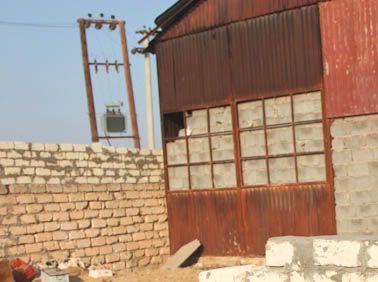
When they finally did decide to get the hell out of there, most prisoners cite the doors as their escape route, while others cite a hole in the wall, and others just don't say.

The hole in the wall is of special interest and worth a detailed look, which it receives in this article.
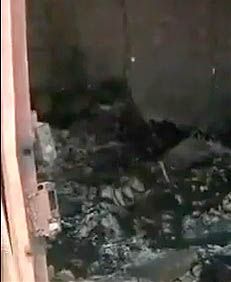
Further, as contributor Petri Krohn notes, the door locks seem less than adequate for any kind of prison. A smaller side-chamber, shown in the link above, was only secured by flap doors, with the lock situation (at ground level maybe) unclear.

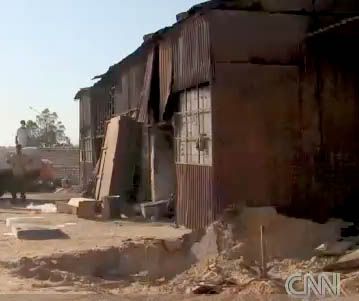
The main chamber has a complex door situation I'll need to analyze some more. With a small (human-sized) door set into two large (truck-sized) doors, it appears the big doors - half the south wall - could have been opened from the latch inside at any time the prisoners had wanted. Consider this still, at left, from a Russia Today Arabic video (1:17).

Large new doors are leaning against the building, waiting for installation.

Lack of Injury and the Racial Dynamic
For those who’d seen the inside of the shed as a prisoner, only Moayed Burani/Abu Ghraim has a good reason for being unharmed: his transfer out of there prior to the fall of Tripoli. By all accounts, the shed was an open area, with nothing but other bodies and maybe a little junk (tires and a gas canister are mentioned) to shield anyone from the guards' weapons. Some were able to hide behind/underneath bodies (el Hitri mentions this), and others behind what seem to be miracles, and then junk. Consider Mohammed Bashir:
I remember one of the soldiers looking at me and trying to shoot. But something happened, either his gun was jammed or he ran out of ammunition. He walked away to get another gun and I ran to the other side of the container and hid behind an empty gas canister."
Yet at least fifteen specific people we've heard from - 10% of the alleged total killed - all meet the following criteria:
- both witnessed and survived the massacre of August 23
- generally did so unharmed, and escaped somehow
- was able to speak to the media a couple of days later
- generally were lighter-skinned Arabs (as far as we can see so far)

The bizarre inclusion of the deceased man on the stairs tries to balance out these trends. But that he's the only black escapee seen on camera only heightens the disconnect, to anyone paying attention. He seems to have numerous upper and lower body injuries, massive blood loss, gouged-out eyes, and a hole in his head. Whereas Abdulrahim Ibrahim Bashir was “was not wounded, hamdullah. They just shot and killed us.”

We’ve heard from the same witness Bashir how both of the brothers from Zlitan, Abdulsalam and Hussain, were hit in the escape. Hussain died later, he says, and was left to rot in the abandoned house they had all hidden in. Abdulsalam lived on with rebel help. These last are, aside from the man on the stairs, the only specifically identified escapees we've only heard of, not from.

Otherwise, only two of the Arab runners are said to have been injured at all in the attack or their escape. One, Mabrouk Abdullah has the wound in his side he’s mentioned and even shown. He’s simply not credible, with a long-healed hole in his side where there should be a raw, bandaged, four-day-old wound.

A.M. Haleem has an overall story that might seem implausible, but he’s one of the few with physical injuries to support it. As Andrew Giligan noted for the Daily Telegraph, Mr. Haleem had ” burns and the marks of shackles clearly visible as he lay at the Tripoli Medical Centre hospital.” These oddball injuries, unrelated to the shed massacre, wereincurred during days of captivity and torture in Zliten before being transferred to the shed. Additional injuries from bullets and shrapnel were spoken of by Haleem, but not verified by Gilligan.

Mr. Aamir Benowen was another survivor with genuine injuries, and serious ones, verified by a journalist. These were, per Tracey Shelton for Global Post, “numerous stab wounds, broken bones and severe bruising covered his body. His neck had been sliced open.” This brutality, he says through a ventilator and via an interpreter, was inflicted by loyalist guards at the Yarmouk shed, four days before the massacre. It could have killed him, and apparently the soldiers and the 150 or more prisoners around him thought it did. He lay for four days in his own blood, unassisted, he swears.

Then the massacre occurred, from which no bullet or shrapnel wounds are mentioned, although he claims he laid through that and witnessed it. He does not explain how he went from presumed dead (silent and still, obviously) to escaping the shed, with or without assistance, before the burning. But he apparently did it without getting hurt any further. One must be excused for wondering about the people who smashed up and cut Mr. Benowen (for real, not in the bizarre story).Were they sitting nearby with a sword as he told this story to the media?

Poetic Touches
(forthcoming)

Saturday, January 14, 2012

The Tripoli Massacres: PHR Shed Massacre Report

January 2, 2012
lat update Jan. 14


<< The Tripoli Massacres
      << The Khamis Brigade Shed Massacre

I recently discovered this December report, in PDF form, from "Physicians for Human Rights" (PHR), a credible-seeming U.S.-based group sucked in by the rebel stories of the "32nd Brigade Massacre." This is the most serious competitor yet to the exhaustive research I've done, along with contributors, of what I call the "Khamis Brigade shed massacre" (see the link above), the largest and most famous alleged crime of the fleeing Gaddafi regime in the Tripoli area.

The PHR report is a monstrous document in more ways than one. Three case studies of alleged prisoner of the shed behind behind the Yarmouk base are included. All three names (Ali, Mohammad, and Omar) are pseudonyms given for "protection." One, "Ali," was transferred elsewhere (into another bizarre story), all retell heinous and poetically revealing abuse at Yarmouk, and two (Mohammad and Omar) say they escaped the shed massacre itself.

Both of these witnesses corroborate each other on how heroic guard "Mustafa" tried to help them escape but failed. That's neat, but no other witnesses recalled that guy. (El Hitri alone, among the 20 others, cites a different guard, Abdul Razaq, who helped differently and succeeded). But despite their corroborations, even these two witnesses disagree on the incident date. "Mohammad" cites it as happening early evening of August 23 as most do, and "Omar" has it late night on the 22nd. Why PHR didn't notice that or find it significant, I do not  know.

They also interviewed other "key informants" and have a fourth case study of "Laskhar," who claims to be one of the soldiers running the camp,overseeing beatings, torture, executions, and the burning of the bodies. He's also a cousin of one of the detainees, "Ali."

One bad sign, as Petri Krohn noticed in the report's ackowledgments:
PHR expresses its sincere gratitude to Dr. Mohamed Othman and Dr. Salem Al-Fergani for their inestimable support in carrying out this investigation.
"Dr. Salem al-Farjani, also known as Dr. Salim Rajub, has already been exposed as the fabricator of the Khamis Brigade massacre fable," Petri notes. That may be a little strong a diagnosis, but he's clearly at least one fabricator of it among many, and now a rebel government functionary in this area...
Otherwise, for now, I leave open comments for anyone who wants to analyze and critique this important roadblock to truth.
---
Update Jan. 14: Global Post reports the other day “New Libya needs justice and accountability”
Opinion: After Gaddafi, Libya must investigate suspected war crimes committed by all sides.
Richard SollomJanuary 12, 2012 13:03

... alleged war criminals from all sides of the recent conflict remain at large, however, and must be brought to justice. Holding these individuals accountable is the most effective way to end impunity and establish the rule of law.
But he only named one such person, the commander of the Yarmouk base, framed by the rebels to give themselves impunity, with the assistance of fakers and easily-duped Human Rights groups.
One whom Libyan authorities should detain and hold accountable is Lt. Col. Mansour, who ordered his troops to kill 153 men in late August.

With a team of forensic experts from Physicians for Human Rights, I investigated this massacre by Gaddafi’s 32nd Brigade soldiers. We interviewed four eyewitness survivors as well as one of the alleged perpetrators, conducted medical evaluations of surviving detainees, and assessed the crime scene using forensic methods. … we provide the first comprehensive forensic account of the massacre and produce evidence of torture, rape, and summary executions of these detainees.
Forensics! They verified that "Mohammed" and "Ali" had injuries, not where they were sustained. That came down to misplaced trust in the men's words.

They found some 9 mm bullets, no real mention (that I noticed) of the gobs of Kalashnikov shells there should be, nor of any study of the hanger for grenade shrapnel and its signs. The bodies were surely gone before they had their look. They missed the surrounding victims, 34 or more, nearly everyone of them a black-skinned man.

They don't know the clues for an early rebel victory there, suggesting almost exactly the given massacre date. They missed the contradicting dates the two escapees gave for that event, missed the contradictions between them and all the others, and that Dr. al-Farjani, likely their primary source throughout, is a proven transparent faker and liar with regards to this very case.

Friday, January 13, 2012

Vast Majority of PoWs Killed?

January 13, 2012

In Sirte, anyway, it seems. Thanks to reader DJ20 for the tip. If I gather correctly, the guy speaking is Orac22, an American who claims he fought with the rebels in Sirte (as a sniper?), and did hang around and film behind their lines with other foreign adventurers. In general, he seems to have few qualms at all about what they were all doing there (see Situation in Sirte: Neither Good nor Great and The Sirte Massacre), but here he's got some tough-ish sounding words...

No further comment at this time.

00041.MTS
Uploaded by orac22 on Jan 11, 2012
09/05/2011
Misurata, Libya
Alreem Kateba
http://www.youtube.com/watch?v=4PPi7OLHl8w

Sunday, January 8, 2012

Khamis Brigade Shed Massacre: Khaled Khalef Khebir

January 9, 2011
last edits Feb. 20 
(misspelled name changed: Kheiber to Khebir)


<< The Tripoli Massacres
      << The Khamis Brigade Shed Massacre


This post will deal with Khaled Khalef Khebir, an ambiguously connected character seen amongst the charred remains in the massacre shed behind the Yarmouk military base, south of Tripoli. These cinder-crusted skeletons, despite the mass of dubious evidence to the contrary, were likely of some part of the Khamis Brigade who had held the base until, apparently, August 23 the given date of the massacre. Largely black men would have been selected for on-site execution, a usual tactic of the Misrata brigades, and the bodies left un-charred around the shed are in fact primarily of brutally executed black males.


Inside the shed, identities were burned away, and among these carbonized corpses, on August 28, this man with the unfortunate initials K.K.K. was filmed by France 24 hugging another man and apparently laughing amongst their enemies. (0:20 in this video, posted Aug. 28)

But the too-many survivors, some self-described family of those who died, and too many other witnesses clarify these were not Gaddafi soldiers but their victims. And it really is funny how similar laughing and crying are. The narrator clarifies he's crying and in deep pain over the loss of his dear brother in this inferno. I don't understand spoken French, but Contributor Hurriya does a bit, and offered this translation, with no guarantees:
Khaled est en état de choc. Il pleure, dans les bras d'un ami. KHALED CRIES IN THE ARMS OF A FRIEND. NOT WITHOUT REASON. BETWEEN THE BURNED BODIES FOUND ON SATURDAY WERE THE REMAINS OF HIS BROTHER, KIDNAPPED ON 18 JUNE.
As will become more clear, this Khaled is apparently the same man I had listed as an alleged escapee from the shed massacre, formerly #12 on the big witness list. I'll move him to a new "maybe" category on the next edit. The original entry said:
12 – Khaled Khalef Kheiber
Euronews filed on an August 27 visit on a witness who, through a third party, apparently claims to be an escapee whose brother wasn’t so lucky.


Khaled Khalef Khebir says his brother Abdulkhalim is one of the dead. “They disappeared five months ago and had been transferred from one place to another,” another man explained.[EU]
That was never the strongest case for inclusion, resting on "they disappeared," suggesting perhaps the brothers Abdulkhalim and Khaled, and on his apparent direct knowledge of his brother's fate. After only four days, how could he be sure his brother hadn't escaped but simply hadn't managed to reach home yet? This report also suggested whoever "they" were were arrested back in March. But the France 24 report said mid-June, and only mentioned the one brother.

It's possible these are two separate sets of brothers, with the one named Khaled surviving. Otherwise, I consider it more likely these are the same and will proceed with that notion.

A more recent find explains how Khaled knew his brother had been taken there and probably died there, if not having been there with him. Richard Spencer, for the Telegraph, Aug 28, used a different family name spelling, and a different name for the dead brother - Abdulhakim vs. Abdulkhalim. I thought I heard Khaled mention, to France 24, Suq al-Juma, the Tripoli neighborhood. Spencer says "Mr Kabir believed his brother's only crime was to come from Souq al-Jumaa, a rebellious suburb which was one of the first areas to rise up." Speaking of an escapee, Spencer wrote in part:
Abdulhakim Khadifa Kabir might have tried the same, his brother Khaled said, but he was almost certainly too sick to make the attempt. 
He was seized at a roadblock on June 18. From a released detainee, he knew his brother was still alive 20 days ago [Aug 7], but very weak.
By this, any knowledge of his brother exact fate was second-hand information. "They" apparently does not refer to the two brothers. Who it does refer to isn't clear.

Spencer also mentioned in the Telegraph how "he [Khaled Kabir] pointed to the corner where inmates had been strung up to be whipped." Maybe he learned that too from the the same released inmate. And perhaps that was the eminent judge who served time there with Abdulwhatever. As Spencer explained,
The shed's inmates were certainly a motley collection. Mr Kabir was a casual labourer. Tucked in alongside him was a judge, Abdul Hadi Abusheiwa, arrested in May because of his ties to Mustafa Abdul Jalil, the head of the rebels' National Transitional Council. He was released in July, but had returned to see what happened afterwards.
He could hardly then testify to Mr. Kabir's status on August 7. Unless it was through someone else, perhaps. Justice Abusheiwa could be the source of Khaled's claims, but either way, he's of potential interest as well, and will get his own post later.

Khaled is apparently the same person all around, I could scrap him from the witness list altogether. However, the Euronews story (suggesting he was detained with his brother, back in March) was different enough from the France 24 one the next day (With Abdulwhatever alone arrested in mid-June) that it's possible he was at one point trying to pass himself of as an escapee. Someone perhaps tipped him off that they had enough, so the next day he returned to clarify the record.

The Tripoli Massacres: The Yarmouk Mosque Dump

22 Black Men, Found Near the Yarmouk Base
December 11, 2011

last edits Jan. 8

<< The Tripoli Massacres
      << The Khamis Brigade Shed Massacre

Bodies Found on a Dirt Road
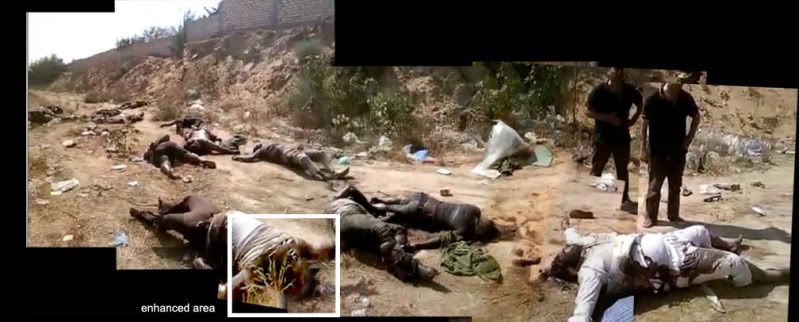
I was started on this by a not-so-new video which I haven't seen yet. Peet73 tipped me off to this amateur, sideways-filmed video of several bodies found in late August in Tripoli/al-Furjan, apparently executed and scattered along a small stretch of road. At least many of them are not bound (now), but they were clearly taken there and killed. They appear to be exclusively black men.

http://www.youtube.com/watch?v=BBLGYUz6QiA
جثت أمام معسكر 32 خلة الفرجان 27-8-2011 [auto-translate: "Knelt in front of Camp 32 trait Furjan"]
Uploaded by 17022011libya on Aug 29, 2011
I'm pretty sure this is the one I downloaded, original sideways format, encoded UTC Aug 28 16:12:16. There are other versions that fix the rotation (like this). The light angle seems about right for thattime of day, so I'm considering this the time of filming. 4pm on August 28.

The Yarmouk base and its attached shed massacre was in a neighborhood called by some Khalet al-Ferjan (Furjan), among other names. By virtue of the base, some call it the Yarmouk neighborhood, as I will here, to emphasize the connection to the shed massacre I suspect but can't prove. The Yarmouk military base was a headquarters of the 32nd battallion, Khamis Katiba (see here for precise location). As Peet73 confirms in a comment below, it's all the same district.

Though they've been around for the same time, these victims don't seem to be mentioned, usually, among the earlier reports from the base discussing bodies in and around the massacre shed. The one exception that I've run across is from CNN, August 29:
Rebels advancing on Tripoli discovered the bodies charred beyond recognition in a warehouse next to the military base. In addition, a resident who lives nearby told CNN that at least 22 bodies were found in a ditch near the base, but it was not clear whether those remains were connected to the killings at the warehouse.

CNN cannot independently verify the claims.
I saw twelve on first count, but now I see at least 13, probably 14, and perhaps as many as 16 bodies are there, depending on what's under certain things (a blanket, a plastic sheet, etc.). I trust the count of 22 in this "ditch" or dirt road, so the others must be off-frame somewhere, or perhaps already hauled off for burial. I was helped by the camera pans from two different positions, which I compiled into two single panoramic images. One view is here split into two, and the other fits into one image, with an odd section - a head area - enhanced. No verdict what that shows. Another upsetting body, left of center, top image, seems to both naked and smaller than average, again dark skinned.


In at least a few cases, blood-soaked dirt around the heads indicate on-site execution of living captives, by gunshot. They aren't bound, but might have been until just before killing. Only a close-up exam of their wrists could say.

Locale: A Mosque!
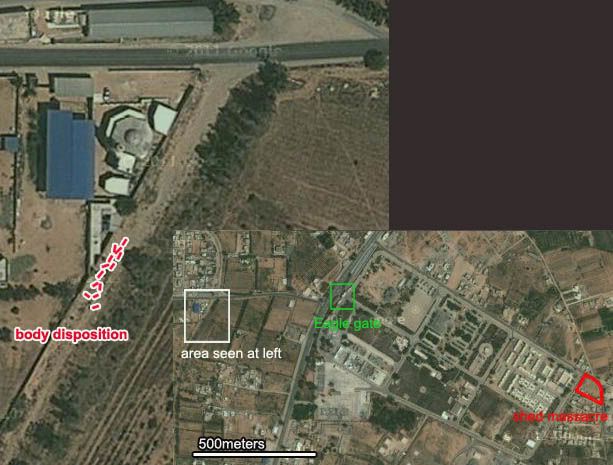
It took a little while and some outside thoughts before I found a firm location for the bodies in the "ditch" - a dry river-bed, forever dead, turned into a less-traveled road. It's further from the base than I expected, but reasonable for lazy rebel body-stashers. It's situated clear across the base from the shed,  across the highway, down one road and another to the left, 500 meters east of the eagle gate. It's a semi-remote area, like the Qawalish tree farm, or the nearby water basin, where bodies the rebels don't take the media to get discovered anyways. It's clearly not logical to claim these 22 black men escaped from the shed and ran that far before being found and executed by Gaddafi's wicked shock troops.

An optional graphic shows why I decided this is the spot - eight details besides the road and wall that line up. The clearest clue is the mosque inside the wall. The door lines up with a building attached to the wall, and there's a glimpse of the minaret's lower portion (middle of the images), between the door and the overhanging tree. The cameraposition is from under or just southwest of the big tree (marked orange there). Another graphic I'll share here shows where the 13 bodies I can see were on that road, and the area relative to the base.
Being behind a mosque could be a clue or a coincidence. The rebels have used mosques as bases for their militant activities in the past, and it's possible they took captives there, killed them inside the yard or outbuilding attached to the wall, then just dragged them out the door into the road. It's probably a bit more likely they just drove them over from the base, down this nearby road, and off the first left after that, somewhere semi-remote yet not too far.

A Swap-Out?
The given number of victims here is noteworthy in being pretty close to the number of alleged witnesses who escaped. I've found video or text accounts directly from at least 15 and perhaps 19 survivors (four possibles speak in Arabic), and Amnesty International "were still investigating the case but had only managed to locate 23 survivors." [source] If the witnesses had said there were about 175 victims to start with (as only Mounir Own did), it would have made more sense. Instead, most cite 153 or something close to start with, with 20-30 escaping, about 20 surviving to speak, and "more than 150" bodies removed anyway.

Was the original plan to dump these 22 elsewhere to make room for their survivors? The 100% race exchange rate is notewoerthy if so - apparently 100% black corpses traded in for 100% living Arab miracles, ripe to inspire the new nation with their tale of escape.


Updates, January 5, 2012:
New York Times, Robert F. Worth visited the Yarmouk base and shed massacre scene on August 27 and reported back, in small part:
Two blocks away, the badly decomposed bodies of at least 15 other men were found rotting in a wooded gully. One of the men had his hands tied behind his back with plastic flex cuffs, and a rebel commando said seven other bodies had already been carted away.
15 + 7 = 22. That's pretty good confirmation. Two blocks, depending what makes a block, but this is confirmation of the proximity and likely connection

Richard Spencer, Telegraph, Aug. 28:
Over the last months, right up until last week, people from across Libya have disappeared into their clutches.

Other, lesser units might release their prisoners as they faced defeat, but not the 32 Brigade, the nation's most feared militia, loyal to Khamis Gaddafi.

Some 18 were taken a couple of hundred yards down a dried river bed opposite the Brigade's grey-walled Headquarters on the southern outskirts of Tripoli.

There, on Saturday night [the 27th], The Daily Telegraph found their decomposing corpses. Several still had their hands tied behind their backs.

Blackened by the summer heat [sic], and maggot-infested, a team of silent volunteers rolled them into yellow plastic body-bags with as much dignity as they could muster. Alerted by Tripoli's grapevine, relatives showed up, somehow able to recognise the missing.
One the bolded: No, it's pigmentation. The sun set the color into living ancestors of the victims, long, long ago. By this, four bodies werealready removed, or their count was just less than thorough. One of theseblack men was identified as the brother of a man who I would guess was not black.
Mohammed Aweidat owned a nearby water bottling factory, his brother, Nasser, said, holding out his hands in puzzlement and shock over the body. He disappeared just last Wednesday when he drove from across Tripoli at the request of a hospital which was running low on supplies [Perhaps Abu Salim, suffering an even worse shortage of non-executed people].

This act of generosity turned out to be a fatal error.
"I have been looking for him for three days," Mr Aweidat, a doctor, said. "I asked everywhere. I found him here." The family believe he was killed for his car, perhaps as a means of escape.

There is also another video, from August 26 by its description. It's in lower resolution but more expansive, continuing down that dirt track, apparently filming more bodies than the 13 seen before. It also pans in more on the blood and gore along the way, although the imagery isn't clear enough to add very much. The non-raw status of this video (Media Info says encoded Sept. 5, two days before its posting) makes me hope there's an original around with better resolution and a raw record time.
قتلى بالوادي بخلة الفرجان طرابلس
[Google translated:Death valley Bkhalh Furjan Tripoli]
Uploaded by khaledshaibi on Sep 7, 2011
Description: قتلى بالوادي بخلة الفرجان طرابلس يوم 26 رمضان 1432هجري الموالفق 26 اغسطس 2011ميلادي
[Death valley Bkhalh Furjan Tripoli on 26 Ramadan 1432 AH Almulfug August 26, 2011 AD]

I haven't done any real analysis yet, or even a body count (more like 22 or 15?). It stays panned in tight, so it's hard to follow. Around 1:55 is a scene I can't decipher. Another black man, unseen before, camo shirt, has something wrong with his head and it's hard to say just what, even though it fills the screen. It's pretty well burnt, perhaps in two pieces...

Manaar.com (Google translated from Arabic)
Local residents said that the areas surrounding the camp Thurs were known as places of execution and murder.

They added, "we are told that human remains were found in different places and removed from there to bury it."

When we visited the place referred to by locals behind a mosque there, we saw the burn marks on the soft ground where the bodies were set on fire.
Then I found a couple of useful photos by Ron Haviv/VII Images.
The dump zone empty of bodies, blackened burn marks only remaining. As shown here, this is a valuable view, clarifying what the video shows, regarding the surroundings anyway. The remaining 15 bodies were burnt, to some extent anyway, before removal. The rebels were by all account fully in charge of this area at the time. Were they then lumped in with the charred bodies from the shed when they were removed on the 28th? 

"Description: A ravine where corpses were dumped during heavy fighting between rebel fighters and forces loyal to Col. Muammar el-Qaddafi is seen in Tripoli, Libya, Aug. 28, 2011."

And then an artsy black-and-white close-up of one of the burn spots. 

"Description: Charred ground marks an area where bodies had been dumped at the site of an alleged massacre in Tripoli, Libya, Aug. 28, 2011. At least 55 men were summarily shot and then burned by loyalist forces in a warehouse near the Khamis Brigade compound."

Friday, January 6, 2012

The Tripoli Massacres: Roadblock Victims

January 6, 2012

<< The Tripoli Massacres

Petri Krohn requested a dedicated post on "the Tripoli roadblock victims." As he explained, to start on an issue I'm less familiar with:
All the intersections of the Second Ring Road had rebel roadblocks and piles of massacre or genocide victims in mass graves or just lying on the pavement. So far we have three identified sites on the 2nd Ring Road, with 20 + 4 + 2 bodies. We also have a photoset of a captured "Afro merc" at one of the grave sites.
Honestly, I forget what we found on that (mostly in comments here and here). Proof that collective "we" is greater by quite a bit than me, anyway. I recommend below we re-gather that information in one spot, along with anything new, and I will follow along, perhaps adding, and after enough is gathered, make a cool map graphic.

Thursday, January 5, 2012

Khamis Brigade Shed Massacre: A "Dr. Salim," a "Mr. al Farjani," and a Key Escapee

January 3, 2012
last edits Jan 5

<< The Tripoli Massacres
      << The Khamis Brigade Shed Massacre

This post will seek to sort out a narrower slice of the shed massacre witness list, one tight little knot among many worthy of untangling on its own.

Leap One: Dr. Salim is Dr. Salem
First, I recently made a crucial discovery about one alleged witness of the massacre by government forces at the shed behind the Yarmouk base south of Tripoli, when it was really probably a massacre of government forces. Dr. Salim Rajub/Rajip (who spoke widely to the media) is actually Dr. Salem al Farjani of Tripoli Medical Center, cleverly revealing his first name and "Dr." title while obscuring his identity otherwise. He gets the nick-name "See-through Salem."

Al Farjani was at the time travelling to mass grave and massacre sites to investigate what he always "found" to be loyalist crimes, and would soon, by late November, be appointed to keep doing that for the new Libyan government. And here he is recounting under a thin pseudonym some of the same "facts" he'll be "finding" later and helping to make official about the single most prominent and poignant among them. (See, in fact, his acknowledgment from Physicians for Human Rights, for one, in understanding this massacre they devoted a whole fancy report to).


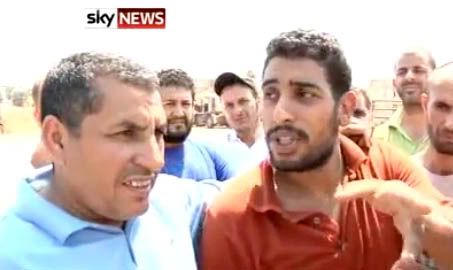
Among the shed massacre "witnesses," Dr. Rajub was already in his own unique space, being the only witness who brought forth another witness, an alleged escapee who remained unnamed. Speaking to Sky News correspondent Stuart Ramsay for the second time on Saturday August 27 (apparently the witness wasn't quite ready before the the first broadcast), Dr. Salim walked up with his left arm around the man's shoulder, and then translated for him, from Arabic to English.

The edit makes the man's story seem amazingly vague, with nothing about his captivity, the massacre's start, or just how he escaped. It only starts with Salim saying "7 -- 10 to 11" people "tried to escape," then which ways people ran upon fleeing the shed, and how some of them were wounded then executed on the way. He closed strangely with "this place was for executing the people who are exactly refusing to kill the other people, the civilian people."

Leap Two: Atiri is El Hitri
Also on the 27th (four days after the massacre), New York Times writer Robert F. Worth spoke with a man of interest (among several other strange people) who was named but not shown, Mustafa Abdullah Atiri, a 26-year old lawyer. By his account as well as approximate name, age, and profession, I decided he's clearly the same as Mustafa Abdullah el Hitri, who was mentioned in the Autralian on the 29th. No photographs were provided of either man to make a visual link. Only a different, believable, transliteration of family name and a different age (forgot he was was 27 now instead of 26?) stand in the way of concluding this leap is quite valid, and he wasn't even trying to give a different identity.

The Australian ran an article from Anthony Loyd, from the Times (of London?). His escaped witness el Hitri had some background on his brief detention at the shed (four days only), the beatings, torture, and emasculating humiliation they were subjected to there. He told of being locked in one of the prison trucks in the compound yard, only taken into the shed on the 23rd, to be killed with the others, one presumes. During that brief walk, Atiri happened to see Khamis Gaddafi right there, giving orders of some kind, generally believed to be the orders to kill them all (basis of possible War Crimes trials for Khamis...).

El Hitri is the only witness to notice the Leader's son, or to recall the man who saved his life later, the heroic guard "Abdul Razak." During the massacre, Razak became "sickened by the killing," and made the decision to open the locked doors while the killers went to re-load. He told anyone still alive to make a run for it, and they did.

Most prisoners forgot that part, however, and said a fellow prisoner kicked the doors open, or the doors were just left open, or the guards never left and were fought past, or the locked doors were circumvented in favor of a "hole in the wall".

With his family name transliterated perhaps better as Atiri, he met Robert Worth of the New York Times on Aug. 27, and spoke with him again three days later ("a week after his escape"), prior to Worth's epic Sept. 21 article, entitled "surreal ..." something, I forget. In greater detail he cited the rebel psycho-babble of ridiculous neglect, abuse, and torture. He elaborates on his sighting of Khamis, and his massacre details are about the same, down to Abdul Razaq and the opening to life he offered to so little recognition. Worth relates how:
Atiri escaped ... along with about 15 other men. Atiri told me that after running from the warehouse, they leapt over a low wall at the far end of the prison, then sprinted between empty houses and farms. They could hear the whine of bullets slicing into the fields around them, and shouts from the guards at the prison. Some of them — after days with little food and water — stopped to drink from a faucet outside a farmhouse and were gunned down. Atiri kept on running.
It was dark by then, but the soldiers fired flares into the sky, illuminating the kill zone. Finally, Atiri and another prisoner named Taha banged on the door of a farmhouse and found a family willing to hide them for the night.
His ordeal was not over. The next morning, Atiri woke up in the barn after a fitful rest, and he and Taha were told they could not stay. There were still Qaddafi soldiers in the area. The family gave them new clothes and some money, and the eldest son drove the two escapees to a neighboring town and dropped them off. They tried to blend in, without success...
A group of local men quickly surrounded them. One put a gun to Atiri’s head and began shouting: “You rat, you rat! Where do you come from?”
That story, and it's a gripping one, will resume below.

Leap 3 - El Hitri/Atiri is the Unnamed Escapee
Hitri/Atiri matters here because while not shown, he was described by Worth in a very helpful way, for which I must thank him. "I first met Atiri four days later [the 27th]. He was standing in the yard of the prison he had escaped from, a big man in a sweaty orange polo shirt with enormous, haunted eyes."

Look again at the unnamed man posing with "Dr.Rajub" on the 27th. We see an orange polo shirt, sweaty-looking, large eye that are arguably "haunted" (tired, dark). I don't think I'd say he's a "big man," however; he's barely taller than Dr. Salem (who is shorther than UN Secretary General Ban Ki Moon), but looks well-nourished enough. It was smart to claim only four day's captivity with the standard scraps of food and drops of water allowed by the cruel guards.

Further, language issues should be considered. Neither Loyd nor Worth mentions a translator (not that they would have). Did Atiri speak to them in English or Arabic? Was the unnamed man truly incapable of English, or perhaps not confident telling elaborate lies in it just yet? No firm answers should be expected to the questions, and we'll have to leave it unclear, and working neither for nor against making a link.


If we take this for a moment as all the same man, his more detailed story to Loyd came two days after his first performance, and to Worth apparently the following day, when he "walked then with a limp, a week after the massacre." For what it's worth, the Sky video (again: "Mass Killing" Evidence Found in Libya) shows him walking up at 2:27. He shows no limp here, or a very faint one if so. My guess is his injury was suddenly more pronounced and pathetic three days later. Crippled for life, likely.

Yeah, I think it's all the same guy. For confirmation just after saying that, near the top in a Google search I could have done at any time prior to now but hadn't, please see: Seamus Murphy VII photo, August 27:
Mustafa Abdullah El Hitri, a survivor of a massacre allegedly committed by Qaddafi loyalists, is seen within the Salahuddin district of Tripoli. One of the worst single atrocities documented so far during Libya's revolution...
...everything we've been told about it is a lie.

[side-note: Another image of Atiri, and another. Anybody out there in Libya happen to know this guy by his face? Is this his real name? Where was he really on the 23rd of August? DO NOT leave a comment or make a sound on the Internet if so. Gather easy proof as carefully as possible and try to leave that messed up place for a while. Get to Algeria maybe and then safely and irreversibly publish it. Hopefully sanity will be slapped back into Libya by itself before too long. ]

We had a look in Mr. Murphy's VII photo library for any glimpses of Dr, Farjani, but no identifiable views appeared. This image could possibly show his arm raised behind the foreground character, as he helps prepare Atiri for Ramasy's coming visit. Other photos suggest Murphy was there shooting  at around 9:30 to 10:30 am, when Sky Seems to have filmed about 11:00 (all by rough reading of sunlight "azimuth").

Leap 4 - Mr. Al Farjani is Dr. Al Farjani
So we have a possible match with the unnamed man Dr. Salem coached to Sky News the same day Mr. Worth first met him. Since Dr. Farjani was there the same day, it's worth wondering if Worth also talked to the man's apparent coach. Not publicly anyway, or by that name. But he did speak with one "Ahmed al Farjani." He comes up at the end of Mr. Atiri's journey, along with "Taha," to some nearby town or neighborhood, where they quickly met unfriendly locals.
At that point, a man named Ahmed al Farjani pushed through the crowd and began arguing heatedly with the gunman. He told the gathered crowd that Khamis Qaddafi’s soldiers had left town, and no one would be harmed for harboring the two escapees. He then led Atiri and Taha to his own house and locked the door. 
In fact, Farjani, a 42-year-old construction worker, had no idea whether the soldiers were gone or not, he told me later.
Is it sheer coincidence that a man with Dr. Salem al Farjani's last name saved Atiri/el Hitri on the 24th, while Dr. Salem - posing as a different Dr. Salim - ushered this same escapee (protectively) to the media three days later? It's possible, but so far the other parallels have not been coincidental, and my money is comfortably on the deceit getting deeper yet. This seems to be a clever code for Dr. Farjani, to give us his full name, just split-up across two fake witnesses, hovering around the same survivor of a fake massacre.

Why would he do that? That's for a psychiatrist to say, maybe.

The given age of this manual laborer is consistent with Dr. Salem's, if the latter's birthday is between Aug. 27 and Nov. 30. But he does have the different personal name, profession, and different implied address from both Dr. Salims (right next to the base itself for the fake guy, and somewhere probably north of there in Tripoli itself for the NTC guy). There is of course no photo here of Ahmed to settle the issue.

If All Four, Then... 
Like el Hitri, a "Salim" spoke to the Times' Anthony Loyd, as published by the Australian. For the record, he sounded quite "in charge"of the facts there, just like if Dr. al Farjani the massacre investigator had arrived. Because he had.
"There are about 65 bodies in all either in the barn or yard," said Dr Salem, a local resident. "But we know for a fact that there were more than 150 prisoners in the barn when the firing started and that only about ten escaped. What has been done with the other bodies?" 
In fact, over 150 dead bodies were allegedly removed on the 28th, but how many escaped? Somehow, Loyd picked up a range of "between seven and ten men [who] survived the massacre." To Sky News, the doctor gave both of these - one the old number, the other replacing it? "Seven -- ten to eleven people." The Original Misrata MilitaryCouncil version, announced at dawn on the 24th, said "no more than 10" survived a massacre that was clearly this one. Later it was over ten, with Atiri himself soon saying 15, others saying 20, two dozen, about 30 and even 35 total survivors have been cited by some members of the burgeoning club (of at least 21, and probably 23 members I have located).

Putting this all together, the doctor and the escapee spoke together to at least three newsmen - Stuart Ramsay/Sky (as Salim Rajip and unnamed), Loyd/Times (as Salem and M.A. el Hitri) and Worth/Times (as Ahmed al Farjani and M. A. Atiri). They both contributed to the specific drive topoliticize the non-event and get the Gaddafi family not just blamed but prosecuted. Ramsay said in conversation with the Sky News anchor (from the earlier report):
Anchor: And they were begging to get this investigated interationally.
Ramsay: Absolutely. The ICC was the first thing that the gentleman ["Salim"] who was talking to me in with fantastic English said please please get this investigated. The ICC is going to have a huge amount of work to do here, perhaps involving both sides of course not just, there's accusations of both the rebels and the Gaddafi forces, but they have a lot of work to do because some terrible things have happened here as we know.

Anchor: But no doubt this was Gaddafi's forces"
Ramsay: No doubt at all, according to the locals ["Salim"], because they [he, said he] went to see what the screams were coming out of this farm building...
And Atiri alone testified to Khamis' personal presence and implied order, a central plank of the ICC's stated interest in pursuing him over this massacre. That's some teamwork, and Dr. Farjani the NTC's chief of body-snatching propaganda made a wise choice taking this prolific escapee under his chicken wing. And he needs the protection and the publicity, to make sure his (version of the) story doesn't disappear due to "sleeper cells." As Worth related,
[Atiri] seemed terrified that the prison overseers would find him. “The brigades are still roaming around, and I still fear they will kill me,” he told me. “They have sleeper cells. I saw a list of names, before I was arrested, of people who have been given money and weapons to destabilize the country, like Iraq.”
Names! From this liar! "Arrest this and this loyalist!" No, no, no... if anything causes that kind of thing, it'll be the same thing as in Iraq. A lie-based demonization and total exclusion of a seriously wronged and vengeful minority large enough to launch a sustained insurgency. I'm certain it exists in Libya, and all signs suggest excellent weapons sales are in store for years to come. I don't support an insurgency, because they don't have enough non-exhausted, no-dead people (remaining) and they still have too many enemies outside. The only answer, I think, will be mental, moral, and global - and eventually legal. It probably will not even approximate true and total justice forwhat'shappened, but it will help more than just Libya. Let's figure out what.

Wednesday, January 4, 2012

Khamis Brigade Shed Massacre: Vehicles

January 4, 2012

I've been a little slow to analyze the vehicular situation around the massacre site, from earth movers to pickups, prison trucks, and more. I'll start with some images I was just alerted to, revealing three corpses removed from the scene early on August 27, apparently just before Sky News first reported. These were taken by Seamus Murphy/VII. These are bodies I've never seen or blogged on before but will. Warning-the one body is especially messed up in the face, most visible in the first image.
http://viiphoto.wg.picturemaxx.com/id/00109399
http://viiphoto.wg.picturemaxx.com/id/00109401
http://viiphoto.wg.picturemaxx.com/id/00109403

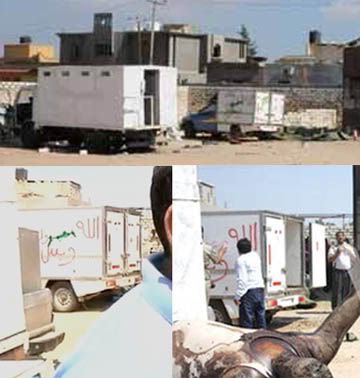
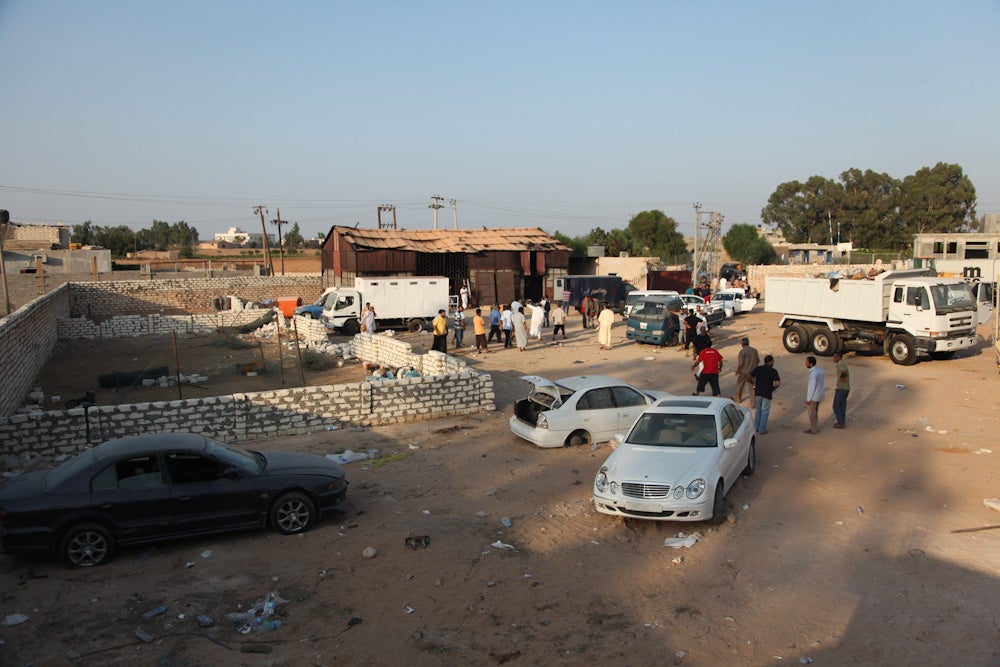
The trucks they show parked on the compound's west side are visible in the Sky News footage, right behind "Dr. Salim" for his first interview. He and Stuart Ramsay are standing about where the loaded truck had been parked and that char-faced, blood-soaked body had been moved around byrebel fighters just an hour or so earlier. To the left, foreground, is the same tall white truck with windows, a (or the?) prison truck,with its back platform, from which the bodies seem to have been taken before being put on the other truck.

The Murphy photo, crop at right above, shows the red graffiti saying, I guess,"Khamis Brigade," "Death Squad," etc., proving who ran the place and its trucks. It's already there but for the green, which it really seems the man is just starting on, recalling Arabs write right-to-left. Or perhaps he's erasing (left-to-right) something else before a later-yet painting over. An amazing photo, really.

The top image there is from a photo in the recent Physicians for Human Rights report on the massacre. That photo was taken, apparently, on the 28th or later. The area of the "mattress victims" looks dug-up, as it did not on the 27th or 28th, aside from CNN's Arwa Damon's late report from almost sunset on the 28th. The area dug-up then, at right, had previously been covered partly in a gray gravel unlike the surrounding dirt. It doesn't seem to dug deep enough to be a grave. It's a mystery.

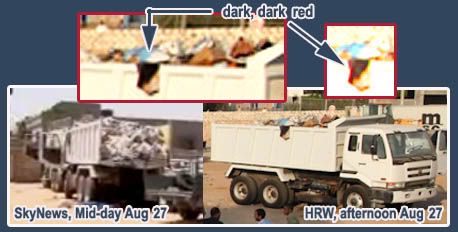
In the later Sky interview, "Dr.Salim" is backed by a different truck, or rather two of them; dump trucks with driver's side doors open. They've been active lately, might be again soon. The one's load we can see is indistinct monochrome, made of numerous large objects -boulders, concrete rubble, garbage bags, body bags, all possibly consistent. Rubble fits the bill best, however, in my opinion.

Below I compared that with a consistent dump truck seen later in the day by Human Rights Watch (full photo, also showing the prison truck). I'm not clear if this is the same truck, or if they've moved (I think still put, driver's door still open, with the one in front off-frame here). Its load is much more colorful-seeming here. Clothing colored objects - brown/orange, black, white, red, a bit of hospital blue, in roughly human sizes. The cloth hanging over the side, stained black, seems to have a red tint when lightened and enhanced. Is that just the sun's reddening light here near sunset, or is that blood?

Monday, January 2, 2012

The Sirte Massacres: The Mass Grave / Tallying the Dead

January 2, 2012


<< The Sirte Massacres


The final fall of the Gaddafi-led resistance, the final "liberation"of Libya and the widely-heralded start of a fresh new chapter there, only was declared upon the still-murky capture and murder of Muammar Gaddafi on October 20. This itself happened amid the culmination of Rebel/NTC/al Qaeda barbarity that rode shotgun on NATO-enforced "Humanitarian" intervention. Let us now take a look at the bloody climax in Sirte of the effort to, as was first explained, "avert a bloodbath in Benghazi."

Past the intro, I'm not ready to tackle this post. I will soon be copying over the info I already have published on the mass grave(s) of hundreds of victims of the city's final liberation. The various reports, changing number of those interned, the gruesome photos of many of them, the clues held therein, etc.

In the meantime, if anyone has anything they think I might not, feel free to leave it in a comment, and save me some time.

The Sirte Massacres: Executions in the Capture of the Gaddafis

November 30, 2011
Last update Jan. 6, 2012

<< The Sirte Massacres

"We only want the head of Muammar Gaddafi. We don't want any death, any blood.We are fighting our brothers. But they are defending him. I don't know what's happened. We want him and they said no. So what's our choice? Kill them."
- young rebel fighter Rajab al Babor, Global Post video,Oct.21, 1:50 mark

This post will examine the fate of many people accompanying Muammar Gaddafion his last voyage, some hundred or so of whom wound up dead on the battlefield, with some of those clearly executed. How many, where, under what circumstances? How many were taken alive at that time and killed later anyways (aside from Col. Gaddafi himself, his son Mutassim, and defense minister Jabr)?

These are some of the people young Mr. Babor spoke of, their fellow Libyans who couldn't be reasoned with, who were actually defending the nation's leader against a foreign-created insurgency, who would only fight to the death. Their hands were forced into this fratricide. But here we see that in many cases, the despised loyalists were taken alive, rendered harmless, perhaps preached to a bit, and then killed without mercy.

A 21 October tweet from James W. Foley:
@jfoleyjourno: 95 bodies on field from Gaddafi's last battle #sirte, most killed by nato or in battle, 6 or so clearly executed
The NATO presumption is from the bodies being burnt, but there are some questions about that. Others say the number of clear executions is a bit higher. As passed on by Human Rights Investigations:
Human Rights Watch visited the site where Muammar Gaddafi was captured, and found the remains of at least 95 people who had apparently died that day. The vast majority had apparently died in the fighting and NATO strikes prior to Gaddafi’s capture, but between six and ten of the dead appear to have been executed at the site with gunshot wounds to the head and body.
Dan Rivers for CNN said HRW had found "at least ten" captives, three of them shown, "shot at point blank range."

As Reuters reported:
Fallen electricity cables partially covered the entrance to the drainage pipes and the bodies of three men, apparently Gaddafi bodyguards lay at the entrance to one end, one in shorts probably due to a bandaged wound on his leg.

Four more bodies lay at the other end of the pipes. All black men, one had his brains blown out, another man had been decapitated, his dreadlocked head lying beside his torso.
[...]
Joyous government fighters fired their weapons in the air, shouted "Allahu Akbar" and posed for pictures.
Update December 5:
In the comments below, details start to emerge about more captives, taken alive on the 20th (that is, NOT part of the few initial executions) who were later killed and then dumped, along with hundreds of other "unidentified" dead in the Sirte mass grave. Libya S.O.S. passed on a posting on Facebook of many of the decaying faces photographed before burial. Among the early internees, number 113 has been identified as Haj Faraj al Husona, seen alive in this video. That's an undeniable match, if I can't vouch for the ID (top image below). In a rare update at Libya S.O.S., another captive from the video was linked, by an e-mail, to victim #81 and given as Abdullah Hasnawi, born 1993 (lower image).
One other idea worth exploring here, perhaps, is the possibility that the strike that burnt this convoy was something other than a NATO missile attack. That will kill many people in cruel ways, but it's not really avoidable once the firing starts. But the possibility has been mentioned that they were massacred by hand, then the scene simply burned to make it seem an air strike happened. Until I examine the scene closer, I have no solid opinion, but it is odd that these cars struck as they tried to drive away seem to have all been parked in a field when they were burned. Maybe I just missed the explanation for that.

Updates Dec. 8/9: 
Captor: The English-Speaker
Some fascinating developments in comments. Thanks to readers Tawergha and Felix, another video shows these same captives being ordered onto a flatbed truck prior to the execution of some (or all?) of them. A possible American tells them in English to "go, go, go," "move, move," and "come on, get back." 

Another (or the same) person, light-skinned and bearded, is trying to smoke a Greek-made "American Legend" cigarette. It's not clear what these clues mean, but there's some speculation below, perhaps linking back to the Gaddafi convoy and an odd figure with a unique story of his involvement in the doomed ("betrayed") extraction operation. 

One important question raised by contributor Petri Krohn - were the captives even really part of the convoy, or just random locals misattributed? Either way, they were apparently slaughtered after their capture.

Captive: The Guy in the Cast
And reader Tawergha brings an original video (youtube link) for another execution proven by video, which I hadn't mentioned in the post body yet. This the man with the "bandaged wound,"actually a full cast, and he was alive, harmless, little flight risk, then dead in the same spot:

Notes, by myself and others, for now in comments. It's getting to be an amazing discussion,far better than this post is now.

Update Dec 28: New Videos
http://www.youtube.com/watch?v=wpdnf8ah9JY

Showing the purported first moments after the NATO strike on this parked arrangement of vehicles, as rebels first walked in and assessed the scene. This video will offer new details, though I'm not versed enough in those available to say what's new here. There are a lot of horrible types of dead on display here, but one pattern strikes me. We hear that the vehicles were hit, but many of the charred and sometimes limbless, headless, etc. bodies are laying several feet away from the vehicles we're to presume they were killed in. Burning people will sometimes get out and run, further away than these. Theones who couldn't have gotten out... The semi-random piling of many of the bodies could be the effect of rebels having pulled them out for processing. It does also resemble how they arrange people they've executed on site.

And a while back Russia Today ran a great piece largely based on these photo-video match-ups, showing some I hadn't seen before. On Youtube.

To the extent I can read the numbers, which is total, they offer guesses I haven't verified  for victims #85, 87 (in the video still frame above), 99 (an old-ish man), and 81 (mentioned above, 19-year-old Abdullah Hasnawi). The faces are blurred in the video, but that's why I have my own copies. I'll make graphics to compare and let others do the same. The numerical lumping is a good clue - captured together, killed together, numbered and buried together. That's the zone to look for more matches in.

Sunday, January 1, 2012

The Sirte Massacres: Leader Muammar Gaddafi

December 1, 2011
(quite incomplete)
last edits Dec. 28

<< The Sirte Massacres

Here will eventually be gathered the best information on this pivotal episode, the capture and killing of 42-year "dictator" of Libya, Muammar Gaddafi. He was captured alive on the outskierts of Sirte October 20, subjected to certain treatment, and then executed under murky circumstances the same day.

For the time being, the information will be in the comments section below, submitted by readers/contributors and myself as we see fit. The leader's last action's, his capture, abuse, killing, bodily display, and secret burial are all fair game for discussion below.

I invite here especially new contributors.

Dec. 28: Some excellent comments by recent-appearing contributor, anonymous, Tawergha, Felix, Petri, and others. Some fascinating theories are being discussed.

On The Site's Arabic Translator(s)

January 1, 2012

On The Site's Arabic Translator(s):
We have none. Text can be plugged into a translating site, but spoken Arabic remains largely gibberish to myself and to all my regular contributors. Personal and city names might be recognizable, certain words or phrases like "Allahu Akbar" (the most common phrase one hears studying the Rebel-centric war coverage) might de understandable.(I can also recognize "شباب", "shabbab," or "youth"). That doesn't help much.

There are Libyan readers, and other Arabic-speaking readers, out there, some reading this in Arabic with the handy translation tool. I ask anyone with the time and interest to contact me by comments here or by e-mail (caustic_logic@yahoo.com) and let me know. Certain video and audio files have been awaiting transcription / translation. Even helping with one or two could be of amazing value.

Also, if anyone has a suggestion for a particularly fruitful Arabic dialog, this is the best place to mention and link to it. Someone might be inspired to translate it right there.

Method: Any characterization of what's said that's accurate is better than nothing, but the best form for me is a direct translation to Arabic text to compare and be scholarly. This I can double-check and translate with the tools I know, but a good English translation would also help. Sometimes automatic translations go wonky. Frequently they do. But sometimes I can fix them with the right guesses.

For an example, and so I can appear in Arabic searches, the above text and some key words translated into Arabic.

Adam/"Caustic Logic", site administrator


---
(بخصوص هذا الموقع مترجم من العربية (ق

لدينا شيء. يمكن أن يكون النص موصول موقع ترجمة، ولكن لا يزال يتحدث اللغة العربيةرطانة إلى حد كبير على نفسي وعلى جميع
المساهمين بلدي العادية. ربما الأسماء الشخصيةوالمدينة تكون معروفة، كلمات أو عبارات معينة مثل "الله أكبر" (واحد يسمع العبارة الأكثر شيوعا دراسة تغطية حرب التمرد المرتكزة) قد دي مفهومة (أستطيع أن نعترف أيضا "شباب" ، "shabbab" ، أو "الشباب"). هذا لا يساعد كثيرا.

هناك قراء ليبيا، وغيرها من الناطقين باللغة العربية القراء ، وهناك ، وبعض هذه القراءة باللغة العربية مع ترجمة أداة يدوية أسأل أي شخص لديه الوقت والاهتمام في الاتصال بي من تصريحات هنا أو عن طريق البريد الالكتروني (caustic_logic@yahoo.com) واسمحوا لي أن أعرف. وقد الفيديو وملفات الصوت معينة في انتظار النسخ / الترجمة.

وقال أي توصيف ما هذا الكلام دقيقا أفضل من لا شيء، ولكن أفضل شكل بالنسبة لي هوترجمة مباشرة إلى نص عربي لمقارنة ويمكن للعلماء : الأسلوب. هذا لا أستطيع الاختيارالمزدوج وترجمة مع الأدوات وأنا أعلم، ولكن ترجمة انجليزي جيد من شأنه أن يساعد أيضا.أحيانا ترجمة آلية الانتقال متزعزع. كثيرا ما يفعلون. ولكن أحيانا لا أستطيع إصلاح لهم الحقالتخمينات.

القراء الليبية تحت الاحتلال : هل نكون حذرين -- الإنترنت ليس الخاص.
موضوعها : جرائم حرب منظمة حلف شمال الأطلسي في ليبيا، والمذابح المتمردين الليبية، وتحديد زورا القتلى والقسوة الاسلامية الثأر عنصرية واتهامات كاذبة ضد نظام القذافي، المجلس الانتقالي الوطني الفساد وبيع ليبيا في الغرب، والأخبار عن الحياة والمقاومة في ليبيا ، مع جيدة الأدلة الداعمة، أن وسائل الإعلام الخارجي لا نتحدث عن (هذا هو الأكثر قيمة ولكن أيضا حيث تحتاج إلى أن يكون حذرا...)

مسؤول الموقع "Caustic Logic" آدم / "المنطق الكاوية
---
Ideal formatting sample:
So I can follow along and maybe corroborate, inserting video time stamps at minute marks - it will usually interrupt a sentence - or maybe even every 30 seconds would really help. For example:


أدركت أن الحارس قد تركته في الخلية التي يمكن أن [02:00] يمكن فتح من الداخل. حصل على الخروج ، وبدأ الإفراج عن جميع    .الرجال الباقين، الذي..

Saturday, December 31, 2011

The Second Battle of Benghazi: Really?

January 1, 2012

Petri Krohn has asked me to start a post on this, as I've long been meaning to. The mainstream version of this pivotal event is well-encapsulated in the Wikipedia article
The Second Battle of Benghazi. The first "battle" was of course the five-day blitzkrieg of Islamist militants and terrorists masquerading as "protesters" that briefly surprised its way to control of Benghazi on February 20/21, in a movement co-ordinated enough to seize all cities east of there as well, and of several in the west.

The latter part of the late-March escalation, in which Gaddafi loyalist forces were blasted by superior Western air power, undeniably occurred, killing hundreds of brave patriots. It dramatically announced that "no fly" meant just that. Or rather, it was there for real, lie that it was. It's the part before that, the loyalist attack on Benghazi of March 19, that stands in question.

It was said Gaddafi promised a mass-slaughter of everyone inside Libya's second city, a fair subject for this post as well. The proof was always semantics-based, aside from what we heard were the first actual attacks in that campaign, already showing troubling signs of random, overblown evil and a severe deficit of logic.

I have already covered the quickly-discarded Gaddafi attack with one fighter jet - within a day the rebels acknowledge they shot it down, then that it was theirs (they have jets?), then that loyalists shot it down. Proof of how close they were to the city's gates... sort of helped the "no fly" thing despite failing ... the Libyan forces were the ones already enforcing a genuine no-fly zone, allegedly.

I do have some research on this, but nothing coherent enough to be able to write a post. I open it for comments and will submit some highlights myself, only later pulling together a summary of the evidence for any such attack.

Mohammed Nabous issues will be covered separately in this post.

Mohammed Nabbous: Really?

January 1, 2012

First post of the New Year. Happy new year to all!

Mohammed al-Nabbous was a semi-famous Internet Rebel propagandist in Benghazi, who gave his life and vanished in a puff of drama March 19, a martyr to proving the "second battle of Benghazi" had been started by Gaddafi's forces of darkness.

What the heck was up with that guy? Did he really die? If so, from what?

Wikipedia to start: http://en.wikipedia.org/wiki/Mohammed_Nabbous
The rest, in the comments section.

Faking the Conquest of Tripoli: Really?

December 31, 2011

Contributor Petri Krohn suggested a post/discussion thread on this issue, explaining it as follows:
---
Just before the fall of Tripoli Libyan propagandists were claiming that a copy of the Green Square had been set up in the desert near Doha, Qatar. When Tripoli was taken in August a video of rebels on the Green Square was first broadcast on al Jazeera on August 20th. Some Green supporters claimed that the video footage was fake and filmed in Qatar.

The evidence presented was flimsy; someone compared frames from the video to some on-line photos of the Green Square. Palm trees that were there in the 1960s were no longer there, missing details on the gate of the old city were gone because of the extreme compression of the mobile phone video (I do not know if you can call these "compression artifacts" as nothing was there.)

I thought the story would die in a matter of hours, unexpectedly it is still alive and kicking. Here is one of the original posts on Libya S.O.S. Here is one recently posted version in Finnish. I am afraid anyone sticking to this story will loose all credibility.

Who were the rebels on the Green Square on August 20th? Where did they come from? Where did they go?
---
I have not much to offer, but here is a spot where anyone burning to know and share on this subject can post related comments.

I will add that on the apparent studio rigging next to the compound: Yes. They had been filming somewhat epic protests there against NATO/Rebel intervention, so the real Green (aka "Martyr's") Square had become in a sense a studio set. The fake studio set version of it you could spot by the lack of such scaffolding. They wouldn't want it to look like a studio!