The Site that Asks: Is the "dictator" justifying intervention by killing innocents? Or is someone else doing it for him? (previously The Libyan Civil War: Critical Views)
Warning
Warning: This site contains images and graphic descriptions of extreme violence and/or its effects. It's not as bad as it could be, but is meant to be shocking. Readers should be 18+ or a mature 17 or so. There is also some foul language occasionally, and potential for general upsetting of comforting conventional wisdom. Please view with discretion.
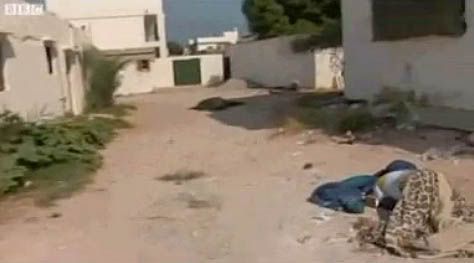
A BBC video report of August 26, primarily about (and dancing around) the Abu Salim hospital massacre, also shows some apartments in the "upscale" Ghargour neighborhood, between Abu Salim and Gaddafi's Bab al Aziziya compound. Here, it's said by reporter John Simpson (an old propaganda hack), Gaddafi loyalists had been living and flying their green flags. "The inhabitants are probably gone," he said, but "they'd left their mark. They'd chopped down eight ordinary people, who'd come back to see if their homes were still safe. Death and more death, and new cases are being discovered all the time." Yes indeed. To be precise, late August was when this was happening.
Those dastardly loyalist inhabitants of that neighborhood! Or was it the inhabitants who'd been killed, or done the killing? Or was that the residents of Ghargour? Does "chopped down" mean killed with blades, or beheaded, like the people at the hospital he'd just been proudly shown? I'm confused. What can we see to start judging for ourselves?
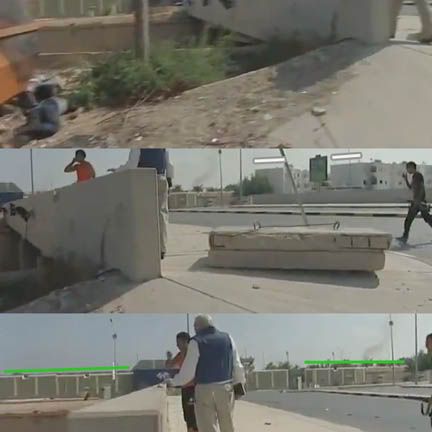
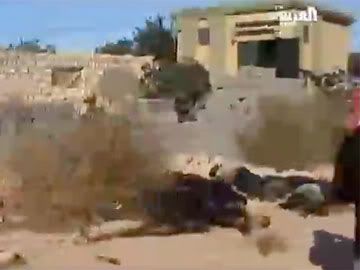
The two victims shown close enough to tell anything (screen grabs at left and below) seem to be black males. One is slumped face-down,his body covered by a leopard-spot blanket, and his perhaps present head by a blue one. He's been left in a sort of alley between buildings, with a second body, also covered, visible a ways further down (see last image in this post).
The other of three bodies, of the stated eight, that's shown (and perhaps a peek of a fourth) is laid by a giant orange trash receptacle (dumpster). Again, he's laid face down, and by his bare feet, seems to be another black man. The fire-ravaged dumspter could well contain more (burned) remains.
How it was known regime loyalists was responsible as the rebels swarmed around is, of course, unexplained but clearly true in Simpson's report.
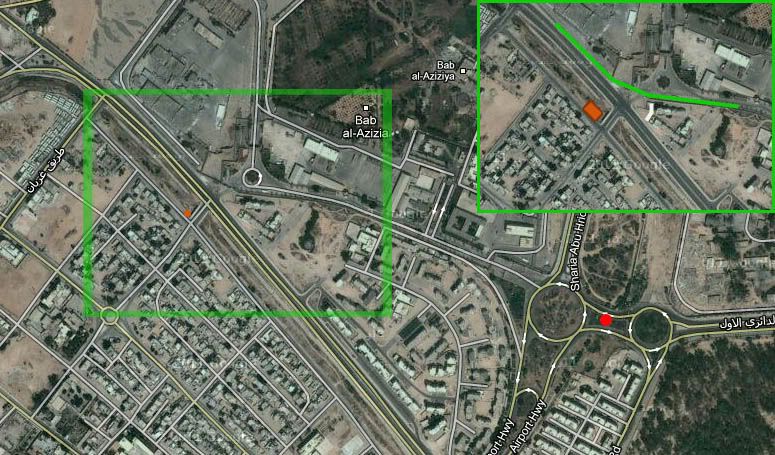
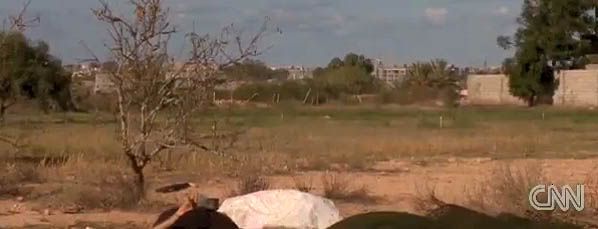
The location was not hard to pin down from the video presented. Below are some frames to set it up. The body at the end of the dumpster is at the base of a bridge over what looks like a canal. A solid green wall of some height (visible at left) runs across from the canal. Two large white buildings are in the near-distance to the right (r-click, new window for larger view).
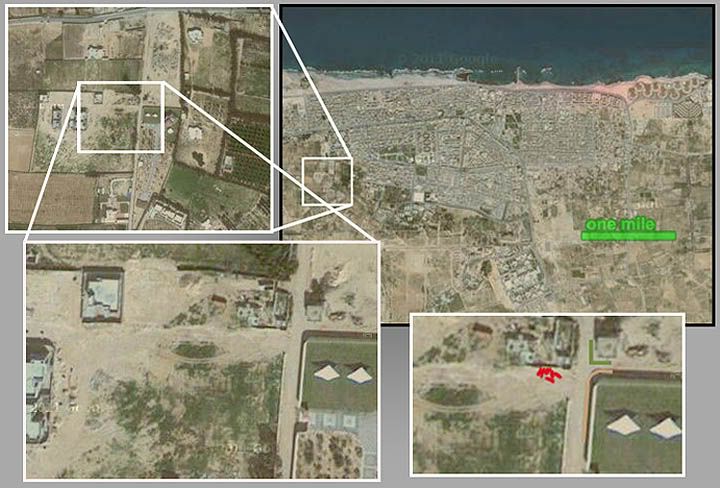
A canal crosses Ghargour, actually marking its northern edge, it seems. The green wall narrows it down, as does the bridge itself. The location is shown below. The wall top is marked in green, the building ends in white. The orange of course marks our trash bin, and for reference, a red dot to the east marks the location of the dozen or more black "mercenary" victims found at the Bab al-Aziziya roundabout.
This puts the location just barely in Ghagour, just across a canal and a street from the outer walls of Gaddafi's compound. It's nearer to the colonel's home than it is to most of those in Gargarish they might've been "checking on." Again as with the roundabout victims, the message seems to be "return to sender." This time the TNC government shock troops used the nearest place for dumping trash to make a further statement, and perhaps also added some burning - of the living or dead - to the mix.
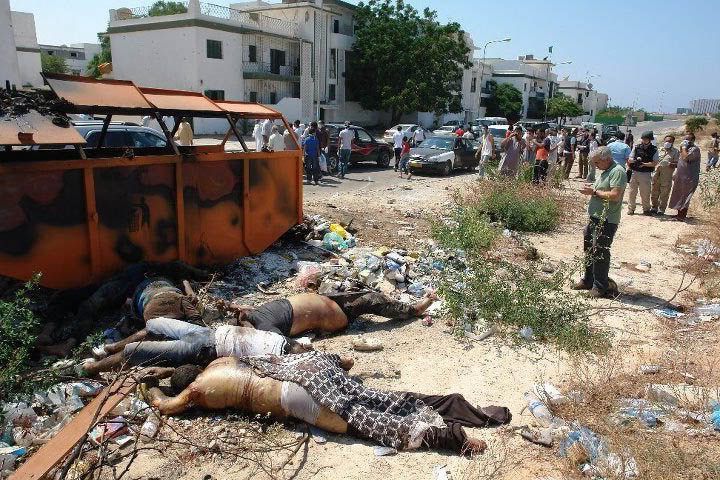
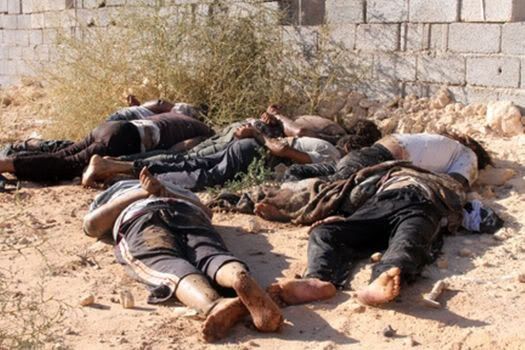
In the scene images above, Simpson's guide took him up on the bridge, pointing down to an area behind the dumpster we're not shown. I just found a photo that lets us see, in distressing detail, the remaining five victims piled behind. As far as I can tell, again, all five are black men, some unbound. Two have their pants pulled down, to humiliate the dead. They're in a middling state of decomposition by the time of this photo (August26th, as with Simpson's report?), bloating and skin cracking.
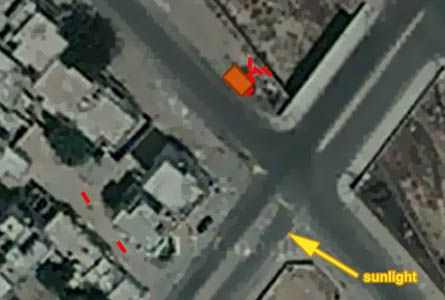
The surrounding buildings across the street conform with the satellite imagery and solidify the location. This in turn helps me find the spot for the other two victims in an alley. That's somewhat less clear, but there's a likely match quite close by. The graphic below shows where I think the dumpster and eight bodies were. ("sunlight" means direction of in the BBC video)
My theory of the crime flows from looking at that. Backon about August 22, eight (or more, depending) captive "African mercenaries" were driven by bearded members of the Misrata brigades to their date with execution. They headed north from Abu Salim, cutting through Ghargour, looking for somewhere near a Gaddafi place so Gaddafi could be blamed.
One of the condemned decided to bail from the pickup truck he was in, hooking his unbound feet over the edge of the bed and waiting. A longtime Tripoli native, he recognized a suitable alleyway and just before it, pulled a mighty sit-up, tumbled out at mid-speed, rolled to his feet, and started running. Another captive managed to follow him somehow before the pickup(s) screeched to a halt.
Still bound hands behind, the two escapees ran down the alley, aiming for the narrow passage between between two courtyard walls(roughly center of the image at right). But it was too far. Their captors got to the mouth of the alley and just opened up on them with the Kalashnikovs.
Immobilized, the men were finished off (for certainty more than mercy), but not dragged out. There was still much to do to the remaining "mercenaries," and to a whole lot of other people in this infested city they had to cleanse.
The dumpster was right there, it was perfect, and they could finish this quickly.
They were a pretty sorry bunch, these ‘Gaddafi mercenaries’. Assembled for my inspection in a scruffy, whitewashed room on the top floor of the courthouse building in ‘free’ Benghazi, six West African men shuffled nervously under the stern gaze of Arab youths.
If they tried to speak they were told to shut up. You could smell their fear.
And no wonder. A few days ago the boot was on the other foot. These men are alleged to have been among several thousand foreign thugs and gunmen that Muammar Gaddafi sent against his own people, to kill and destroy and quell the uprising in eastern Libya.
On the evidence mercenaries - these or any - were used in Libya's second city, Pendlebury offered:
In the past week anti-aircraft cannon and shoulder-launched rockets were deployed at close range against civilians armed with stones. Mobs of Gaddafi thugs in plastic construction helmets – dubbed ‘yellow hats’ by the protesters – also killed with machetes and clubs.
Reliable medical sources told me that more than 1,000 people have died so far in Benghazi as a result of Gaddafi-orchestrated violence. Some were killed when funeral processions for earlier casualties were attacked by snipers.
That number sounds extremely high, especially if it's meant to include, as it would seem, only "protester" deaths. These funeral processions occurred, four days in a row, right against the main military base in the city. I agree that many participating were shot dead by government forces. Each day, the protests devolved into fights, with the insurgents better armed each day. On the 19th they were shooting lots of machine guns stolen from nearby, and on the 20th they blew the place open with a suicide bomber (hidden in the funeral procession) and started slaughtering the soldiers. This is where the deaths happened - they were enraged by the side-effect of their own rage. They stole all the weapons. That's what the soldiers were trying to prevent,as they would in any country. From a censored distance, we all cheered the victory.
And more to the point, none of these context-free dead people videos, wherever and however they the killing happened, prove that African mercenaries were responsible. Not when many have said so, but not a single one of these attacks, pivotal though they are, has been recorded and shared online.
The Mail was able to negotiate a brief meeting with some of the prisoners, with bearded authorities "worried that if the thousands of people still chanting victory slogans on the seafront were to know of their presence so close there would be a lynch mob." The location seems to be the city's main courthouse, soon to be the NTC government headquarters, and the scene of beheadings of alleged African mercenaries.
The Africans I saw ranged from a 20-year-old to one in his late 40s with a grizzled beard. Most were wearing casual clothes. When they realised I spoke English they burst out in protest.
‘We did not do anything,’ one told me, before he was silenced. ‘We are all construction workers from Ghana. We harmed no one.’
Another of the accused, a man in green overalls, pointed at the paint on his sleeves and said: ‘This is my job. I do not know how to shoot a gun.’
Abdul Nasser, a 47-year-old, protested: ‘They are lying about us. We were taken from our house at night when we were sleeping.’ Still complaining, they were led away. It was hard to judge their guilt.
Perhaps not so hard for everyone. That paint trick is pretty good. They probably teach it at mercenary school. Too bad it conflicted with the man who said "we are all construction workers." (I bold and insert that facetiously). They kept to their "cover-stories" until the rebels took them away to avoid poisoning the press with their nonsense. But one of them 'fessed up - to other people being bloodthirsty mercs - and was then pushed before Mr. Pendlebury as a sort of antidote.
Then I was shown a prisoner who was prepared to admit some part in the bloodshed.
A tough-looking young man in a black corduroy jacket, he would not give me his name, but admitted to being a 27-year-old member of Gaddafi’s presidential militia and having wounded one protester on the evening of February 19.
‘The African mercenaries put guns to our heads and forced us to open fire on the people,’ he claimed. ‘If someone refused then the mercenaries poured petrol over their head and set them alight. I saw this with my own eyes. I had to do what they said.’
The man said he was guarding the gates of the militia base in central Al Berka Square against stone throwing protesters when he shot one man in the leg at a distance of 50 metres.
‘He had stones in his hand,’ he said. ‘When he fell down he pulled himself up and gave the victory sign.’
How many people had he seen killed that night? About 40 members of the militia, executed by the mercenaries, he claimed. And what about the people they were shooting at? ‘More than a hundred,’ he admitted.
He claimed he had deliberately aimed only to wound and had fired over the crowds’ heads when the mercenaries were not present. He had not been able to sleep for the guilt at what he had done.
This was his story. I did not quite believe him.
What did he expect to happen to him now? ‘It is in God’s hands,’ he replied.
He really played that perfectly, right down to the Islamist-pandering closing. That's an extremely detailed account, with only a wounding, no death, from his quarter, but tidal waves of evil sworn to around him. Perhaps this is following on some plea deal - rat out the other mercs and be allowed to go home safe in return. "Yes sir, in God's name, that man Mr. Nasser over there was their leader. I saw him splash the petrol all over the soldiers..."
And again, we know from credible "protester" sources that loyalists in Benghazi were burning people alive for refusing to obey orders of the "kill protesters and mourners" kind. These five soldiers (be sure to see the second half) suffered that fate at the same "Birka barracks," possibly at the hands of these same afro-mercs young [name not given] presumably swore to in the Benghazi court of free Libya on or around February 25.
This story emerged along with the alleged capture of one of colonel Gaddafi's more prominent sons and national security adviser, Muttassim, who's been talking tough and keeping Sirte resistant for a while now. It was for real this time, the NTC said; they finally did capture a Gaddafi family member and Sirte should just give up now. There were celebrations with gunfire, but no proof, then back-tracking on the claim, a loyalist surge, a rebel retreat, a renewed rebel push, renewed NATO strikes...
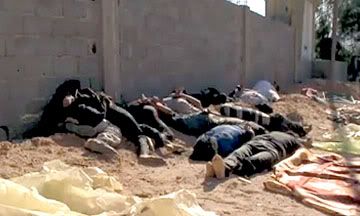
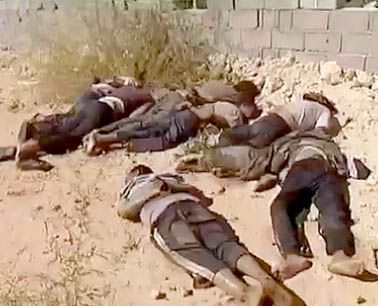
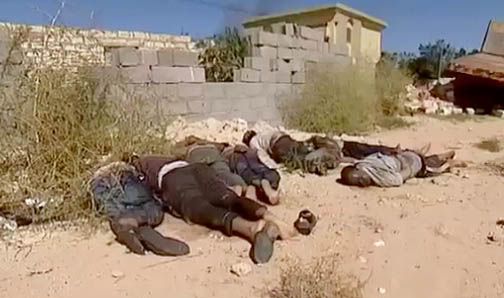
Anyway, the victories may be largely fake (for both sides), but the brutality is real. CNN had Dan Rivers there to report (a Youtube posting). His crew filmed a number of bound and executed men piled next to a wall (see image below), and explained "on the outskirts of Sirte, we find evidence of atrocities. Here, a dozen bodies bound and some apparently shot in the head. It's not clear who murdered these men or whether they were civilians or fighters, but they were certainly wearing civilian clothes [transcript]." The rebel fighters shown elsewhere in the video tend, these days, to wear some part professional camouflage, with only some in purely civilian attire. A rebel-affiliated "hospital official" named Abdullah al-Manghoosh told CNN:
We're here to check. We don't know what happened. We don't know the story. But clearly they [the victims?] are revolutionary fighters.
It's not clear who they are. They were captives, bound with plastic ties, piled helter-skelter, mostly face down. Rivers counted twelve bodies here, and that seems about right. They look a bit like the victims of uncontrolled rebel barbarians, except for being primarily light-skinned Arabs for once.
There is a large patch of black fluid on the wall near one victim's head would seem to be blood. I saturated the color to see if there's any there, but the black stays black, no hint of red. So I'm not certain it's what it look like, but it might well be days-dried blood. The close-ups show flies but no maggots. To me that suggests they've been dead no more than approximately three days. A photo I found shows flies, bloating of one victim, and the strange posture some of them are in, legs splayed like frogs. It's not really clear if the one in the red "8" shirt still has a head.
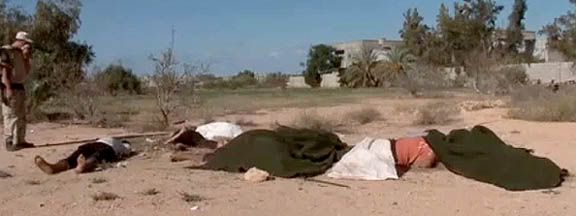
About five more bodies were also filmed by CNN nearby, more scattered in the open, mostly covered with blankets. The three whose pigmentation can be discerned (on the left here) seem to be black.
It's not clear at all the above are really at the main location we'll be considering. But until I figure out whether or how to split that off, it remains and we turn to the bodies found around Muttassim Gaddafi's compound.
Global Post has a great photo, from October 12 also, of yet another seven bodies laying in the dirt near another wall at another location that a reader was able to locate (see below). They too have hands bound, shoes removed, laid mostly face-down. At least two are definitely black, and one (the fat or bloated one, who's apparently bearded as well) are definitely not.
From the apparent dampness of their clothes and the mud on them, I'd say they were killed somewhere wetter, like any flooded street of Sirte, and have been laying in the sun here for 24-36 hours at most. Unless it rained lightly overnight, I suppose (the weather can be checked anywhere, usually. It's on my to-do list).
Supporting a dump, I don't see any large patches of blood here. But so far, I'm not seeing a whole lot at all of the things one would need to see (the same close-ups the news doesn't like to show) to be more sure. The CBC (Canada) however had a reporter up-close to what might be this batch of victims, and said they weren't always laid out side-by-side like this.
At one site, seven bodies lie on patches of burnt grass, four of them on top of each other, as if they had been dumped there. The corpses are sprayed with what look like bullet wounds.
Well, sprayed with bullets anyway. I don't see burnt grass here, but otherwise it's a possible match.
Rebel Details
The article at Global Post accompanying the above photo gives much detail, and mentions quite a few dead bodies - several dozen - appearing in areas the rebels had taken in fighting. And then it strangely closed with "during the conflict, 75 were injured and 6 killed." They must mean rebels injured and killed in the day of battle observed, ignoring loyalist deaths, and considering all others killed as executed by loyalists prior to the battle. Let's tally the pre-liberation crime spree then, starting with this article's treatment of the bodies shown above, together with several others in a certain, very convenient spot:
As fighters for the transitional government advanced into inner Sirte today 42 bodies — beaten, bound and executed – were found on what a local man identified as the property of Gaddafi’s son Moutism.
[...]
The bodies were discovered in four locations in the fields behind Moutism’s [last known, allegd] home. Two groups lay along a concrete fence, appearing as if they had been lined up and executed. Another group lay scattered in a field among cattle. Rebel fighters held their noses against the smell, and looked at the bodies with anger, sadness and disgust.
“There are 42 bodies,” said volunteer medic Nabeel Alghoail, as he checked the bodies from the first location with a team of four. “All have been shot many times. They are all civilians.”
I thought they were clearly "revolutionary fighters?" The article continues:
All were men and appeared to be aged between 20 and 40. They were bound at the wrists with plastic ties. Yusef Haddaga was among the group who discovered the bodies. “We were moving through at around 2 p.m. when we found the bodies lying here like this,” he said.
Haddaga said he recognized one of the men as an engineer from Misrata. Others said they believed the men to be prisoners captured by Gaddafi troops several months before, but no positive identification has been made at this time.
What they say, with words out of their mouths, can't be trusted in a case like this. And further, it's not clear how we can know that five days ago Muttasim's people, but not the rebels, had access to the area (or can we? see below). They've been pushing into various districts for weeks now. And further, loyalist leaders are likely moving from any known homes, like this one where bodies were found, to new undisclosed places, perhaps underground.
Many of them seem to be prisoners from Sirte's jail. "See their hands. Their hands are tied behind their back," Lt. Hussein Abdelsalam said through a translator as he showed the sites to a reporter.
How's that for sleuthing? Plastic handcuffs can only come from a Gaddafi jail now. A rebel doctor again gave the usual story: killed by the bad guys, and before the good guys got here (we'll be able to check that somewhat, below), and again, they're having a hard time attaching the bodies to acceptable identities.
Abdul Rauf, a doctor who sides with the revolutionary forces, said he examined some of the dead and thinks they were probably killed by Gadhafi loyalists last weekend [Oct 7-9], as NTC troops launched their all-out assault to finally capture Sirte.
[...]
Rauf said the bodies are hard to identify because they're now swollen. The ongoing hostilities have made it difficult for coroners or pathologists to attend to them. [... however ...] "I think that they were people which they held, and when our fighters reached there, like it's the last chance: Just kill them and run away. Just don't leave them to tell the story," Rauf said. "It's like that. You want to kill the story with them."
The First Survivor
But the diminishing Gaddafi regime isn't very good anymore at killing stories - not even fake ones. The CBC continued on to speak with an alleged convenient survivor who gave the "inside story"on how these deaths came to be.
Anis Farej, who was detained for nearly a month in the Sirte jail, said he believes the bodies are his fellow prisoners, though he could only recognize and name a few of them. One was Abdullah Ferjani, Farel said, a sheik from Sirte who was arrested because of his anti-Gadhafi stance.
Anis Faraj, 22, told The Sunday Telegraph: "They are not bothering to put them in prison any more. If they think you are against Gaddafi they kill you." Mr Faraj said described how suspected revolutionary sympathisers had been taken from their cells and shot dead last week - a fate which he only narrowly escaped himself.
[...]
Mr Faraj said he had been thrown into prison last month after Gaddafi loyalist volunteers found him shirking military service by hiding with family members in the nearby district of Abu Hadi. For three weeks, he and 47 other men [sic] were crammed into the small dungeon like cells inside Sirte police station. Last week, he said, as interim government forces advanced on the area, guards had come to the men and told them that Col Gaddafi's son Mutassim, who is said to be directing defence of the enclave, "wanted the disloyal rats from the prison".
"They lined us up, all 47 men outside with our back to four armed guards," he said. "They shot their weapons around our feet, and tied our hands with zip ties." As the prisoners were bundled into pickup trucks and led away, Mr Faraj was saved by a guard who recognised him as a colleague from Misrata airbase where he had previously served, before defecting.
"He took me to his house, gave me a Kalashnikov and told me to continue the hunt for the 'rats' with them," said Mr Faraj, who eventually escaped across the front line. "They are hunting down men inside their district, and anyone who does not support them is taken away. Soldiers I was with spoke of taking opposition members to the beachfront to kill them."
That's an unusual escape story, compelling enough in its way. And for the doubters, the same man was able to identify the dead from videos, like we've seen, as his fellow revolutionary cell-mates.
Doctors who first examined the bodies of Mr Faraj's fellow prisoners counted a total of 42 men dead, some of whom Mr Faraj identified from a video recording the discovery as his former cellmates. Their wrists were bound in the way he described. Lieutenant Col. Hassan Ali of the interim government's Gabra brigade, who found the bodies, said: "There are other corpses further in. We can see them through cracks in the wall but we cannot reach them as there are too many snipers."
More Visuals and a Partial Location
Al Arabiyah filmed the victims as well, in the very low resolution image at right. I first thought it referred to the "Dollar neighborhood." But then I was alerted, by reader Petri Krohn, of Twitter reports from Rasmus Tantholdt, International Correspondent of TV2 Denmark. These spoke, on October 12, of "7 handcuffed bodies" and three more nearby "burned with tires around them." In a video report for Dutch channel Nyhederne, Tantholdt's crew gave different views in good resolution (see below) showing it's the same spot as seen in the Global Post photo above, piled next to a partly collapsed cinderblock wall.
Between the different views, I think five or even six of these seven "revolutionary fighters" look more like the standard "African mercenary" than anything else. The Nyhederne video gives enough surrounding footage to feel out the scene. The missing sections of wall could be knocked out for defensive sniper positions or blown out by a rebel RPG from the south aiming for such. There's also some sort of cargo trailer nearby, leaned up on concrete rubble, possibly another defensive improvisation against invaders coming from the south.
From the Nyhederne video
The details seen made it possible to start locating a spot in satellite imagery. The video shows a large, open dirt area enclosed by low walls nearly meeting at right angles at the northeast corner. On the other side of one is a high-walled compound with a curved corner, and large trees in the distance to the south. And near the other, partly collapsed wall where the victims were piled, is a small square building with nothing else around (visible at right).
Before I even set to considering where the sun is coming from, Petri Krohn found the location, sharing a handy link I didn't know you could do. It's on the western side of town, not much over a kilometer from city center, yet surrounded by small farms. That's Libya. By this finding, which I'm fairly confident in, the curved wall runs north-south and encloses a rather fancy, if not large, house with a well-planned yard and long, narrow garden of palm trees. It looks arguably royal, like a place someone suave like Muttassim would live. There's also a possible upscale residence at least as big, well-walled and landscaped, just on the south side of this enormous walled yard (200m square).
In the image below, the lower rightblow-up has the curved wall and the small square building indicated, as well as the victims' location (in red). We can see how it might be a convenient drop point for anyone in control of the area, a stupid place for Muttassim to have ordered executions carried out, and a fine spot to display the defenders on this compound after its capture.
I've scanned around a bit for a location for the CNN views of the other 17 or so bodies. I don't think it's at the same locale described above. The wall that 12 are piled next to doesn't seem to be around there, but then again, it looks fairly new, as does the earth around it. So the existing imagery, a few years old usually, may not show it.
But the four or five bodies they filmed in a field might be nearby, and locatable. If I'm reading the sun right in the image above, it's afternoon and the fighter's shadow points somewhere roughly northeast. We have another large field, a wall with decent-sized buildings on the other side running to the east. And the zoom-in below shows in the near distance, to the north, built-up city area. Between seems treed, absent any tall buildings, and perhaps dipping down. Palms are visible on the right. Note the odd building visible at the left-hand skyline - curved or unusually angled and shiny, it seems. One of the ring-shaped apartment blocks north of the area we're looking at?
Battle Lines
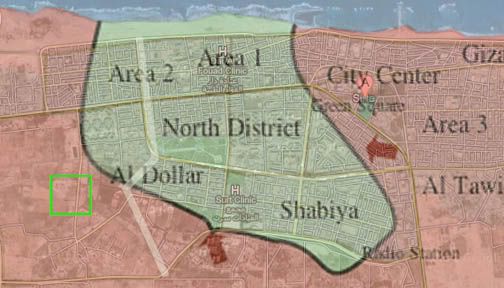
The scene is continuing to come together, visually and in terms of basic facts. See comments below for a preview of the updates coming. Most important for now is what the narrowed-down location of the seven means. The images below compare the compound Petri found with a Wikipedia graphic of rebel holdings in Sirte as of October 10, and an image from the Guardian, showing the front on various dates. I lined them all up and got this:
The compound is in the green square relative to the background map. It's within rebel-held territory on the 10th (pink). The faint white lightning-bolt line marks the western front on October 4, with that west of the line rebel-held. I suspect it's mistaken on the rebels controlling half of the fiercely resistant district two by then, since they apparently still didn't six days later. But they were apparently telling people that. The less built-up areas, like the one in question, make more sense to be under their control that early.
Either way, what this means is that the rebels are square in the picture, despite how they framed it. The bodies seem to be no more than two or maybe three days old. They were killed on-site, NTC forces and a survivor said, by Muttassim's men. They were killed by these people at this place as long as a week after the rebels had taken it. That's what they're telling us anyway, in parts and at different points, with apparently little attention to how their story lines up.
Burnt Victims in the Back
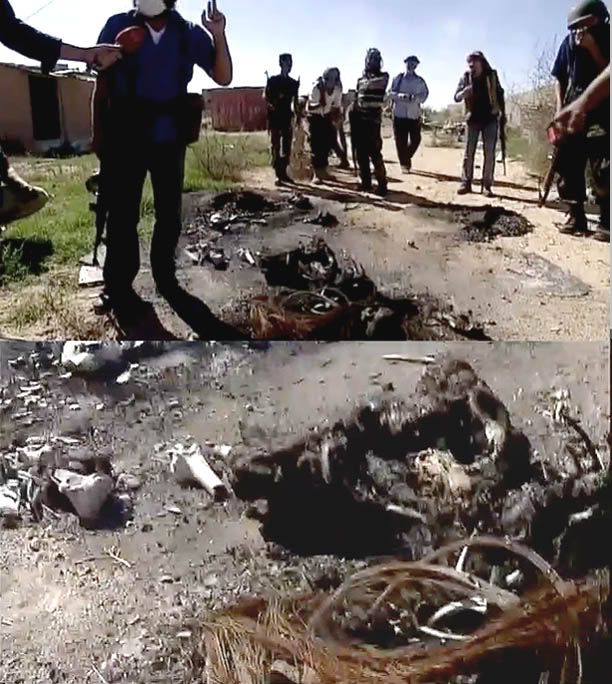
Petri alerts me further the charred skeleton, and signs of others burned, fimed by Tantholdt's crew are on this same premises, and separate from the burned and/or run-over bodies in nearby Hay al Dollar. It's just a few yards north, amongs the few small out-buildings set behind the wall the seven are lined up against. A red cargo container shown in the satellite images, near a mound of earth, is also shown in the video. They open it and show the camera the inside, with air holes shot into it like they say Gaddafi's people do for their prisoners (except sometimes).
Below is what seems to be one of these bodies, a little more burnt than I expected. The reports from Tantholdt said three bodies were burnt, but this is the only one we're shown. The posture suggests the victim struggled as he burned. The feet seem fairly intact. The missing flesh on the lower left leg, down to the ankle is odd. Predation of the meat left less over-cooked?
We hear that 42 bodies were found at four spots around the compound. How many of CNN's victims might be at this area is unclear, but we've seen 23 or 24 bodies in three spots aside from this. Only seven are confirmed here, 4/5 I think are clearly elsewhere, and 12 possibly here but likely elsewhere. This suggests we've only seen eight of the 42 victims at Muttassim's compound, counting this one. One wonders why.
Tantholdt further tweeted that these three burned captives had "tires around them." This could mean discarded nearby, or actually around their necks, suggesting the execution method called necklacing. Used famously in South Africa, it has a gasoline-soaked tire placed around a captive's head and lit-up, until they die from the random heat trauma to the face and head. We don't see this in the video. Only the one corpse is shown here, apparently tire free at time of filming, though the rebels seem to be pointing like bird-dogs to more further north.
But in the image at left we see a spot some bodies apparently had been burnt. Weird remains are in the foreground - a mesh of reddish fiber, curved metal bands, a large lump of black material. The last could be melted rubber or human tissue of several kinds.
There are also recognizable bone fragments, arm or maybe leg, suggesting a very hot fire and possibly severe bodily damage prior to burning. It is right on a road. More victims run-over and burnt? There's also visible here a black ooze on the right edge of the burn zone. That's not good. Did the road's dust mingle just with a thick flammable fluid, or also with human juices and melted fat?
As for the skeleton shown above, note that it has a rope or cable attached to the right leg. As shown, it's not attached to anything else, but looks like it could have been tied to that cinder block about two feet away. It could be the same fiber material we see at left. Cinder blocks are missing from the wall the other victims were at. That's not heavy enough to pin down a full-grown man, obviously, but perhaps they had first set something heavy upon it, like the pulled-out refrigerator-looking thing in the background (far left).
Racial Makeup
Further, we should note the race of the victims. The bodies CNN showed were largely Arab, but of the ones we can verify are at Muttassim's place, we have this: 5 or 6 of the seven whose skin is visible are apparently black. Of the of the others, the one is charred, unreadable - a rebel sympathizer like all, they say, but they've been wrong in the past on charred victims (the first ones were called disloyal soldiers, but were actually captured Chadian workers, black men, burned alive by the rebels). The possibility here of necklacing, the cruel African-style punishment, suggests indirectly these victims too may have been black folk, with race erased by the flame.
Only the pale, bloated, apparently bearded victim by the wall clearly shakes up this mini-trend. The remainder of the 42 we apparently don't see, and again, one should wonder why.
Again as at bab-al Aziziyah, and the hospital in Abu Salim, in Qawalish, and probably in Tawergha, the "fleeing Gaddafi rats" show their penchant for killing primarily black-skinned rebels, who by all evidence make up a very small portion of their racist organizations. And again as usual, the Gaddafi clowns leave the proof of their racist cruelty right at places they were "known" to be in control of at the time, with no attempt at hiding their stupid, stupid work.
My first encounter with the works of Salem Gnan, activist, was an important call he made to the UK Guardian on February 21, as cited in the post "Bombing His Own People." Really? Three reports of Libyan gov attacks on Tripoli came in that day, within an hour and a half. The latter two were to al Jazeera and called it aerial bombardment, but the first call, Mr. Gnan's, said the city was being shelled from the sea. As the Guardian reported:
5.07pm – Libya: Salem Gnan, a London-based spokesman for the National Front for the Salvation of Libya, says eyewitnesses in Tripoli have told him the navy has opened fire on parts of the capital.
"We have just heard that the military ships are bombing an area in Tripoli and many people have been killed although we don't know how many at the moment because people have just called to tell us it is happening."
Gnan said the navy appeared to be bombing a residential area outside the city centre as part of a desperate crackdown by Gaddafi's troops.
"He is even turning the ships on his people now. His plan is to use absolutely everything he can to stop what is happening."
Gnan said he had had also had reports of ongoing shooting around Gaddafi's residence in Tripoli and said more people were taking to the capital's streets as darkness fell.
"This is going on because if it stops that means it is finished. This will be the last act." He said people were travelling to Tripoli from across the west of Libya for a "final showdown."
I have had calls from people in towns and cities all across Libya. Those in the east can not get out but those in towns and cities in western Libya, everybody is saying: "We are going to Tripoli." The plan is to come from everywhere and go to Tripoli to sack the city, for the finish.
Yeah, on that "finish" to the "popular uprising" ... Even with massive help of all kinds from some of the most powerful nations on Earth, it's finally been approximately finished, eight months, thousands of very real bombs, missiles, and rockets, and tens of thousands of deaths later.
And on the bombings reported by Mr. Gnan and others, as explained at the above link, they apparently did not occur. There's still to date been no other evidence produced, of any variety, for something that should have been quite video-recordable and should have left plenty of physical evidence. Evidence like bomb parts, flattened buildings, and specific dead people in situ or shown with compatible injuries. Only "confirmations"(repetitions) of these same baseless reports ever emerged.
Reader Felix dropped some great research on Mr. Gnan in comments beneath that piece. The below is derived primarily from these.
The group he swears allegiance to is the National Front for the Salvation of Libya (NFSL - Wikipedia), a Natural-Seeming Front for those Salivating over Libya. With the basic premise that Libya neededto be "saved"from Gaddafi's revolutionary system, it's been a long-time CIA-connected training ground for anti-Gaddafi activists. Founded in 1981, it was staging both sit-ins (see below) and armed attacks by mid-1984. According to Medialens:
US official records indicate that funding for the Chad-based secret war against Libya also came from Saudi Arabia, Egypt, Morocco, Israel and Iraq. The Saudis, for instance, donated $7m to an opposition group, the National Front for the Salvation of Libya (also backed by French intelligence and the CIA). But a plan to assassinate Gadafi and take over the government on 8 May 1984 was crushed.
As Felix notes, the NFSL is also "the same group which organised the ill-fated protests outside the Libyan People's Bureau in 1984." This resulted in the Murder of policewoman Yvonne Fletcher on April 17. A bare three weeks before the daring NFSL attack against Gaddafi's compound, the regime allegedly shot itself in the foot by ordering embassy personnel to shoot at their cousins in central London in broad daylight. [see also here] Several Libyan kids were injured, and one cop, Fletcher (the only female officer there), was thoroughly killed on accident, greatly souring Anglo-Libyan relations just ahead of the NFSL's offensive. It was well-fated for their purposes.
More than two decades later, the front has apparently matured to a less violent group, focused more on talking, and feeding with the greatest ease Western misconceptions of Libya. As war broke out on the streets in 2011, they fused with other groups to create the National Conference for the Libyan opposition in support of the uprising. Their members went on full-tilt with the propaganda, and Mr. Gnan did his part, seeding the lies above.
He apparently learned from his follow-up callers that day that air attacks are the most potent thing to allege, and three days later was telling the Guardian all about more such, near the capitol if not in it:
3.47pm: Salem Gnan, a London-based spokesman for the National Front for the Salvation of Libya, whom we have spoken to regularly this week, says the situation in his home country today is "very bad".
Gnan says he was called by his niece this morning who lives in al-Zawiya, scene of bitter gun battles between Gaddafi loyalists and protesters and supposed location of Gaddafi's speech this afternoon (see 3.25pm).
She said they are bombing the town and lots of mercenaries have been flown in. People had been going to a gathering to hear speeches this morning when the planes came and bombed them. More than 30 people were killed. It is very bad. My sister's daughter was crying and crying on the phone but the people will not stop fighting.
No other sources mention bombing on Az Zawiyah (which is given here both correctly and as above), about 30 miles west of Tripoli and the closest "rebel-held" city in those days. That it would be bombed on the same day they said a speech by the leader was recorded there is doubly strange. A government attack is alleged on Feb. 24, but with no photo or video proof, and I remain less than convinced. These reports mentioned land-based shooting that killed several insurgents (ten by this source) and damaged the central mosque's minaret. All available videos show the protesters carrying machine guns and RPGs, firing them in a vague and possibly fake gun-battle, burying some of the previous day's dead, and hearing a fiery sermon about Libya's youth, the bombing of which was not filmed. All these and other events there happened in the city's main square, showing how little they really controlled - certainly not the part of town Muammar himself was in that day. (See the whole chronology at the fall of Az Zawiyah.)
Until now, I've heard nothing at all about alleged bombing there. Gnan's niece is a cold liar. Or simply confused. Or did he make the stuff up himself? Why did he feel a need to pass on such bogus information, and how did he know which lies to tell? Was he connected to some CIA-type networkof plotters and propagandists engaged in psychological warfare or something?
He later, on the defection of Libyan spy chief Moussa Koussa, spoke to the AP (via the Guardian 31 March 2011):
London-based Libyan dissident Salem Gnan suggested Koussa could provide a trove of information on Gadhafi's inner circle, the country's shadowy past and the dictator's increasing desperation. Koussa is Libya's "black box and curator of Gadhafi's top secrets," Gnan said. "He will uncover it all. He has got all the names, the documents and the information."
His supposed value (in solving generally fictitious crimes) was well-enough known, by Koussa and by his new hosts, first in London, then in Qatar. By trading on these, apparently, he got a cushy deal, effectively immune from prosecution so long as he helped inform the war effort. He reportedly has, and in so doing, helped fulfill the largely-French plot going back to late 2010, that many suspect Koussa was the main architect behind (see here).
Salem Gnan, if he doesn't work for Koussa, certainly helped his cause against Gaddafi and helped reinforce the reputation of his boss (sorry) as he stepped up to the bargaining table.
Felix adds some more (will work in later):
I think you can see Salem Gnan, سالم قنان here in a London demonstration (probably outside the Knightsbridge embassy) in this YouTube video uploaded on 17 February. (I think this is him too on 6 October recently,interviewed by Alaan. In May he seemed to be in Nalut. Also here on Al Arabiya 18 April.
(Nalut seemed a key town for rallying of westerners for an assault on Tripoli in August)
Salem Masoud Gnan is stated to be a lawyer but has directorships of several companies, EXCEL PHARMACY LTD of 23 Church Road, Isleworth TW7 4PR, but also of TOTAL MEDIA SERVICES AND MANAGEMENT LIMITED of 3A MONTAGU ROW, LONDON
W1U 6DZ and AGNAN LOCUM LTD of 32 WOODSTOCK GROVE, SHEPHERDS BUSH W12 8LE.
More interestingly, he is a director of the Oxford based Centre for Libyan Studies of Suite 220, 286 Banbury Road, OX2 7DL, a charity. Funding? The directors in 2008 were :Mustafa Rugibani
Youssef El Megreisi (Company Secretary)
Omar Abdulatef (Chairman)
Doctor Fathi Sikta
Mohamed Ali Ahdash
Salem Gnan (Appointed 25.03.2008)
To start with, I've read reports around, unproven, most of it perhaps nothing but rumors, that armed resistance agaisnt TNC rule continued in Tripoli. There is video evidence of at least those rebels manning road blocks being killed by loyalist snipers, for example (Dec. 12 - scratch that. The same scene was filmed in this video "the fight isn't over" was filmed back on August 21 or 22, as the battle was just about over). Sites like Libya S.O.S. have been running a series of updates (Dec. 11's installation), with little or no verification, chronicling Green (loyalist) victories nationwide, as the NTC drop like flies to assassin's bullets. But until the other day there's been nothing that was undeniable enough the mainstream media had to acknowledge it as news, as what they all call the first violence since the initial conquest.
This time, the violent resistance was preceded, as the NATO rebels' once was, by speech (raising the green flag). It occurred in broad daylight in the streets of the capitol and was darn near filmed (was it, directly?). And this time the perpetrators neither won nor ran off afterwards, and they gained two more martyrs who, for once again in the capitol, died on their feet. So clearly, this is a different phenomenon.
Myself, I wouldn't mind seeing the same thing but larger and with no guns. How do the authorities of "liberated Libya" deal with the people just expressing themselves?
I start with two articles from a mainstream news search, a third article, and then invite comments until I go looking deeper.
Libya's new government increased security in Tripoli Saturday with extra roadblocks and house-to-house searches after fighting in the capital with supporters of Muammar Gaddafi raised fears of another insurgency.
At most a few dozen pro-Gaddafi fighters appeared Friday in only a few neighborhoods of the Libyan capital that are known to be sympathetic to the deposed ruler.
[...]
Residents said fighting broke out when a group of up to 50 armed men had appeared in Abu Salim, a repository of pro-Gaddafi sentiment, Friday and at least one other nearby neighborhood and chanted pro-Gaddafi slogans.
Hundreds of NTC fighters in pick-up trucks shouting "Allahu Akbar" (God is greatest) raced into Abu Salim and the two sides exchanged rifle and heavy machinegun fire.
They're searching, finding some guns, and "pick-up trucks with heavy weapons were stationed inside the district, firing occasional volleys over the houses to make their presence felt." Always over the houses? They're getting more subtle as they mature into a government. Or in this case, into a tacitly allowed terrorit militia to intimaidate the people into subservience.
Further, this articlegives the death toll as three: two Gaddafi supporters and one NTC fighter, citing "NTC official Abdel Razak al Oraidi," during a news conference.
Libyan fighters fanned out in Tripoli neighborhoods Saturday to search for armed supporters of fugitive leader Moammar Gadhafi a day after a major gunbattle rocked the capital for the first time in two months.
[...]
Revealing serious divisions within the revolutionary ranks, Saturday’s sweep of Abu Salim was being conducted mainly by a breakaway militia that refuses to answer to the main Tripoli military council.
It is one of many factions that have refused to put themselves under the umbrella of official revolutionary authorities, raising fears of vigilante justice as the North African nation faces continued fighting by loyalists of the fugitive leader.
[...]
Abdullah Naker, the head of the so-called revolutionary council, called on all anti-Gadhafi forces to join them in the search and warned his men will fight anybody who gets in their way.
“All of Tripoli will be searched and we will reorganize our checkpoints and our guards in public and private institutions inside of Tripoli and outside of Tripoli,” he told reporters.
He said eight wanted men and 12 other suspects were arrested. He also alleged that teachers have been telling students that Gadhafi will return and said teams had been sent to stop the practice.
“We gave the military council a chance to prove themselves and they failed, and we will not leave things to chance,” he said.
A few more details from the article on how it's said the clash started:
A senior Interior Ministry official, Ibrahim al-Bargathi, said Friday’s skirmish started when a group of some 30 people, including eight women and some armed men, started walking with green flags. Local opponents began fighting with them, then revolutionary forces swarmed into the area from across the city, he said.
He said six people were injured and 14 were captured — nine men and five women.
[...]
The firefight in Tripoli began after Friday prayers. Witnesses said dozens of loyalists carrying green flags appeared on a square in the Abu Salim neighborhood, which has long been a pro-Gadhafi stronghold. Residents also reported fighting in several other areas known to still hold loyalists of the former leader.
The head of Tripoli's supreme military council, Abdelhakim Belhaj, pledged tough action against the pro-Gaddafi fighters and "sleeper cells" of the former regime which he said would be targeted in the clean-up operation.
[...]
"The fighters are in the process of clearing the buildings in the area of Gaddafi loyalists," Hamad (40) -- an NTC soldier manning one of the checkpoints in the neighbourhood -- said on Saturday.
He said they had already found evidence that the Gaddafi loyalists had been preparing for the clashes, including sandbags and flak jackets on the roofs of apartment blocks.
Abdelrazaq al-Aradi, vice-president of the security committee in Tripoli [...] told a news conference that around 50 armed Gaddafi supporters were behind the violence, 27 of whom, including four "African mercenaries", were arrested on Friday.
Abu Salim residents said the fighting broke out during pro-Gaddafi demonstrations after noon prayers, prompted by a call to rise from a pro-Gaddafi Libyan television presenter earlier in the week, broadcast on Iraqi [Syrian] TV channel Al-Rai.
Wow, people in foreign lands, speaking on video screens, encouraging people to rise up against their governments? Unprecedented. As for the mercenaries, how much do you get paid to help start a seemingly hopeless uprising and just get arrested/shot for it? Those unprincipled scum, black devils, they'll do anything for enough money.
Update Nov. 2
We'veseen what guns plus green flags means as far as making someone a legitimate military target. And in Libya's fledgeling democracy, new ideas on how to deal with non-violent loyalists are being freely exchanged in the capitol . As NPR reported back on October 6:
At a checkpoint in Abu Salim, two anti-Gadhafi fighters argue about what they would do if they spotted someone waving Gadhafi's green flag.
"It's a democracy," one of them says. "As long as they don't have a weapon, I would let them go on their way."
The other waves his gun and says he would shoot them dead.
As the header for this site shows, others share the view of the guy most likely to win any argument that emerged at that checkpoint. And the Az Zintan fighters are perhaps the meanest among them. As the Associated Press reported on the latest (rebel-on-rebel) clashes on Halloween, they mentioned another case of protecting the people from loyalists I haven't found any further details on:
Last week, a woman from Tripoli's once [sic] staunchly pro-Gadhafi Abu Salim neighborhood was killed after an argument with a Zintan fighter.
Here I'll consider together three described incidents from late February which share features but also differences.They could represent one, two, or even three seperate incidents of early rebel brutality in Libya's east.
In short, this was a massacre of 22 largely black men in military and civilian clothes, prisoners with bound hands, blindfolded and executed by gunshots to the head, laid out across some parking lot-type area inside a low-walled area.
It was said they had been killed by their commanding officers, or perhaps by African mercenaries, for refusing to fire on demonstrators. It might be true in a roundabout way - they failed to shoot all the attackers fatally, so the "protesters" got hold of them and they were then executed.
These 22 at least seem almost certainly to have been killed by their rebel captors - militant Islamists, by the look of it. A second video shows a nighttime session in some mosque, perhaps, where nine military/civilian prisoners are condemned to death. The match of one victim between the alive view and the dead view is perfect, and at least one other is a very strong match. As many as five others of the nine prisoners are consistent with one or another of the dead (two, one a teenager, are non-matches-apparently spared).
Airport Defender Executed
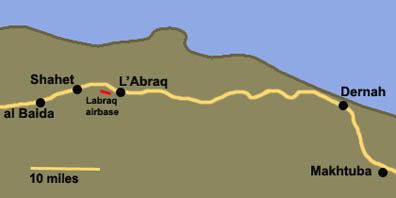
In a recent update to "Behind the Scenes," I finally mentioned the link to L'Abraq Air Base; according to a fairly credible video, the soldiers sentenced to die were captured at this airport just east of al Baida. Reportedly unarmed townspeople went there on the 18th to capture or kill the planeload of "African mercenaries" rumored to be arriving. Indeed, black soldiers were inside (all Libyan), and a somehow fierce battle ensued, which the people won in a matter of about two days.
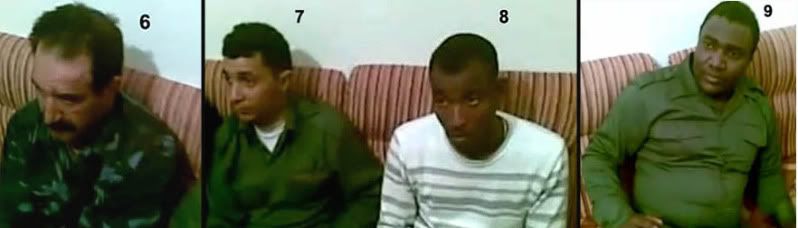
Recall that the original claim was these 22 were part of 130 soldiers executed by the regime for refusing to massacre the people, and the video of captive officer (prisoner #6 here) singled out as their "emir" (commanding officer) and apparently among those killed. Then consider this excerpt from a June 1 UN Human Rights Council report [PDF]:
On 18 February, at the demonstrations [???] near Al-Abraq Airport (east of Al-Bayda town), the Commission received information that 11 persons were killed by security personnel of Khamis Katiba, including the Commander of Husein al-Jiwiki Katiba. According to several sources, the Commander was killed when he refused to shoot at demonstrators, and was shot as a result of his refusal to shot at demonstrators. Witnesses noted that an 11 year old child was shot in the head while sitting inside a house close to the place of incident.
The Khamis brigade came and killed "demonstrators" who soon (about Feb. 20) conquered the airport. They killed a little girl at her home nearby (she's elsewhere given as 8, 10, or 12, and killed in her bedroom at 3am), and killed the on-site commander for refusing to help in all this killing.
The 'killed by his own' story and the airport link hint at a relation. But the date of the Husein al-Jiwiki commander's demise, the 18th, and the first appearance of the videos of the slain 22, Feb 23, are nearly a week apart. And the number of dead doesn't match. Only one that's given as military, one a girl, and the remaining nine - presumably those demonstrating. So this is apparently some other incident I'm happy to leave as murky for now.
The Makhtub Massacre?
Here's where it gets interesting again. Recall the rebel interrogator's obsession with identifying the commanding officer, or "emir," among the men to be killed. The Libyan government had this idea that Dernah in the east was declared an Islamic emirate, and the massacre video has been given as happening in Dernah (besides al Baida, Benghazi, and even Sirte).
I've never been able to locate a precise spot on Google maps that fits the video, allowing me to say which of these is correct. I mostly looked around al Baida and L'Abraq, but Wikipedia has some clues I should have found earlier, suggesting another town altogether:
A group of 15 to 22 Libyan army soldiers captured in Darnah were reportedly executed in the village of Makhtuba, 20 kilometres (12 miles) east of Darna. According to a widely circulated story, the men were claimed to have been "executed by their own officers for disobeying orders".
The number of dead and claimed story match enough it was well-worth looking into. The source for this claim was an article I somehow missed before: "A rebellion divided: spectre of revenge killings hangs over eastern Libya." Graeme Smith, Globe and Mail, April 1. It's behind a paywall, but there are readable re-posts like this.
Smith wrote, apparently from rebel sources, how "a group of 22 soldiers" broke out from the airport, and drove through "the rebels’ barricades near the airport on Feb. 23." In three pickup trucks, the fighters "raced down the highway that winds down the cliffs toward Darna, blasting their way through a rebel encampment along the way." They killed two rebel fighters, the story goes, and others there called ahead to Dernah. The roads in do really twist, so they'd have a while to prepare. Smith reports on their response:
Locals say that a rebel commander named Abdul Hakim Al-Hasadi organized an ambush near the outskirts; the 45-year-old had quickly become a prominent figure among the rebels because of his expertise in guerrilla warfare, which he received at training camps in Afghanistan from 1999 to 2002. (In an earlier interview with The Globe and Mail, Mr. Al-Hasadi declined to say who operated his training camp; al-Qaeda ran camps in the same part of Afghanistan during that period.)
Mr. Hassadi's involvement is interesting. He's since admitted to being an al Qaeda member, albeit one who disapproved of 9/11 and felt America was getting less evil with its assistance to their cause in Libya. He's gone on to lead the fight in Dernah (along with fellow Afghan AQ member Sufyan bin Qumu). Later, al-Hassadi allegedly sailed to Misrata to lead the besieged city's rebel fighters, who would eventually be known for their bravery and relentless brutality in Tawergha, Tripoli, Sirte, and elsewhere.
Back in late February... Smith continues with a story full, like the roads into Dernah, of twists and turns:
The rebels caught all 22 soldiers and started transporting them in pickup trucks back to Darna; although seven leapt from the back of the trucks they were recaptured the next morning in a neighbouring village. The remaining 15 arrived at the central mosque in Darna, where a large crowed gathered and called for their execution.
What's interesting is the divided response to these captives. While the militants and the "angry mob" wanted to off them, other locals were willing for whatever reason to shelter the attacking soldiers. A veterinarian who joined Darna’s rebel council told Smith “We were screaming, ‘Please don’t do this.’ My own cousin was killed at the airport, but I’m a Muslim and I must respect the prisoners of war.”
Mr. El-Magri said a group of educated men tried to shelter the prisoners inside the mosque and planned to disperse them among safe houses with families in the city. Most of them were bundled into vehicles and kept away from the mob, he said, but men in the crowed snatched one of them from the back of a pickup truck. He saw them hang him with rope from a green pedestrian bridge near the mosque.
Families that sheltered the prisoners that night remain afraid to speak to the media, fearing retribution. Abdel Gadir, 29, said one of his friends took in a group of prisoners and soon found it difficult to keep them. “His door alarm rang in the middle of the night,” Mr. Gadir said. “Men with guns were in the road with covered faces. They told him, ‘Give us those criminals.’”
The masked men took away the prisoners. The next day, Mr. Gadir said he returned home in the evening to his village of Makhtuba, 20 kilometres east of Darna, and found his neighbours upset. They had discovered a pile of bodies, apparently executed with gunshots, at a nearby crossroads known as Hisha.
“My friend said, ‘Our revolution has taken a wrong turn,’” Mr. Gadir said. “Each of the bodies had a bullet in the head.”
Comparing the Makhtub Massacre and the al Baida Massacre
The mosque where the main 15 were taken could be the scene of the famous interrogation video (with six prisoners unseen). That occurred at night, and the videos of all 22 already dead were online and being reported about on the 23rd (See SaveLibya's posting). So if this is the same incident with no timeline fudging, they must have been captured at about midnight or one AM on the 23rd, the escapees found and sentenced before the sun rose, and all 22 killed swiftly thereafter.
The details of this story also fail to account for the two capitives at least that clearly are not among the dead (prisoners 2 and 4). The original pool had to be at least 24, even if none of the others were spared.
Smith's version, gathered as it was from locals of different viewpoints, has strength to it. But the story of the initial capture is especially prone to distortion. The airport had fallen by Feb.20, so what 22 soldiers were still holed up inside to "break out" and go on the attack, semi-justifying their execution, three days later? Making this the story's beginning makes Hassadi out to be a defender, aside from a war criminal, but it doesn't seem to make a lot of sense.
That detail and the given date of capture aside, I'd consider it more likely these passive, stunned-seeming young men were just taken captive as the airport was seized on about the 20th, and killed somewhere in the next day or two before the cover story was finalized, and the video released, on the 23rd.
On the visual location search - often when things come together, they all start to. I'll look at satellite imagery and find a match, and things will just crystalize. But even narrowing it down to tiny Makhtub (given as Matruba on Google maps) still gives no obvious match. There's no sign the area of filming was at a crossroads, nor that it wasn't near one. And finally, splayed out in a walled area isn't the same as piled at a crossroads.
So in the end, I can't simply reconcile these as the same incident, nor shake the feeling they might be. What we have in this still-connected disconnect is either:
- two separate rebel atrocities of 22 victims each, in that area, on about February 23.
- the same incident told in multiple conflicting ways, left scrambled and indecipherable.
New intro, Oct.3:
One month ago, as Tripoli was being "secured," the rabble forces turned their eyes towards col. Gaddafi's hometown of Sirte, to which the ruler had "strategically withdrawn." Both sides issued some tough talk, Gaddafi vowing a long insurgency based from Sirte, the rebels promising to take the city in a few days. As the Associated Press reported on September 1:
"We want to save our fighters and not lose a single one in battles with Gadhafi's forces," said Mohammed al-Rajali, a spokesman for the rebel leadership in the eastern city of Benghazi. "In the end, we will get Sirte, even if we have to cut water and electricity" and let NATO pound it with airstrikes.
Surely that was hyperbole - a medieval siege of that type would be illegal, something Gaddafi gets accused of, but which the forces of enlightenment and liberation - and their Euro-American air support -would never dream of actually doing. The possibility of surrender, or an internal coup, or something helpful was talked up, but serious battle was readied for just in case.
Neither Good nor Great
A few weeks later as Western journalists laid around embedded with rabble (Government, NTC or "former rebel") forces outside besieged Sirte, they have picked up bits and pieces from some of the civilians currently fleeing from within. A few managed to capture some surprisingly candid moments:
"The situation isn't good. There's random shelling, rockets falling on people every day, falling on civilians," resident Jamal Makhzoum said from the driver's seat of a sedan heading west from the city.
When a man near the car interrupted, Makhzoum held up his hand and suggested it was not clear to him who was responsible for the shelling that has destroyed dozens of homes and prevented deliveries of much-needed food and medicine.
"Just a minute. These people say it isn't them," he said, gesturing toward Sirte. "And the revolutionaries here say it isn't them. And every day we bury two or three people." [Reuters]
It was never left this ambiguous in Misrata - only Libya's rebels could be so audacious as to suggest the shelling from the outskirts was by the besieged party inside. (And, ironically, there's some evidence they themselves have done this somewhere, while dressed as drunk Gaddafi soldiers and filming themselves.) They insist someone stating the obvious to the media correct himself. "Shoot randomly?! Target civilians?!! Us?!!!" I can see a rebel fighter shouting, firing his AK back and to the right for effect, hitting dirt and another car.
The ever-level UK Telegraph reported that rockets were being fired, by someone:
Hundreds of civilians continued to pour out of the city on Thursday in cars and pickups loaded with mattresses and food as the former rebel fighters fired machine guns and incoming rockets crashed on the city's outskirts.
National Transitional Council (NTC) forces have surrounded the city for a week, but say their progress has been stymied largely because there are many civilians still inside the city."
Those civilians are slowing them down? On the upside, at least that should allow their ammunition to last. The downside is that these civilians are shielding the regime forces from attack. Again, human shields, prevented from leaving, we hear, by crude threats. But they were starting to come out now, by what they're saying, because too many of them were dying from random rockets from someone, and the de-facto food and water and medicine embargoes were probably starting to hurt.
The Telegraph heard from a different refugee, citing a whole different class of problems compounding and/or replacing those other things.
"The situation isn't great," said one resident who did not give his name as he left the city, where he said Gaddafi's forces were moving "like gangs" through the streets. "There have been executions," he said, naming two men who he said had been executed on Thursday. He also said he had witnessed executions in front of the house of a local family, whose name he gave as Safruny.
For a while now there's been a reported pattern of brutal and even bizarre Gaddafi atrocities right before a rebel conquest, with the results found just after. In reality the massacres often seem to happened just after as well, despite the rebel stories (consider the Abu Salim trauma hospital). This time, we're getting glimpses ahead of time that the people who will turn up sliced in specific ways will be proven regime crimes. Handy.
An NTC commander on the outskirts of Sirte, separately showed Reuters a handwritten list of families whose members were said to have been executed in Sirte. The list, which he said he compiled with information from people inside the city, included the Safruny family.
The commander gave his first name as Saleh but declined to give his family name. He said other attacks on suspected NTC sympathisers had been carried out. "One man, they cut him like this," Saleh said, dragging his finger from the ends of his mouth across his cheeks. "Another, they cut his lips."
Take note and sharpen your knives. Also, don't expect many public records to help verify identities to have survived rebel - er NTC - destruction over the past six months.
But the "NTC forces" have for the moment halted their offensive, perhaps allowing a few less deaths for the moment and a little aid perhaps, to this battered holdout city. One reason given was a shortage of ammunition, which they haven't been able to use much of, considering all the civilians still there. But it was also acknowledged the rebels took heavy casualties from the stiff resistance still there despite everything. History has taught us that they get angry at resistance, and as we hear from Tawergha, people are found dead and cities emptied when they're angry. I think whether there are or aren't sliced up dead people there now, who can be claimed as rebel family, there will be before this is done.
NATO's Humanitarian Bombing, Seven Months In
This is all about the attacks from the ground, but for a while now Sirte has been suffering worse from the Rebels' unreachable sky Gods, all without hardly a sound in the Western media. They could be doing just about anything there, like using cluster bombs (video often cited) or mustard gas (it's been allegedly confirmed in Bani Walid). And since Gaddafi can still hire mercenaries, France says, NATO bombing continues and must. A few days ago, Human Rights Investigations posted a great piece on what's happening there: NATO bombing of Sirte: the new Guernica
Moussa Ibrahim, in a call from a satellite phone to Reuters office in Tunis on Saturday 17th September, said:
“NATO attacked the city of Sirte last night with more than 30 rockets directed at the city’s main hotel and the Tamin building, which consists of more than 90 residential flats.
“The result is more than 354 dead and 89 still missing [usually dead] and almost 700 injured in one night.” “In the last 17 days more than 2,000 residents of the city of Sirte were killed in NATO air strikes.”
As usual, NATO cannot, for all the trying in the world, confirm a scrap of it. These kids and old lady could have been hurt and killed by anything:
A good French site I just discovered has video of the latest portion of this, posted September 22. Auto-translated:
The hospital in Sirte in Libya is full of dead women and children killed by the bombing of French and English pilots. A massacre in absolute silence of the UN and NGOs French and English. Circulate these videos for the families of the pilots voeint their children swinging in Libya killing of babies and children.
The same site also has the hospital itself being bombed. If I may pull a Western journalist here, I'll just pass on these reports as unconfirmed but alarming. There is a guy who might be a doctor, with an invisible arm injury, and a woman who might be a nurse, with mysterious but mechanical injuries, perhaps grave, and to the whole upper body - very sad to see.
THE civilians pouring out of the besieged city of Sirte accused NATO of genocide yesterday as rebel forces called in reinforcements and prepared for a fresh assault on Muammar Gaddafi's home town.
Long lines of civilian vehicles were leaving after a night of NATO air attacks on the town. Rebel forces fighting for the National Transitional Council added artillery and mortar fire.
The people leaving the town, many looking scared, said conditions inside Sirte were disastrous. They made claims which, if verified, are a challenge for NATO - which operates under a UN mandate to protect civilians - saying the NATO bombing raids hit homes, schools and hospitals.
"It was worse than awful," said Riab Safran, 28, as his car was searched by rebel fighters outside Sirte. His family had slept on the beach because the houses were being bombed, he said. "They hit all kinds of buildings - schools, hospitals," he said. He could not distinguish between the NATO bombs and the rebels shells, he said, but believed it was a NATO bomb that destroyed his home on Saturday.
Thousands of refugees have tried to flee the city, forced to pass through checkpoints set up by the NATO-backed forces, where many have been taken prisoner,accused of being Gaddafi supporters. [...] those remaining in the city feared violence at the hands of the “rebels” after reports of many of those fleeing being detained and of women being abducted from cars leaving the city.
[...]
The Wall Street Journal reported from one of these checkpoints, describing lines of cars and trucks, packed with civilians and piled with mattresses and other belongings:
“As refugees gathered, the Misrata fighters checked their names against lists of suspected Gaddafi loyalists. Some men were arrested while others were told to wait on the side of the road with their families.
“‘We’re going to punish even those that supported Moammar with words,’ said a bearded fighter to a man who protested his detention. ‘We are the knights that liberated Libya.’ ”
Responding to rebel criticism that NATO isn't bombing enough, Colonel Roland Lavoie, the air campaign's military spokesman, riterated that they've been flying 100 sorties a day just over Sirte and the few other holdout cities. He said to AFP “the number of strikes depends on the danger against the civilian population, in conformity of our mandate." It seems instead he's got it backwards - the danger to civilians depends on the number of NATO strikes. He also added, in a sickening display of doublespeak as they've brought the rebels to the verge of national control "we do not aim to bring support to NTC forces on the ground, this is why there is no operational coordination with NTC forces.” No, it's just a coincidence that they're both committing war crimes against the same city to make life unbearable or impossible and flush the people out swiftly.
The conditions within the city unleashed by this humanitarian concern make it clear why some are willing to risk the demanding gauntlet to leave. Medecins Sans Frontieres (MSF—Doctors Without Borders) was somehow allowed brief contact with hospital staff within the black hole. They told of hospitals overflowing with the sick, injured, and dying - grave injuries from NATO bombs and/or rebel shells and rockets. Medicines - from antibiotics to painkillers - are running low, and compressed oxygen is simply unavailable (oxygen plants are a frequent NATO target in Libya). Shockingly, water-borne illnesses are proliferating as their clean water has run out (see below). There's constant danger, almost no food, little sleep, and little remaining hope in the city.
Some would say it's like Misrata, but this time, it's hit much harder and much quicker. This time, no powerful outsiders are ignoring a weak Libyan government blockade to evacuate wounded, bring in weapons, reinforcements, or even the basics for survival. This time it's the West's embargo and the combined firepower raining in on the city (from whoever) that has nothing coming in. Many would like to help, and are ready to, but no one's even able to help the residents inside at all, thanks to the inhuman NATO-rebel axis. Van Auken's piece continues:
“There is no food, there is no medicine, and every night, for five or six hours, NATO bombs all sorts of buildings,” Sami Abderraman, 64, told the Spanish daily El Pais as he sought to leave Sirte. “Hundreds of women and children have died like animals.” Abderraman estimated that as many as 3,000 people have been killed in the siege.
Another refugee, who asked not to be named, told El Pais that “The people who remain are going to fight to the death.”
[...]
Ali Omar, who fled the city with 27 members of his extended family, recounted the carnage being carried out by the NATO-backed rebels advancing on Sirte from Benghazi in the east.
“The easterners are exterminating everything in front of them,” said the 42-year-old Omar. He and his family, he said, had been pinned down inside their home by heavy gunfire for seven hours on Sunday.
And we still await further news on the Gaddafi-ordered massacres to be found inside, once these fighters take control of every house. I predict Gaddafi victims will be found starved, stricken with waterborne disease and denied medicine, blown up by artillery, crushed by bombed houses, perhaps gang raped, tortured, sliced-up as specified above... The variety of the Colonel's cruelty, sure to be revealed soon, is only matched by the mountain of crimes it needs to be stretched taut over, in a lame effort at concealment that will work like a charm on most.
Oct. 1: A Little More on Food and Water A Reuters report took note of the increasing role of enforced hunger in the NTC's plans to flush Sirte of its people, one way or another:
Several residents said they were leaving Sirte because they had not eaten for days.
"I am not scared. I am hungry," said Ghazi Abdul-Wahab, a Syrian who has lived in the town for 40 years.
Abdul-Wahab said he had been sleeping in the streets with his family after a NATO airstrike hit a building next to his house, making him fear his home also could be struck.
Some residents said they had paid up to $800 for the fuel to leave the city because it was in short supply. Others said pasta and flour were now changing hands for large sums.
Doctors at a field hospital near the eastern front line said an elderly woman died from malnutrition Friday morning and they had seen other cases.
I admit I'm a little hazy on the details, but if Gaddafi's people had ever laid a siege like this on Misrata, it would be strenuously called a war crime and attempt at genocide.
And water ... In a desert country, nothing's more precious in maintaining the line between life and death. The old government currently being starved into submission in Sirte had supplied water to all Libyan cities via its Great Man-Made River (GMMR) which, to my knowledge, they never turned off on any rebel city during the whole war.
So if a city is out of water like everyone says Sirte is, it's because someone turned off the spigot to them. The NTC is in general control of the country and the spigots, and the city they're besieging is starting to die of thirst. [update, Dec. 12: Rather the water mains were all burst, flooding the streets with the city's drinking water. Then rebels were slowed a bit by the knee-deep pools, and claimed that was why Gaddafi ordered the water turned loose - to slow the rebels down a little once they got in]
Reuters reports the UN had to bring water in towards the city, but couldn't get it inside:
The United Nations is sending trucks of drinking water for the increasing flow of civilians crammed into vehicles on the road from Sirte, heading either toward Benghazi to the east or Misrata to the west, he said.
But fighting around the city, Gaddafi's hometown, and continuing insecurity around the Bani Walid area, the other loyalist hold-out, are preventing the world body from deploying aid workers inside, he said.
"There are two places we'd really like access to, Sirte and Ben Walid, because of concern on the impact of conflict on the civilian population," the U.N. source in Tripoli, speaking by telephone on condition of anonymity, told Reuters in Geneva.
So water is finally available, but only to those who agree to surrender and leave, putting themselves in NTC hands, for whatever fate awaits. Then they can finally have access to drinkable water again, if they're not arrested first for daring to support the government in the past. The report also says:
U.N. officials do not have direct contact with pro-Gaddafi forces in Sirte, where both sides accuse the other of cutting off water and electricity, the U.N. source said.
Really? They have the fucking balls to say Gaddafi's people, African mercenaries I presume, finally turned the water off - to kill the people of Sirte as they make their last stand there? And the rebels can't figure out how to turn it back on, for all their desire to just help people who are trying to live there? More accutely than usual, I'm aware these "people" are spoiled rotten and unaccountable, lying, evil, twisted sacks of shit. And they're totally winning, with the stupid world kissing their asses all the way through a crash course of war crimes just reflexively now put on Gaddafi's endless fucking open tab.
Update Oct.3:
A brief cease-fire was declared to allow some civilians to escape, and hundreds took up the offer. One family family fleeing a bit too fast was shot dead (as usual, it was unclear to most which side fired on them). Then the cease-fire ended and bombing and shelling have resumed. It doesn't seem anything went into Sirte, and nothing but fire is scheduled until there's no life left in it.
Oct. 5/7: See the comments below for continued fascinating and sickening developments, submitted by readers and by myself, in the historically notorious and criminal grinding down of Sirte, Libya. Of special importance is the obvious rebel moves to keep the Red Cross, again, from helping or even seeing the city's hospitals, starved of all possible supplies and power, and reportedly bombed repeatedly. As CNN's correspondent said with muted disgust, the rebels felt only Gaddafi loyalists remained, so they felt free to squeeze and "make them beg."
Hey, the video a way up this post shows a kid who's been begging for a while or is dead now after a NATO bomb burned half his body, crushed and mangled his legs, and crushed his guts. I've seen the video and he's struggling with immense pain in the absence of proper medicines and painkillers. I doubt they've been able to evacuate him, for "safety concerns," and the situation only gets worse as nothing is allowed in. But I understand - not until every last person is begging and none capable of fighting anymore will the last bullets be fired to finish them off and then peace. So go the brave, and so slaughter the plague rats of NATO.
Update Dec 12: I didn't update this forever, but once the rebels controlled the city, they simply vacated it, blasting open every building, and leaving a pile of rubble. And then through October and into November the Sirte massacres started piling up - at least 400 loyalist dead in a mass grave now, an unknown but significant number of them executed, some after withstanding torture, eye-gouging, etc., visible in leaked photos of the mass grave internees. How many more were disposed of in other ways or unknown to us is obviously unsure.
Civilized world: time for another pat on the back.

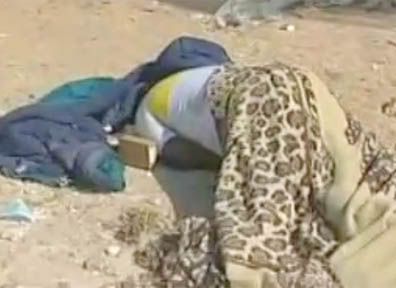
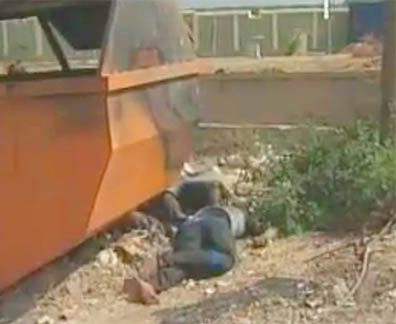 The other of three bodies, of the stated eight, that's shown (and perhaps a peek of a fourth) is laid by a giant orange trash receptacle (dumpster). Again, he's laid face down, and by his bare feet, seems to be another black man. The fire-ravaged dumspter could well contain more (burned) remains.