Warning

Warning: This site contains images and graphic descriptions of extreme violence and/or its effects. It's not as bad as it could be, but is meant to be shocking. Readers should be 18+ or a mature 17 or so. There is also some foul language occasionally, and potential for general upsetting of comforting conventional wisdom. Please view with discretion.

Friday, August 12, 2011

African Mercenaries: In Mythology and Reality

July 6-8, 2011
last edits October 26, 2011

Note, July 11: There are renewed and more credible reports of people who could almost be described as foreign African mercenaries fighting for Gaddafi. These are covered separately, for reasons explained there. This post is dedicated to the disastrous and unfounded accusations of February that helped make excuses for the excesses of the uprising.

Accusations:
One of the most widespread claims of the Libyan civil war is the Gaddafi regime's use of sub-Saharan African mercenaries to crush the protests and turn back the first military gains. The "people of Libya," we heard, were up against well-paid, black-skinned, black-hearted killers from the sandy or steamy depths of the continent Libya sits at the northern edge of. It's so prevalent a claim as to be bland and no longer shocking - hundreds of articles, reports, and videos cite Gaddafi's "African mercenaries" as self-evidently behind a range of atrocities.

There's no real controversy over the Libyans regime's occasional use of foreign mercenaries, from farther south in Africa, to supplement the small military Libya can cull from its six million people. But the over-the-top and reflexive allegations here seem to flourish with ignorance, not scrutiny. It seems to be a racist mass hysteria - or something more calculated - at work.

My article Anti-Black racism among Libyan rebels explains some of the background tensions and how they've played out this year. It's ultimately nothing new, with Gaddafi's pan-African vision, aid across the continent, exchanges and moves toward unification going back years, along with racial tensions and violence erupting, occasionally in massive race riots. But this time, it's really been whipped up with specific allegations, claiming special knowledge that, in retrospect, seems to not have existed.

One rather troubling series of tweets from supposed rebel insiders I re-posted here. It uses the term "protesters" interchangeably with "mercenaries," and the paranoid idea seems to be the same:
"Abdallah: yes there are pro gaddafi protests: but they are not Libyan, they are Africans they are killing everybody. As libyans we expected this from #gaddafi, recruiting protesters to fight us from Africa namely Chad #Libya #Feb17 he warned us about this. #Qaddafi has threatened to flatten #Benghazi and rebuild it, and place in it African Migrants. African mercenaries now in #Benghazi #Libya sources in Libya say they're chasing and killing people with knives and swords. We only fear God"
ABC News (US), Feb 22: Gadhafi's Private Mercenary Army 'Know One Thing: to Kill
Moammar Gadhafi is using foreign mercenaries from Africa who don't speak Arabic, as a private army to protect his regime and they have shown no hesitancy to fire on civilian protesters, witnesses have said.

A doctor in Benghazi told ABC News several foreign mercenaries were captured by Libyan police who have sided with the protesters. [...] "They know one thing: to kill whose in front of them. Nothing else," said the doctor who was reached by phone, but asked to not be publicly identified. "They're killing people in cold blood."

The doctor said he didn't know which country the mercenaries were from, but said they were black, spoke French and were identified by wearing yellow hats. "They have special forces bringing in from outside Libya," he said. "They bring from Africa some military forces, I don't know, some special army, put them in Benghazi and in Tripoli now."

These yellow helmets can be seen famously bobbing around in a crowded street, as they're said to be terrorizing or massacring protesters. This video is something I've analyzed in detail in another post, in video and words. It only shows some kind of security men guarding some green doors. Two or maybe three possible protesters run into their ranks and perhaps get arrested. At the end, the gaurds get the door open and start going inside.

An insightful early article by T. Miles (Feb 20) delved into Libya's  racism problem in connection with these emergent allegations.
CNN has just prominently shown a Libyan woman, tear stained, crying out on the newly liberated streets of Egypt. She calls for justice for her people, for the killing to end, begs Obama to intervene, and then repeats “Gaddafi is killing us with his Africans!” She is not alone in arranging this revolution between the Libyan people on one side, and Gaddafi, his family, and dark-skinned “outsiders” on the other.

For the benefit of those unfamiliar with the use of a map, Libyans are Africans. But Africans here means “black people” and there is a very long very pernicious racism in their part of the world towards “black Africans”, not unlike that in my part of the world. When I see tweets like the following, I cringe. I also see a history of fear and contempt slipping out in a time of unparalleled suffering.

Gaddafi is ordering african mercenaries to break into homes in #Benghazi to RAPE Libyan women in order to detract men protesters!
This last was a common theme, supported with no credible evidence. In connection with mass rape charges, Afro-Mercs are frequently invoked as sexual boogeymen, as can be seen in the post "Rape Allegations Ganging up on Gaddafi."

The examples of reckless mainstream media bullhorning of these alarmist allegations are too legion to bother with. Just two egregious examples from one outfit, the UK Telegraph will stand-in: a video of Feb 20: 'foreign mercenaries using heavy weapons against demonstrators' and an article of Feb 27: African mercenaries in Libya nervously await their fate.

Some took the notion of Black African fighters to ridiculous extremes. One Canadian Twitter twit accused these villains of being government slaves raised from birth to kill. "Confirmed the African mercenaries were raised in campus [sic] around Sabha and West Mountain since childhood as salves [sic]." [source] If these bred killers had lived in Libya since childhood, are they really foreigners?

Another silly take passed on by Maximilian Forte, Monthly Review, April 20
While a spokesman for the TNC alleged that a whole army of 3,500 fighters from Chad was responsible for the slaughter of "thousands" of opposition fighters and their withdrawal from frontline cities between Benghazi and Tripoli, actual footage obtained from Al Jazeera, showing government forces moving through one such frontline area, shows absolutely no evidence of this Chadian army or of any apparent mercenaries. As far as I know, TNC spokespersons have remained silent on this.
A strangely credulous dispatch from the UK Guardian, February 22, which I previously overlooked, adds some detail to the allegations.
Witness accounts seem to bear out the claims. One resident of Tripoli was quoted by Reuters: "Gaddafi obviously does not have any limits. We knew he was crazy, but it's still a terrible shock to see him turning mercenaries on his own people and just mowing down unarmed demonstrators."

Saddam, a 21-year-old university student in Bayda, claimed mercenaries had killed 150 people in two days. "The police opened fire at us," he said. "My friend Khaled was the first martyr to fall and seven others died with him. "The next day, we were shocked to see mercenaries from Chad, Tunisia, Morocco speaking French attacking us ... We captured some of the mercenaries and they said they were given orders by Gaddafi to eliminate the protesters."
[...]
Ibrahim Jibreel, a Libyan political activist, told al-Jazeera that some had been in the country for months, based in training camps in the south, as if in anticipation of such an uprising. Others had been flown in at short notice, he said.
That's some specialized and unlikely knowledge these guys claim to have. And did these simple folks understand the importance of what they were witnessing with their own eyes and reporting truthfully?

Implications:
The negative fall-out of these troubling claims were of two broad types - those against the government of Libya (intended), and those against non-mercenary black men in Libya (if not intended, not hard to predict either)

Implications for the Libyan government said to employ these savages:
The main hit against the Gaddafi regime of this Afro-Merc fever was helping create the image the leader had lost his legitimate military to defections to the rebel side - they went to "the people." It was later noticed how little of the army - aside from its weapons - showed up in the rebel ranks, and how much of it NATO had to bomb. But before these twin facts became clear, Gaddafi was presented as stripped of the native force's loyalty, explaining why he bought up some cheap slaves as a "personal army" to throw at "his people."

A point that was quickly decided about these foreign mercenaries is that they must have been flown in to kill innocents, especially to airports in the south (where some of the Black soldiers were flown from there). This in turn became a factor in imposing a no-fly zone and air embargo against the regime, to prevent the arrival of more "mercenaries."

The merc meme has also damaged by discrediting Gaddafi's long-standing policy of African unity. It re-brands his empowering policies, continent-wide aid projects, and encouragement of immigration into a crime against humanity.

And paying the Afro-Mercs to replace the army was a factor in the U.S. freezing of tens of billions of dollars of Libya's sovereign funds - at least $10,000 for each man, woman, and child on all sides, who won't get it back 'til they agree to shake Gaddafi.

Although the idea has faded some with time (see below, it was debunked), as recently as July 25, Newsweek ran an "expert" and his poetic opinions. In part,he said:
As for Libya, Gaddafi has no future. The day his mercenaries grow weary, he will fall.

Implications For Black Men in Rebel Hotspots:
Christian Science Monitor's credulous report of Feb 28 Libya's mercenaries pose difficult issue to resolve 
Muammar Qaddafi is likely relying heavily on African mercenaries, but if Libya falls to the anti-Qaddafi protesters, they're the ones who will have to figure out what to do with them.
Oh they figured it out, as it fell to them bit by bit. As an unnamed rebel soldier was quoted referring to the unfounded allegations of mercenary violence: "After what happened here, we lost faith in every black guy that’s walking around. So especially if he doesn’t have a passport, we just grab him.” [source]

Some suspects were released quietly as innocent after all, but others were first lynched, bludgeoned, burneed, tortured, decapitated, and so on. Rebel treatment of suspect mercenaries who weren't quick enough to flee can be to some extent seen here: http://libyancivilwar.blogspot.com/2011/04/rebel-atrocity-videos.html. Routinely, black-skinned prisoners were singled out for worse treatment and more frequent, and brutal, degradation and summary execution. And then more degradation, usually. What can you expect from irrational fanatics who run around believing things like these guys were part of a murder and rape conspiracy against themselves? Based on skin color, maybe language, paperwork...

Many other were thus chased away in fear. Refugees fleeing racist-infesteed Misrata, especially, in rickety refugee ships that have an unhappy habit of sinking - at least four so far, with many hundreds left dead. (Italy, swamped with most of the survivors, likely breaths a sigh of relief mixed with sadness each time).

American National Public Radio did a piece on February 25 (after earlier reporting mercenaries as fact), called "In Libya, African Migrants Say They Face Hostility." What kind of hostility did they claim to face? A Turkish oil field worker had to speak for some of them:
"We left behind our friends [so-workers] from Chad. We left behind their bodies. We had 70 or 80 people from Chad working for our company. They cut them dead with pruning shears and axes, attacking them, saying you're providing troops for Gadhafi. The Sudanese, the Chadians were massacred. We saw it ourselves." 
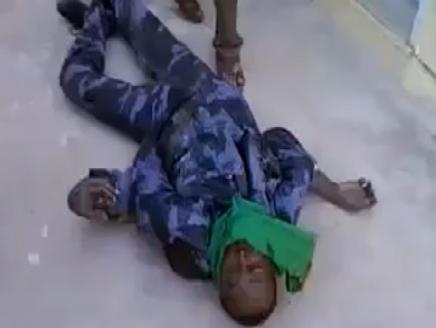
A famous video published on Feb 19 (still at left) shows the corpse of an "African Mercenary" killed and shown to a camera, described as seeming to be from Chad. But as has been noted, he seems to be wearing the uniform of Libya's internal security forces. As far as anyone knows, they only hire Libyans. The "Chad mercenary" was, according to an online posting, killed in Az Zintan, south of Tripoli. He seems to have been tortured - perhaps into confessing he was a mercenary. What else explains these grave injuries to a finger, his nose, and his cheeks?

Others fled or otherwise left that town in the same days - in March the same security man was re-discovered dumped in the desert, and in late May, at least twelve bodies of black men were found in the desert south of Az Zintan. Each in his unique civilian clothes and frozen in his own final pathos, they were found half-mummified by prolonged exposure. I suspect they died there about two months prior.

The sickening description at that Liveleak posting (by a "Mr. Creosote" no less) says: "The survivors [sic] of a gang of Nigerian mercenary wretches [sic] who were forced to flee into the desert south of Az-Zintan are kept alive [??] by the heroes of free Libya. The gang fled into the desert without water, after coming under concerted attack." Why did the "mercenary wretches" cross the Sahara? To get to the other side? I don't think so.

At the end of the video, at least two living black man are shown being watered and cared for by someone. These tack-ons look emaciated, but clearly not "survivors" of the same doomed party as it was found and shown. Perhaps they were the ones who made it back to town after they were all dropped off for dead.

In the long run, this epic episode of violence is likely to create a lasting rift between Africa and Libya, if the rebels who oversaw the slaughter manage to gain control. And in the short-term, it robbed uprising hot-spots of a known source of regime support. Blacks there, especially dual-nationals and immigrants, tend to support Gaddafi just as Blacks in the United States tend to vote democrat. They make as obvious a target to anti-Gaddafi rebels as certain Florida voters did to anti-Gore Bush family members in 2000.

I now have a video on this subject, showing much of this and more. I'll go ahead and re-embed it here. Do be warned, it's meant to be upsetting stuff. There's blood and hate, dead people and bad people, and spooky music.

Refutations:
The refutations started coming in almost as soon as the allegations, but were somehow ignored as the implications rolled ahead heedless.

VOA Nearly Level, Souare's Doubts
Voice of America even, on March 1, cited two experts, one supportive of merc use and one not, neither supporting anything like the massive threat the rebels claimed to fear.
It is unclear how many mercenaries Libyan leader Moammar Gadhafi has deployed against Libyan protesters, but African analysts such as Na'eem Jeenah, executive director of the Afro-Middle East Centre in Johannesburg, suggest the number is relatively low.

"It is difficult to say exactly how many mercenaries are operating in Libya and how widespread it is, but I think it is safe to say that they number at least in the hundreds," said Jeenah. Jeenah and other analysts says Gadhafi has a long history of using mercenaries [...] "And so yes, they can be called up at short notice therefore, called up at short notice, transported in to the country as [some have] been, etc."
In contrast, Issaka Souare, senior researcher at the Institute for Security Studies:
"The reason why I doubt the thesis is that we started hearing these claims just the third day of the revolt, and I would imagine it would take some time before you really can go and have recourse to these mercenaries, unless you are foreseeing that your own army is not going to be loyal to you," said Souare. [...] I don't exclude the possibility through migration that some sub-Saharans have integrated, having taken the Libyan nationality, have integrated [into] the Libyan army, or that Gadhafi at some point created a militia formed mainly of these people, and that these are deployed, and then protesters see these, conclude that no they are mercenaries." [emph. mine]
The bolding is important to consider - a basic reason the whole paranoid construct fails to even make much sense. The whole rebellion was a surprise - protests were known of, unrest likely, but this ... if they'd known, there are other things besides pre-positioning Afro-Mercs that would have been done (like beefing up the defense of army bases).

Mr. Souare was also cited by the Guardian. On the 22nd, he was reported as saying:
"In the south of Libya you do have people of sub-Sarahan origin, including Hausa speakers. Some might have integrated into the Libyan army and these would probably be among the first to be deployed. It will then be easy for people to say they are foreign mercenaries.

"People started talking about this issue on the third day, but I think Gaddafi should have had sufficient resources to deal with the protests before resorting to mercenaries. How long would it take Gaddafi to get mercenaries together and deploy them? Maybe a week. So I see it as unlikely at this stage, but it could happen if army defections continue."

HRW and Bouckaert: "No mercenaries in eastern Libya"
In a March 2 interview with Radio Netherlands Worldwide, Peter Bouckaert - emergencies director for Human Rights Watch - refuted the claims, after going to Al Baidah. This was to investigate reports that 156 mercenaries had been arrested there, and should be a good opportunity to verify at least a few.
The rights investigator said that what he found there were, in fact, 156 soldiers from the south of Libya and not from another African country. After talking to them he found out that they were all black Libyans of African descent. The soldiers have since been released by the protesters.

According to Bouckaert, the support of the black southern Libyans for the Gaddafi regime is explicable as Gaddafi fought to counter discrimination against this group in Libyan society.
http://www.rnw.nl/africa/article/hrw-no-mercenaries-eastern-libya-0
“Thousands of Africans” have come under attack in Libya, fueled by “hysteria” that mercenaries are involved in significant fighting. “Many of these Africans have been the target of attacks by enraged Libyans because of these rumors,” said Bouckaert.[...]

“There are dark-skinned Libyans in the south of the country who are largely loyal to Qaddafi because he did take steps to end systematic discrimination against dark-skinned Libyans,” said Bouckaert.
http://www.nowlebanon.com/NewsArticleDetails.aspx?ID=246936
[The claims about mercenaries] were rashly disseminated by local residents and carelessly peddled by the foreign press. “This is a prime example of lazy, irresponsible journalism on the part of the mainstream media who publish rumors as truth,” said Peter Bouckaert, the emergencies director for Human Rights Watch.

CIRET-AVT/CF2R
International Center for Research and Study on Terrorism and Aid to Victims of Terrorism (CIRET-AVT) and the French Center for Research on Intelligence (CF2R) sent a joint team of their top people and a translator to sort through "disinformation" and chatter to get a clear view. Throught the month of April they visited both sides, received statements and supporting evidence, and reported at the end of May. Their findings on Mercenaries adds some nuance, finding foreign fighters presence at some fairly early point, but under circumstances much different from those alleged. There's no evidence any of these real foreign fighters were among those lynched by the hundreds and arrested by thousands.

July: The Smack-down: Amnesty International, HRW, Others, Dismiss the Hoax with Force
AI and other experts, including HRW again, came out in late June with more solid doubts yet.
Independent, UK:
Nato leaders, opposition groups and the media have produced a stream of stories since the start of the insurrection on 15 February, claiming the Gaddafi regime has ordered mass rapes, used foreign mercenaries and employed helicopters against civilian protesters.

An investigation by Amnesty International has failed to find evidence for these human rights violations and in many cases has discredited or cast doubt on them. It also found indications that on several occasions the rebels in Benghazi appeared to have knowingly made false claims or manufactured evidence.
My observation here - their more astute plotters learned from watching the best - the Anglo-American propaganda machine against Libya, the ones responsible for the travesty of the Lockerbie "investigation."
My take on this development, with larger excerpts 
A critical re-posting at a rebel propaganda site (see comments)

Update, October 26: New series of articles "Mercenary Myths" deals with specific cases of alleged Afro-merc activity. Two entries so far, none more promised.
Mercenary Myths: The Aruba School Captives (al Baida, Labraq airport)
Mercenary Myths: A Confession in Benghazi (Benghazi's main courthouse, Feb 25) 

Thursday, August 11, 2011

Video: How the Rebels Gave Africa the Boot

How Freedom* Came to Libya, part 2: How the Rebels Gave Africa the Boot
August 11, 2011


Here, the video. Warning, it's graphic and creepy in spots. See part one here. More notes or explanation, etc., perhaps forthcoming.


Wednesday, August 10, 2011

The Qawalish Water Basin Massacre, via ... New York Times?

July 21, 2011

News of Abuses
With a little illegal help with air-dropped weapons, rebel forces in the western Nafusah mountains have in July been able to expand their holdings from Az Zintan outward to towns like Qawalish, aka Gualish, between Mizdah and Gherian in the desert of southwestern Libya. There the liberators discovered a number of "African mercenaries", and trumpeted to the world as supporting the claim they'd been making since February 18. As NPR found, Gaddafi's army was "hiring sub-Saharan Africans" to replace those lost in the war, but upon inspection "they aren't the fearsome mercenaries described by many rebels." They were all amateurs, culled from Libya's body of undocumented workers, and simply didn't exist as a force before April at the earliest.

It seems that the rebels were less forthcoming with some others among the town's defenders, and we have New York Times columnist C.J. Chivers and his towering photographer Bryan Denton to thank. He wrote on July 10 about abuses during the taking of Qawalish, whose entire population had fled in advance, as if the Mongols were coming. It then became evident why - Chivers witnessed open and massive looting (especially of grains, animal feed, and straw, possibly "punitive," he thought) and burning certain homes (especially of the loyalist Mashaashia tribe). They drained the only gas station of fuel, and then burned the place. Sounds a bit punitive, and highly criminal, to me. He also noted:
What was obvious and beyond dispute by Sunday was only this: Whatever their motivation, the behavior of rebels in Qawalish, who have been supported by the NATO military campaign against Colonel Qaddafi, was at odds with the NATO mandate to protect civilians and civilian infrastructure, and at odds with rebel pledges to free and protect the Libyan population.

Moreover, the leadership of the Free Libyan Forces, for all the statements otherwise, appeared to lack the ability or inclination to prevent these crimes.
[...]
The rebels say they plan to push further through the mountains soon, toward the city of Garyan. Will the villages along the way suffer Qawalish’s fate?
On July 12, Chivers reported back with the supportive findings of Human Rights Watch, adding news of reprisal beating across the area.
Col. Mukhtar Farnana, the region’s senior commander, said that reprisals were not sanctioned and that he did not know any details about them.

But Human Rights Watch said the same commander shared details with its investigators and conceded that rebels had abused people suspected of being collaborators as towns changed hands.

“People who stayed in the towns were working with the army,” the organization quoted him as saying. “Houses that were robbed and broken into were ones that the army had used, including for ammunition storage.” The commander added, “Those people who were beaten were working for Qaddafi’s brigades.”
Maybe some of them were patriots like that - it might just take a team effort, civilian and government, to turn back the no-longer civilian rebel forces and their multi-government outside support, and its air power presence. The local commanders might have hit on something their soft-hearted patrons don't realize - maybe starving out these cities and clearing them of loyalist people - everyone if necessary - is the only way to free those towns the way NATO and the rebels want. Destroying villages to save them is nothing new.

Nothing New
Daniel Larison at the American Conservative, on July 11, called Chivers' dispatch "a balanced, detailed report," but astutely noted:
The depressing thing about Chivers’ report is that this sort of behavior from an ill-disciplined insurgent force advancing into likely hostile territory is completely unsurprising and entirely to be expected.
Indeed, amazing and relevant as the reportage is, the public shock comes across as naive. These atterns especially apply in Libya, 2011, where the spirited, "Allahu Akbar" shouting, weapon-confiscating, absolved-of-everything buggers at first gleefully filmed themselves butchering their captives, as can be seen in their own Rebel Atrocity Videos. Most of their victims were military, but some were foreign workers, and at least one was a truck driver from the Warfalla tribe. Mr. Hamza al-Gheit Fughi, was executed in March; the assassins filmed themselves painstakingly removing his head with a knife, for refusing to denounce Gaddafi.

By and large, these artifacts of cruelty show black-skinned men beaten, hanged, shot, hacked, burnt, degraded, displayed, and always called African mercenaries. If what the experts have found so far holds across the field, none of them were mercenaries, but those things did happen to them.

Aside: NATO's foot soldiers in old barbary are barbarians. 
To the shores of Tripoli they're pointed, ready to wash it in blood if need be. 
Between red blood shed and funeral black, they're doing their part in earnest 
to add their colors to the new flag.
(any poet who wants to re-work it, go ahead) 

These recordings were made all across Libya, but most relevant here (see below) are two examples, both from the Nafusah region we're considering here, of victims' bodies tossed out like garbage. This crime adds insult to injury, since Islamic law mandates a proper burial within 24 hours. An internal security soldier was tortured and killed by rebels, in crucial Az Zintan, on February 19. Shown to the world as an Afro-Merc (Chad), his body was found again and filmed two weeks later in the desert. Another twelve or more alleged mercenaries (Nigeria) - but in civilian clothes - were filmed in late May, long-dead and mummified in the desert south of Zintan.

Predictable Brutality: Bottom of the Basin 
There is an allegation in a video, which I was alerted to in comments below, that at least four civilians were executed in their home in reportedly empty Qawalish, while al-Jazeera was filming (from the outside, and apparently ignored the deaths inside). Otherwise, the reportage so far doesn't seem to reflect the killing of any civilians, loyalist or otherwise, in this region. But it does now reveal killings of those in the line of duty, along the lines of their earlier known rampages, as seen on Youtube.

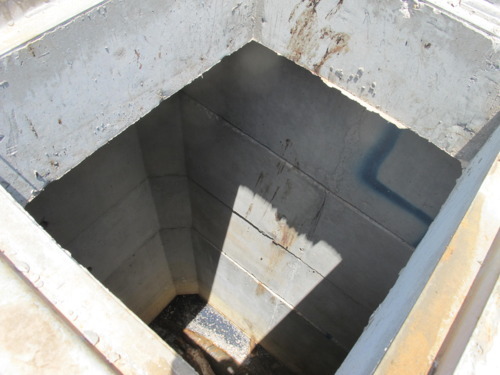
Since March, we've seen less of those atrocity videos, because the rebels either got more civilized, ran out of victims or steam, or became more discreet about their abuses. Chivers' next finding suggests the last option is closest to the mark. A photo-based piece collaborating with Denton, it chronicles their discovery of "the rotting remains of five men whose bodies had been hidden in a cement basin on the road outside Qawalish." Again, clearly not a proper burial. The text, with one photo, is as follows:
Most of the pictures in that sequence are too gruesome to publish here. The dead men appeared to be wearing the olive green uniforms of pro-Qaddafi forces. 

There were signs suggesting they had been executed and then lifted atop the basin and dropped down this hatch and hidden away from view. One of the men had his pants bunched down around his ankles. Another appeared to have been beheaded, though the orientation of the bodies made this not quite possible to verify without entering the basin
[...]
Who were these men? Who killed them? Why? None of this was clear. A sixth rotting body was buried under one of the olive trees to the left.
More recently yet, he added this on the rebel response:
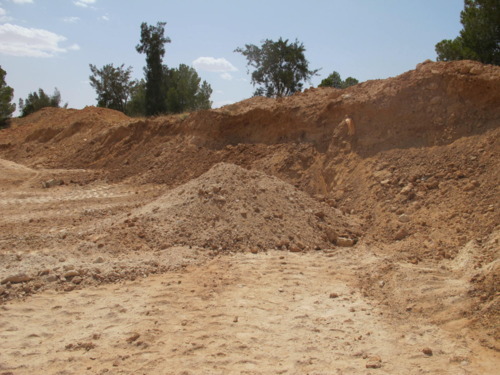
Since those reports, questions surrounding what happened to these men have found traction among other news agencies, and reports from other journalists are forthcoming. And since then the site has been bulldozed.
[...]
The corpses, apparently, have been covered with this mound of soil, below, which is a few meters away from where the remains were first found. Rebels now say the dead men were given proper Muslim burials. We’ll leave to you to decide if the grounds in these images looks like a proper, religious or respectful burial.
An Equally Predictable Denial
What happened to these men remains an open question. But official rebel sources have made their position clear, insisting that these are the remains of Qaddafi soldiers killed and hidden by other Qaddafi soldiers. The evidence for that claim is, principally, that the rebels say so. The possibility that some of rebels might have done this to their enemies has been rejected outright.
This as well is nothing new. It was the "protesters" who were well-known for using fire as a weapon against government buildings in February. But whenever charred corpses were found in those days, they were filmed and shown as victims of Gaddafi's mercenaries - soldiers burned alive for refusing to shoot innocent protesters. The world just needed to see the horror for themselves, they explained in apology for so shocking us. When 21 soldiers were were found in al Baida, bound and with their heads blown off, the same story was given, and still accepted, despite video proof the rebels themselves ordered the killings.

Chivers also added the dumpers chose their spot poorly, the basin being visible from the main road to Qawalish. Upon simply walking up to this odd spot, "the blood stains on the concrete, and tire treads on the soft soil" were clear, along with a scrap of green clothing, and even a picture of a handsome black-skinned man in uniform, perhaps one of the victims. These things they photographed but left, and they're all gone now.

He closes with a promising sign that freedom and openness are finally, at such great cost, coming to Libya - now that the rebels are being called the government of the place by people like Barrack Obama. No more massacres, cover-ups and lame excuses, and government minders controlling the press. As Chivers and Denton saw the bulldozed area on the road days later:
we tried to stop to learn more. Our driver refused, announcing that he was under orders from the rebel military leadership not to allow us near the site. It seemed, he said, that doctors were worried that journalists might be exposed to unhealthy conditions near the rotting remains. This did not quite pass the sniff test, so we pressed. Then came a different answer — the rebel military council had simply told him, without notifying us, that he was not to take us there, and that was that. That was Saturday.
Either way, we know enough for now to know what's needed next are these things:
- The rebel authorities need to get those bodies identified,buried properly, and their families noted.
- Wherever they live, CNN should ask these families how they feel about the condolences of the new "government of Libya."
- Find out if anyone else is missing.
- Start pressing the rebels there for straight answers. Do they, or do they not, work for us? How many were killed in Qawalish and the other towns and hastily stashed around? Six only is suspiciously low.

Update August 10:
It seems Mr. Chivers and Denton saw the bodies first in the well, but not after they were removed. Between their removal and burial of whatever sort, it seems the bodies were laid out and observed by, among others, a reporter from the UK Telegraph. They reported on Jul 20, a day before I first got this thing up, a story completely in line with what the New York Times people saw. Five bodies werein the basin, no more (I forgot to check if they even mentioned the sixth guy buried under a tree). The five looked like government soldiers, and had been floating face-down. The body Chivers said "appeared to have been beheaded" was “cleanly decapitated.” The other with "his pants bunched down around his ankles" is confirmed with "the trousers of another had been ripped down to his ankles, a way of humiliating a dead enemy." There is a photograph attached to the article of some men standing around looking, with only one of the victim’s hands visible in the foreground. The site was bulldozed, the Telegraph confirmed, the burial situation unclear, and an investigation was in order.

What might prove more interesting than six killed soldiers is the separate Qala'a massacre, revealed August 7, from about 30 miles away at Qala'a. For this we have video, but no clear date or details, of 30-34 slaughtered civilians. Rebel supporters instantly asserted this was the government's work, but some say the rebels did it. I think a wee bit of study is in order, and perhaps quite a bit, if needed. This puzzle might be easy to solve.

Monday, August 8, 2011

Refugees and Human Trafficking

August 8, 2011
last edits August 14


The Scope of the Crisis
The Libyan Civil War has unleashed an epic outpouring of foreigners who had been living and working in Libya, especially from impoverished African nations. A May report by the International Center for Research and Study on Terrorism and Aide to Victims of Terrorism (CIRET-AVT) and the French Center for Research on Intelligence (CF2R) addresses this in some detail. The report (which I've written on here) estimates as many as four million (and as few as three million) have fled "the fighting."

Considering that desert-dominated Libya is a nation with a native population of only about six million, this is bound to have en effect on Libya, let along the refugees' home nations. There are also an unknown number of foreigners who haven't left - those still employed and safe, those lynched in "free Libya" and now dead - a number that's almost surely in the thousands - and those existing unsafe but in hiding in Benghazi and elsewhere, we're looking at possibly five million or more. That's a lot of damn people who the rebels felt didn't belong there.

Their employment was enabled by government-run oil funds, foreign investments, and internal stability, all of which have were stripped between the February uprising and the "world community's" follow-up blows. For the effects in Libya and the region I'll cite the CIRET-AVT/CF2R report [English-language PDF], written by their top people after a month-long visit to both halves of Libya.

The flight of foreign communities
Before the revolution, Libya, although totalitarian in nature, offered employment and income to its population and many foreigners, including Africans and Asiatics. Libya has for some time absorbed the unemployed of neighbouring states. Many immigrants worked in the petroleum and construction industries. About 3 to 4 million foreigners left the country due to the pressure of the events.

- 1.5 to 2 million Egyptians,
- 1 million Sahel, West and Central Africans,
- 600,000 Sudanese,
- More than 200,000 Moroccans,
- More than 100,000 thousand Tunisians,
- 60,000 Palestinians,
- 10,000 Algerians,
- As well as many Turks, Philipinos, Sri Lankans and other Asiatics.

The civil war therefore caused the return home of many economic emigrants, even though their countries have high unemployment rates. This exodus risks aggravating significantly the situation in these countries; they lose a source of revenue - that income sent home by the emigrants - and see return home those who will swell the ranks of the unemployed and disaffected. This will increase the number of those being smuggled to Europe, since the Gulf countries are not interested in immigrants from some of these countries, even though they are ‘brothers’ and ‘revolutionaries’, they prefer workers from Asia.

Another consequence of the departure of these foreign workers, who contributed to economic functions in the country, is that this has put it into a state of 'hibernation.' Construction sites, hotels, restaurants, businesses and service stations functioning, due to lack of staff.
[p21]

"... lets remember NATO decided to intervene in Libya to protect civilians," MSF field coordinator for the Shousha camp in Tunisia, Sasha Matthews, told IPS. And it was the United Nations Security Council who decided to impose an air embargo, to prevent "mercenaries and weapons" being flown in, but it's prevented everyone else from flying out. Desert crossing are a dead end - no one is allowed to fly or sail out of Tunisia or Egypt, it seems. A Medecines Sans Frontiers video has all those who want to leave returning to Libya first and sailing from there. One Somali man's pregnant wife took off without telling him, he says, trying for Italy but dying in one of the many ships that sank in the sea.

A Dangerous Crossing
After the flood of refugees really started, a few weeks after the protests started, the deaths started racking up. Apparently 335 disappeared in a late March sinking. On April six, hundreds were missing after another capsize. Final death toll: about 250. [source] Again in early May, another ship named Abdi went under, killing hundreds. [link] And those are just a few.

It seems worth asking if ships usually sink this often, but again, we're talking about 3-4 million people moving out, nearly all by sea. Inter-Press Service News Agency reported on August 6 that the death toll had reached at least 1,800.
Just last month a Spanish NATO vessel rescued over 100 African refugees who had escaped Libya. Among the group were 17 women - four of them pregnant - and eight children. They were denied entry and shelter by Italy and Malta.

Since the start of Libya’s Arab Spring and the North Atlantic Treaty Organisation (NATO) air campaign against Muammar Gaddafi’s regime, more than 1,800 men, women and children have reportedly drowned trying to cross the Mediterranean Sea in heavily overcrowded, unseaworthy boats.

The Italian coastguard recovered 25 bodies of sub-Saharan African refugees Monday, who choked to death in the engine room of a boat crammed with nearly 300 people. The boat was trying to reach Italy’s southern holiday resort island of Lampedusa.
Others have died from on-board violence, and in one strange case in May, several were reportedly tossed overboard by superstitious passengers hoping to end a storm. The ship went down anyway. All told, that is less than 2,000 out of 3-4 million, not necessarily that horrific, all things considered. It's a death rate of at most one per thousand and perhaps less than half that.

But of course, these are people we're talking about, precious, unique, irreplaceable human beings. Highly valuable, in the right hands.

Whole Vessels Disappear?
CNN mentioned it on May 10:
Hundreds of people are missing after the ship Abdi was on went down last Friday, while 250 people died in a shipwreck at the beginning of April, and two boats with 480 people between them have simply vanished, the United Nations High Commissioner for Refugees said.
More can be found with the people who prodded the high commission to check and confirm.
An Appeal to the United Nations: There May be Survivors Among the 335 sub-Saharan Refugees Who Went Missing on March 22nd, 2011.
Gruppo EveryOne
Milan (Italy), August 4, 2011. On the night of Monday, March 22nd, 335 sub-Saharan refugees, including many women and children, mostly Ethiopians and Eritreans, set sail from Tripoli (Libya) hoping to reach the Italian coast and flee from persecution. The boat, driven by a smuggler, went missing just a few hours later. A relative of two of the passengers on the boat raised the alarm by contacting EveryOne Group and other humanitarian organizations, who immediately alerted the authorities to ask for patrols to be sent into international waters, and requested the intervention of the UN High Commissioner for Refugees. Five bodies of sub-Saharan refugees - two boys, two women and a man - were found in the sea with gunshot wounds according to Libyan authorities and local NGOs.

They were part of the group of 335 refugees, predominantly Eritrean and Ethiopian, who left Tajura (Libya) on 22nd March and have not been heard from since. It is not clear who may have murdered the refugees and the authorities have not provided photos of the bodies. EveryOne Group, which was in constant contact with the families of some of the missing refugees (both in Eritrea and Europe) in the weeks following the tragedy collected together some reports according to which there were survivors of the attack, and these people had attempted to contact relatives abroad. The survivors are said to be in Libya, in a prison or a detention camp. EveryOne Group released news of these reports and has repeatedly contacted the Libyan authorities and the United Nations, asking for a search for these survivors to be made.
Smugglers Put in Charge of humanitarian evacuation? 
Under what kind of authority was that approved? Well, it seems, the local authorities where allied lynch mobs had first pushed these human cattle to want to leave. I again refer to the CIRET-AVT/CF2R report, page 14, "Irredentism of Eastern Libya"
Finally, a little known fact, Benghazi has become, over the course of the last years, the epicentre of African migration to Europe. This human traffic was transformed into a vast industry, turning over billions of dollars. A parallel mafia type world developed in the town where the trafficking was deeply rooted and employed thousands of people in all areas, not without corrupting the police and officials.

It is only a year ago that the Libyan government with the assistance of Italy was able
to control this cancer.

With the disappearance of its ‘business’ and the arrest of a number of its leaders, the local mafia was ready to finance and to support the Libyan rebellion. Numerous gangs and members of the underworld emerged from the shadows and are known to have carried out punitive assaults against the African immigrants in Benghazi and its suburbs. Since the start of the insurgency hundreds of immigrant travellers, Sudanese, Somalians, Ethiopians, and Eritreans were robbed and murdered by the rebel militias. This fact is carefully concealed by the international media.
That benefitted the rebel cause greatly - the dead and captured black men became temporary "proof" of the Afro-mercs who signaled Gaddafi's eminent demise. In return, a cut of the exit fees, and perhaps on the side, a few boatloads delivered onto some slave market for tens of millions a pop. A cut back to the rebels to help them buy guns? Who knows...

One Troubling Actor
Ali Abdelaziz al-Essawi is currently Vice-Chairman of the Executive Board of the rebel NTC and was previously the TNC's minister of Foreign Affairs, and one of the highest-ranking member of the council (Wikipedia). He played at least some part in spreading and giving credibility to the blood libel that Gaddafi was hiring mercenaries from black Africa, and tasking them with beastly acts of savagery. The UK Guardian's strangely credulous article from February mentioned this:
Essawi told al-Jazeera: "People say they are black Africans and they don't speak Arabic. They are doing terrible things, going to houses and killing women and children."
Maxmillian Forte also cited that quote in an excellent article from April, as well as this decade-old classic from the regime insider, from the time of horrific nationwide race riots in 2000 that killed hundreds, including black-skinned diplomats:
the then Minister of Economy, Trade, and Investment -- one Ali Abd-al-Aziz al-Isawi -- stated about the African presence: "it is a burden"; and then he added this: "They are a burden on health care, they spread disease, crime. They are illegal."
For this older quote, Forte cited this UN Watch demand for Gaddafi's Libya to end its systemic racism against Blacks. Violent protests and lynchings started one year later to the day, the racists took over half the country, and won instant support from UN Watch (see here, here, and here, for starters - the last specifically endorsing al-Essawi on the "hired guns" paid to "massacre," just ignoring the racial element of it). And the Security Council of the UN they try to keep in line did everything it could to allow and encourage the army of the lynch mob in its bid for full takeover, with no protest from UN Watch. The real problem they have was never with racism itself, it seems. This is what China's calling "Human Rights Imperialism," and the gripe was with Gaddafi. In both cases, they used the racism of those like Essawi - within the regime or without - to injure the Jamahiriya.

At any rate, we see a consistent pattern with al-Essawi: whenever riots boil over, cause or effect, he's there to fertilize the public mind with paranoia. This spurs greater violence and bloodshed, chasing off the unwanted blacks, troubling and burdening the regime, and creating an immense rush of business for those who profit from the misery of others' displacement. Just what Mr. al-Essawi or his business associates might gain from the latter is something we cannot know.

Sunday, August 7, 2011

Dr. Moussa Ibrahim, August Press Conferences

August 7 2011
last update Sept. 14

Dr. Moussa Ibrahim, the spokesman of Libya - real Libya, not made up rebel Libya - has some worthwhile words on the recent and future, given at still-regular press conferences.  Despite increased pressure to mute Tripoli, he is still able to post press conferences, usually a couple of days behind, on his Youtube channel.

And I have some good posts coming up, but not ready yet. Ergo, this filler. (even then, I can't claim to be following or understanding the recent chaos on the Benghazi side).

August 3, Tripoli, English:


He promised a trip to Zlitan, and reported the next day from there with some press in tow.

August 4, Zlitan, Arabic:


August 4, English - hard questions throughout, but strongest near the end:


Sept. 14: Bit of a throwaway post, but there were more August press conferences. One about the 10th was from Majer, near Zlitan, asking whether the 33 children killed were "a legitimate target." By the end of month he was fleeing, later speaking defiance by phone to obscure media outlets. He continues to stand up for what he feels is right, and will likely be dead before long, mutilated I'd guess.

Friday, August 5, 2011

Libya's Free Market Future

May 11 2011
last edits August 5

The Future Path and the Basic Problem
Gheriani tried to assure me that the new state the rebels envision would be led not by confused mobs or religious extremists but by “Western-educated intellectuals,” like him.
- Jon Lee Anderson, New Yorker, April 4

This message from rebel Transitional National Council spokesman Mustafa Gheriani is re-assuring in a way, ominous in another. The mobs of "pro-democracy demonstrators" the world is so excited to protect are a troubling lot, with the urge to burn soldiers and lynch blacks entirely too close to the surface of their hearts, oozing hatefully with the slightest scratch of a Twitter rumor. Known al Qaeda operatives took the lead in Dernah and apparently set up an Islamic emirate (quickly recalled and denied). Some rebels looted, raped, tortured and killed for fun. All of this was part of the overall takeover, but not part of the long-term future, it's hoped by more level heads.

That future path will surely run to the West, and will be informed by base material and geopolitical motives - obviously oil, but also its amazing water system, the central bank and so on. The whole Libyan state is public-sector, government run, with proceeds that took Libya from among the poorest countries in the world to the richest (per capita) in Africa and with the highest living standards by far. There's a certain level at which it's obvious that this is the crux of the decades of demonization, sanctions, the epic framing of Libya for Iran's destruction of Pan Am 103, and so on. Too much shared with the people, not enough with Wall Street.

A vendetta against Gaddafi's unusual economic system could also help explain NATO-types' approach to this "humanitarian crisis." It's costing more lives in "stalemate" than Gaddafi's repression likely would have, but it does have the opposite outcome for who runs Libya. Coincidence?

Obvious air support for the rebels (or is it the rebels are obviously NATO's ground troops?) is masked always as a simple measure to protect innocent civilians. An obvious assassination atempt that kills four innocent civilians, three of them under two years of age, was a simple part of the aforesaid mission, targeting command and control, and communications, intelligence, morale, whatever. It's all obvious, just too much so to bother explaining. Doublespeak is what it's become.

The French Connection and February 17 Movement
All this when much evidence suggests the spontaneous revolt was planned in advance with outside (mostly French) help. Nouri al-Mesmari was Libya's protocol minister - Gaddafi's C-3PO - until he resigned in protest at the shooting of protesters on the Day of Rage. He was in Paris at the time, having gone there for some reason four months earlier, in between meeting with French secret service and leaders of the planned rebellion.

Alex Lantier at the World Socialist Website describes al-Mesmari as "a prominent pro-free-market reformer in the Libyan ruling elite." In a video interview shortly after resigning, he revealed he is the son of a monarchist minister, who's long been trying to get back nationalized family wealth.

Another leftist at the Monthly Review, Vijay Prashad, describes the top leaders of February 17, three of whom allegedly met with al-Mesmari: "These men (Fathi Boukhris, Farj Charrani, Mustafa Gheriani and All Ounes Mansouri) are all entrepreneurs."  [5] As the quote above shows, their spokesman Gheriani, the one not on the Paris trip, at least-considers himself western-educated.

Rebel Leadership and Privatization Fixation
Those entrepreneurs were arrested, aside from Gheriani, in the days before the war started. From there, he and others then became important in the Interim Transitional National Council in Benghazi. Vijay Prashad wrote of two of the more important and prominent among these:
The Benghazi council chose as its leader the colorless former justice minister Mustafa Abdel Jalil. Jalil's brain is Mahmoud Jibril, a former head of the National Economic Development Board (NEDB). A U.S. embassy cable from May 11, 2009 (09TRIPOLI386) describes Jibril as keen on a close relationship with the U.S. and eager "to create a strategic partnership between private companies and the government." Jibril's NEBD had collaborated with Ernst & Young and the Oxford Group to make the Libyan state more "efficient." Jibril told the ambassador that "American companies and universities are welcome to join him" in the creation of new sectors outside hydrocarbons and that "we should take him up on his offer." His Ph.D. in strategic planning from the University of Pittsburg is useful in this context.
More comes to us via the Willyloman wordpress page, May 10: Al Qaeda Linked “Rebels” in Libya Need More Money… So They Come to Congress. It says in part:
The money poured in already by outside sources looking to cash-in on the wholesale privatization of Libya like the 20 million ponied up by Great Britain, is running out. Or so claims Ali Tarhouni, Washington’s man on the inside of the Interim Transitional National Council (TNC). Tarhouni is an American professor of economics at the University of Washington but he’s taken a bit of a leave to serve as the TNC’s minister of finance, oil and economics.

Now he has returned to Washington * from Benghazi to pass the hat so to speak in D.C. looking for access to the 35 billion or so of the Libyan people’s money that Hillary Clinton [sic] froze. You see, he want’s to use the people’s money to return Libya back to the good old days of the corrupt monarchy, the system that was entrenched in Libya before the revolution in 1969 led by one Moammar Gadhafi.
*(To clear up some confusion - the Washington of that University is the state in the northwest. "You dub," as it's called around here, is in Seattle.)

This American theft ("freezing") of Libyan riches is a shameful and cruel episode. By fiat of piracy Obama withheld this money - over $5,000 for each Libyan man, woman, and child - until they join the rebels (whom we're willing to pay) or come under their rule. It was deceptively called Gaddafi's personal fortune, siphoned from the Libyan people. An equal or larger amount was also frozen by various nations outside the United States, turning the people of Libya into something like Human shields in a socio-economic sense.

To explain his trip back to the US, finance minister Tarhouni told MSNBC:
“We’re faced with the same sanctions as Gadhafi,” he said, referring to U.S. sanctions that have frozen more than $34 billion of Libyan government assets, in addition to U.N. and European sanctions. “I don’t have access to any foreign exchange to cover any purchases, open lines of credits to merchants, so that’s a very challenging aspect to what I do.”
An older article I missed had mentioned Dr. Tarhouni in his American acedemic connection - Dr. K. R. Bolton, Foreign Policy Journal, Feb 26
“Most participants argued for privatization and a strong private sector economy.” That is a statement culled from a report of a panel discussion entitled “Post-Qaddafi Libya: The Prospect and The Promise,” organized by Washington’s Center for Strategic and International Studies in 1994. Dr Ali Tarhouni stated at the conference, “with privatization, entrepreneurs will reach out and get involved in regional cooperation by searching for markets.” Is that what the long-planned, well-funded “spontaneous revolts” now toppling regimes like a house of cards is actually about?”
The handy thing is how many talking heads and think-tank experts there are to back these guys up. "Of course privatization is the answer! Gaddafi was against it and he was evil! Had mercenaries on Viagra rape kids! Just look at the state Libya was in before under Gaddafi's Green Book sytem!" Indeed, take a look - ask for specifics. Environmentally speaking, do we need more bio-diversity, or more monoculture? Why is it different when it comes to economic systems?

And let's be honest a moment - in an age of such Western economic failure, is the Euro-Atlantic community really more likely to be dispesnsers of good advice - good enough for a regime change war?  Or to be looking for some stored up financial blood to suck, via a regime change war and the plunder-by-privatization of Libya?

Tuesday, August 2, 2011

Ambassaddor Shalgham Speaks, Feb. 22

July 29, 2011
edits August 2

I recently became aware of the details of and serious questions surrounding the defection of Libya's mission to the United Nations, as explained in my article Sketching out the New Libya: Departures from Protocol at the UN. As my source, Ronda Hauben, explained, this effort was led by the Deputy Ambassador, Ibrahim Dabbashi.

His Feb. 21 defection was followed by a presentation of his roadmap to the new Libya which, as I noted there, was "not the cautious statement of a loyal servant of his government forced by events. The turns of phrase and even more the suggested actions reveal a rather advanced conception of what this crisis offered and how it should be exploited." War crimes trials, asset freezes, travel bans, trade sanctions, a no-fly zone, military action to back that up, regime change by whatever means possible if not "Arab Spring" magic. All these were conceptually tabled by Dabbashi on day six of the surprise violent protests.

These actions were based on rumors that hadn't been sorted out yet, and would be later shown to be overwhelmingly untrue. Fancy that.

On the other hand, his superior, Ambassador Abdel Rahman Shalgham, at first acted quite differently. Before mindlessly repeating the tales of massacres and "genocide," he called home and asked. He was genuinely concerned, and at least half-convinced that the government was killing lots of innocent people. But the fact that he held any doubts whatsoever of the grander charges clearly irked the outside world, as can be seen in the following video.

He's being questioned by reporters right after his deputy's rather stunning presentation. As some have noted, he behaves as if stunned. A range of crushing offensives had just been proposed against the country both he and his junior the warmonger had represented, and which Shalgham still did, until his resignation three days later.

This video below was cited by Hauben in support of a major shift in Mr. Shalgham's attitude. Watched and listened to, it strongly supports the difference. Unlike Dabbashi that day, Mr. Shalgham does sound legitimately pressed, hesitant, confused, but still intrinsically sane. For the sake of history, here is the video and my transcription, or the best I can do with his garbling accent and mood and the other noises and excited cross-talk.
Update, Aug 2: I thank reader "quiestbml" for helping fill in some previous blanks, errors, and formatting. I used most of these recommendations. The rest can be seen in the comments below.


His English comments begin only at 1:53 and proceed slowly, underpinned with deep sadness, fatigue, and later annoyance, and are about as follows:

What I will say - I was in Libya, a few weeks ago. I had a meeting with my friend, the leader, al-Gaddafi. We are friends, from the school. I come from a tribe to the south of Libya - that he's my friend. I can criticize him, I can't attack him.

Q: Which tribe?
Hotmon/hotmal [ph].

What I will say - there are three phenomena - that, they don't exist anymore. Slavery, occupation, colonialism, and autocratic regime. I spoke with everyone in Libya. Secretary of parliament, and the chief of cabinet of colonel Gaddafi, [name], everyone. I told them you should stop bloodshed. [long pause - finished?]

Q: What's your personal position from the bloodshed? You're talking about bloodshed in your country. What's your personal position?
I am against death.

Q: Are you calling on the security council to take action too?
Q: Did you ask the leader to stop the bloodshed? Who is responsible?

I will try to speak with him first thing.

Q: Is Gaddafi responsible for the bloodshed?
[nodding no] I don't think he is off - he is very brave. [raising voice to cut off another leading question] I think, he is very brave. I think that he'd want to have a very ... clear and brave ... decision.

Q: Are you worried about the no-fly zone?
[nodding] No, no no. I spoke with ...

Q: What can he do?
No, I think Muammar Gaddafi is [able to decide?], he can decide, he can decide.
Q: Is he recruiting mercenaries? Mercenaries?
No, that's not ...
Q: he's not flying in mercenaries?
No, no, no, no. [he was right]

Q: Would you ask the leader to step down?
[nodding with increased annoyance] No, I ask him to stop crackdown, I ask him to change, I ask him for a constitution, for freedom, for ...


Q: Did you speak with, with him?
I tried this morning, but I couldn't.

Q: Can you clarify if in fact you're supportive of going to the Security Council, like your deputy has requested, or ...
[nodding gravely] No, no.

Q: [incredulous] You're not. You're against going ... are you against going to the Security Council?
Q: [incredulous] You're not defecting?
[nodding no] I speak to - look, excuse me, the Security Council is going to have an appeal to the regime to stop the bloodshed, this escalation?, [to abort it?].

Q: Otherwise, other measures that are requested by - the - Shal - mr. Ibrahim Dabbashi, you are against other measures?
[nodding again, negative then affirmative, yes, against]

Q: ICC?
Q: Everything? Everything. All of - everything that's ...

[nodding no again]

Q: Do you think it's - the bombing, the aerial bombing of the ...
[nodding no] It's outrageous. [name] called me yesterday, and I said to him "look, if you don't stop this I will to resign." He told me that he will invite CNN, al Arabiya, all the channels to come to the Tripoli and see on the ground the [stronghold?].

Q: So there's no aerial bombimg ...
[nodding and now walking away in frustration] No. [he was right]


Q: Thank you (repeated by many).
The Ambassador changed his tune a couple of days later, comparing his brave old friend to Adolph Hitler, and requesting the world to destroy him. Something snapped in those few days in between, and the real Abdel Rahman Shalgham, the one we see dying away here, was apparently killed off in the process. Another early victim of the Libyan Civil War, snuffed out under murky circumstances.

(may report back with specific quotes if interesting).

Videos:
Shalgam Gaddafi attacks and calls on the UN ... Arabic speech at the UN, Feb 25. Hugs are shown after, and Shalgham seems to be crying. But while speaking, clear and energetic, unlike a few days before.
Sky News, with translation:

Behavior Shalgam rejected by his family استنكار ... (Arabic, Libyan TV)

Saturday, July 30, 2011

The Life and Death of Abdel Fateh Younes

July 30, 2011

It's fairly new news and there's a chance this will the first someone hears of it, so ... it seems to be solid that rebel military commander, Libyan turncoat and suspect double agent Abdel Fateh Younes has been killed, on July 28, almost certainly by the rebels who had him in custody at the time. They say, of course, Gaddafi militiamen killed him.

His Wikipedia says so, and gives some details and sources. I presume plenty other articles do as well.
Major General in the Libyan

I suspect this is a major voctory for the rebel,NATO side, and another blow to Libya's future. This thing is getting less Libyan all the time, and that's good - helps purify it. Viva Heftar! Viva CIA!

I will scrap this whole text and put in its place the promised 'life and death of' post, when I have the time. In the meantime, comments are welcome.

Monday, July 25, 2011

Video Study: Hospital Brutality (disturbing)

July 25/26, 2011

Below is a very telling and detailed new rebel atrocity video that deserves its own post. I've not seen this before, and it seems to have been first posted on July 21 by the important Libya S.O.S. site. Nonetheless, I suspect it's old, from the rebellion's first days in Benghazi.

The on-screen title gives the locale as al-Jalaa hospital, Benghazi. This is a facility I know little about besides this tidbit from Chinese news, Xinhua, February 18:

Oea newspaper reported on its website [...] that a group of protesters killed the managing director of AL-Galaa hospital in downtown Benghazi, Libya 's second largest city. The victim's body was tortured, it added.
Why? My guess is for daring to treat the "African mercenaries" the "protesters" were brutalizing across town. That would fit what what we see below. And do remember, the evidence of foreign fighters still consists of unsubstantiated rumors - all those captured as Afro-mercs wound up being Afro-workers or loyal Libyan fighters of dark skin.

What this video shows is a hospital under what I hope is not the normal management. So I presume it's later on the 18th or a day or two after the directing manager was ruthlessly killed.

In this hospital, dimly lit, a young black man lays on the floor, pants pulled low in a fashion familiar elsewhere, and his shirt long gone. By his pants, he's a civilian, not a soldier, so most likely a foreign worker, perhaps pressed into some type of counter-protest. Presumably suspected of being a brutal well-paid mercenary, he's clearly injured, touching his head gently with concern. His hands and arms are caked with blood, and thick blood has been bubbling from his nose.

The men crowded around this casualty do not seem interested in helping him, but neither do they start out (here) attacking him. He manages to stand slowly on his own, but then they instantly grab, push, and attack him. He apparently starts trying to flee and they - about eight men in civilian and medical clothing - chase (it's chaotic). At least one "doctor" (by his blue surgical gown) waves a curved sword above his head as he follows. The victim is making little if any sounds, seems feeble, possibly drugged, or just delirious from blood loss. The whole scene is surprisingly quiet by the usual standards.

The video now, for those who can stomach it:


And the rest of the description for those who aren't sure:

When we see the victim again, it's not far away and he's down again, face down on the floor, covering his head with his hands. A blue-gowned medical terrorist is striking him hard on the head or shoulders, with a sword - it's audible - at least three blows. One man in blue then steps in, standing between the swordsman and his reeling victim, until others grab his feet and drag him down the hall since he's unable to walk out any longer. One patient (?) hits the man with his walking stick in as he passes.

One more quick sword attack I missed at first, just as he's pulled through the door into the parking lot. It looks like a forcefully placed blow by a kid in a dark sweater, probably to the left upper arm or shoulder. The "protesters" shout "Allahu Akbar!" as they get him out of the hospital into the sun, apparently their main goal - no treatment of mercenaries.

The persona non grata is tossed down, with an audible sound, onto the curb right by the brightly-colored garbage cans. He's kicked and stomped, and swiped at with a sword again, not real hard but enough to visibly cut his lower left side (?) at 1:17.

Then again a man intervenes, and there's a short edit. Next, someone starts pulling the "mercenary," again by the leg, from his shielded huddle. He sits up instead, as if snapping awake, showing a serious red slash on his right shoulder blade. He's quickly hacked again on the right side and falls back in surrender - his hands and his whole upper body are bloodied now, his hand on his belly, the spot just sliced, and his left upper arm is visibly pulsing out blood.

The men around him start to argue instead of attack; one definitely seems to be saying "enough," and at 2:05 stands over the lynch mob's prey defensively until pushed aside by the others. A few resume kicking and stomping the man, and somehow something like baking soda is splashed across him. As the barely conscious victim is rolled over, we see he's been bleeding badly all over the concrete. But his hands seem intact, and nothing's noticeably coming off. (on closer look, some of the sword strikes look more like slaps.)

Collectively, the crowd has second thoughts about where this is going. They pick him back up ... and carry him back into the hospital, it seems. The video ends there, seemingly disappointed with no guts spilled. But a powerful testimony, perhaps, to the differing interpretations of mercy in Islam.

But for all we know, he might have been killed by another mob the next day who were all "what's HE doing here?" And again, these are the monsters working for the cabal Barrack Obama calls the legitimate government of all Libyan people. Pray for Libya.

Great Man-Made River, Being Undone by Men?

July 25, 2011

I don't write so much here on the nature of the fighting in the Libyan Civil War, geeking out instead on the underlying moral justifications and the reality of the rebellion in February (and before), and only highlights of later, broader developments. But this shocking new turn is one those, and warrants special mention.

It's been seriously alleged, though details are still coming out (see below), that NATO's warplanes have started targeting Libya's civilian water system, the epic "Great Man-Made River." At right, the horse-shaped system as shown on the Libyan 20 dinar bill, from Wikipedia's entry on the "GMR". This government project provides most of Libya's people and crops with fresh water piped in from a vast aquifer beneath the southern deserts.

The portion reportedly attacked is that ending at the government-held but rebel-coveted city of Brega - approximately the horse's behind in the network above, just past the furthest reach rebel country in the east, or the horse's tail. Brega is also a major oil terminal and host to repeated NATO assaults in recent weeks, including an unprecedented July 6 taking out of fuel supplies used by the government of Libya. It's also hosted repeated rebel assaults and claims to have taken it. It's past the reasonable dividing line between east and west Libya.

Now, it's alleged, NATO's trying to turn off the water to this town. Government spokesman Moussa Ibrahim, as quoted in an AP report carried by USA Today:
"Most Libyans drink from the Great Manmade River, most Libyan land is farmed from the water, so any harm against this vital project is a harm aginst all Libyans. We believe this a very dangerous development in NATO'S attacks."
I'm not sure what he said in his full remarks (will report back if interesting), but this doesn't specify the  physical system was being targeted. My first tip-off to that effect was via the interesting Libya S.O.S.  blogspot site, and picked up by many, including by Uruknet.com. "RAPE of LIBYA : GREAT MAN MADE RIVER reason for NATO attack."
July 22 2011. A date for humanity to remember. NATO hit the Libyan water supply pipeline. It will take months to repair. Then on Saturday they hit the pipeline factory producing pipes to repair it.

Sine [sic] when is the water supply pipeline itself a legitimate target?
I don't know ... like with the oil facilities hit, again in Brega - it could be that "Gaddafi's forces" were using it to hydrate themselves during their attacks on "civilians." Who apparently don't require water?

Was it only the Brega part hit? If so, NATO isn't trying to deprive all Libya of water to pressure them against Gaddafi. That would only say all loyalists in Brega should move out and leave the plum of a prize to rot in Benghazi's orbit.  This is a rebel town now, they'd be saying, and only our contractors (French water privatizers no doubt) will be allowed to build and run the replacement system. "Illegitimate" governments don't get to do that.

Those are some first thoughts I had, anyway. On first blush, it's simply alarming. But I needed to learn more, of course.

What (it seems) Happened
The widest-run article was by AP (it's what USA Today used, and also Canadian Business.com. While relating this war crime alleged against NATO, the article focuses on rebel demands that Gaddafi leave Libya and stand trial for his own alleged war crimes. If I felt the slightest confident the trial would be fair, by the way, I'd be urging him to go and get his name cleared of the charges.

The rumors these were based on have brought on the third and fourth foci of the AP report, yet another bombardment of Tripoli to pressure the people into revolt, and an attack in Tripoli on some high officials by pressured people, which the government denies happened ("cooking gas," says Ibrahim, an "accident.")

On the GMR attack, besides quoting Mr. Ibrahim, this report says only:
NATO planes struck a factory near the embattled oil city of Brega on Friday [July 22] killing six guards, Libyan officials said.

The plant, located six miles (10 kilometers) south of the strategic oil installation, builds the huge pipes that carry water from underground aquifers deep in the south to the coast as part of the Great Man Made River irrigation project.

"Major parts of the plant have been damaged," said Abdel-Hakim el-Shwehdy, head of the company running the project. "There could be major setback for the future projects."

At least 70 percent of Libyans survive on the water carried through the pipes to the coast in the project, according to government figures.
As for the earlier attack that had required these replacements: I can't find anything yet aside from the implication by Libya S.O.S. that the pipeline factory was hit Saturday (the 23rd), following a strike on the "water supply pipeline" itself on Friday.

Until I learn better, I'm considering this one-two punch interpretation a mistake. And that would narrow the possible crime to weakening the government's ability to repair the pipeline, should it be attacked, by rebel/al Qaeda elements or NATO, in the future. And of course, they'll insist the factory was making or doing something else besides pipe work, something horrible they can't explain, related to "attacking civilians."

video: Libya / Brega: NATO bombed "Great Man Made River"factory, war crimes

It looks like the expansive grounds of a factory, not a section of pipeline spewing water. A sign above the door says, in English:
"We try to continuously
Safety First , Quality Best
Save Cost , Delivery Just"
Another large building in the complex is demolished - its frame is mostly intact, but its walls and contents are blown out across the grounds. Then the factory's purpose is shown, a huge lot of 10-foot pipe sections, row after row, hundreds at least, filmed I think after the attack, and still available. It's only if they need more than this - and in a time of war, it's possible - that their downturn in production will matter much.

So as I see it, this facility is, technically, a part of the pipeline system - its management and maintenance parts. But it's not a part that starts bleeding life-water when blown up.

For the six guards killed, if true, and for their families, the matter is more immediate.

Further Reactions, Perhaps Beyond the Mark
NATO Bombs Libyan Water Pipe:Humanitarian Disaster
NATO jets destroyed key water infrastructure near the Libyan city of Brega on Friday. The plant is located six miles outside of the city of Brega, and was specifically targeted. Six plant workers were killed during the attack.

The plant is part of the Great Man Made River Project
[...]
It is an unfortunate strategy designed to create human suffering. NATO is desperate to spark unrest against the Gaddafi regime by any means.

The irony is that this war began under the auspices of helping the Libyan people. Now they are made to suffer as part of a NATO strategy. The policy reinforces the reality that the Libyan war has as little to do with humanitarianism as the Iraq war had to do with weapons of mass destruction.
Mathaba, a Libyan-centric but independent media outfit ran a piece that added Muammar Gaddafi's own personal reaction to the new strike(s):
Mathaba has learnt that the Leader of the Revolution sent a message on Friday to members of the UN Security Council who are not taking part in the aggression against Libya, notably Russia and China, regarding the NATO European terrorists targeting of the pipe factory of the great man made river in the city of Brega, where pipes are manufactured to compensate for damaged pipes of the river, the only source of drinking waters and irrigation for the people of Libya.
(bolding mine - actual damaged sections or hypothetical ones?)

Russia's pre-eminent Pravda.ru website pulled no punches here:
A NATO terrorist attack has hit a water pipes factory in al-Brega, murdering six guards, this being the factory which makes pipes for the great man-made irrigation system across the desert which brings water to seventy per cent of Libyan homes, according to sources in Libya. The factory was hit after the water supply network was destroyed on Friday.
The source is the same Libya SOS report, so it's not a support. But Pravda added:
NATO has committed another war crime, targeting a civilian water supply network which brings water to 70% of Libya's population, according to Pravda.Ru sources in Libya. The general manager of the Man Made River Corporation which controls the pipeline reports it was hit in a NATO strike on Friday. In another clear violation of the law, a consignment from Italy of 19 000 AK-47's was caught in Ajdabiyah by the Libyan authorities, according to Libyan military sources.
[...]
If NATO's contribution to protecting civilians is bombing their water supply then the international community will respond to this heinous war crime, whether or not the politicians do. Will anyone please do something about this horrendous war crime? Or will we all sit back while NATO destroys water supply lines, a civilian structure? Is this protecting civilians or is this an act of revenge because NATO is losing?