
last updates October 16
Under and Over Rebel Control
Az Zawiyah (لزاوية الغربية) is one of Libya's larger cities at around 200,000, and home to one of its two most important oil refineries [wikipedia]. Just 30 miles from Tripoli's gate, it was the closest of the cities that briefly fell to rebel forces in late February, and in that regard the greatest threat. It was sternly re-taken in early March, and has remained in government hands since (not for a lack of rebel attempts to re-take it).
The mainstream media's collective account of the initial uprising in Az Zawiyah seems to be missing some key parts. By and large, the western narrative only picks up with any interest on the government threat in early March. Before then it was just another city that rightly came into rebel hands by the magic of Arab Spring idealism, and witnessed a golden age of freedom and peace before the re-conquest.
Not everyone agrees, even outside Libya. The French CIRET-AVT / CF2R report of May was based on a month-long fact-finding mission, by six terrorism and intelligence experts, to both sides of Libya. The report shared their findings on the period between the fall and the government re-seizure of Az Zawiyah (from the English report):
The insurgency in [az Zawiyah...] was planned and co-ordinated, and was neither peaceful nor spontaneous from the outset.More, as translated by National Review Online):
The ‘active’ demonstrators were only about 300-500, the majority Libyans - amongst them a number returned from abroad - but also according to the Police, Tunisians and Egyptians. From the start of the events, they entered the town and centre, taking hostage some of the citizens with them.
During the three weeks [that the town was controlled by the rebels], all public buildings were pillaged and set on fire. . . . Everywhere, there was destruction and pillaging (of arms, money, archives). There was no trace of combat, which confirms the testimony of the police [who claim to have received orders not to intervene]. . . .I haven't seen much to confirm the worst of that, nor to rule it out. Another video shows locals speaking in April with CCTV reporters about the arson and mayhem under rebel occupation, partly confirming the French mission. It was, as we'll see, an ugly time. For comparison, here is a splendid video of the city in peacetime. This has a few useful views in establishing where later videos occur, but mostly serves to show what was there before the rebels started a war in late February (if az Zawiyah followed the general pattern across Libya).
There were also atrocities committed (women who were raped, and some police officers who were killed), as well as civilian victims during these three weeks. . . . The victims were killed in the manner of the Algerian GIA [Armed Islamic Group]: throats cut, eyes gauged out, arms and legs cut off, sometimes the bodies were burned . . .
Another and more cynical view of Zawiyah after its re-conquest by the authorities was found there by the team from Sky News. They were allowed the film there, and showed wounded buildings (all by Gaddafi's mortars and rockets), draped again in green flags, healing green streamers, and portraits of col. Gaddafi to show the city's acceptance of his rule. A small group of a few dozen pro-government demonstrators wass shown, but the correspondent/narrator, Stewart Ramsey, said in his low, grave, unamused tone: "There are 200,000 people in Zawiya. We're not convinced this dozen [sic] actually come from the town itself."
Ramsey focused on the mosque used as a headquarters by the insurgents, later demolished by the government, and the graves of the fighting's victims in the central garden, later dug up. While Zawiyah might seem happy to be past the troubles, beneath it, the government was "trying to erase history in this place."
And for a taste of the uncertainty over how that deadly conflict began, consider the Wikipedia entry for "the battle of Az Zawiyah." It says the "battle," which didn't end 'til about March 10, "began on 24 February, when Libyan troops loyal to Gaddafi attacked a mosque where protesters were holding an anti-government sit-in." Protesters simply communicating their desire for change, as opposed to actually overthrowing, met with brute force. A familiar story.
The Feb 24 attack was also described there as being waged "on the city," which by implication had somehow become enemy territory (free of government control) prior to that. After looking into it, I think this AP report of Feb 24 is closer to truth:
Militiamen and pro-Gadhafi troops were repelled Thursday when they launched attacks trying to take back opposition-held territory in Zawiya and Misrata, near the capital, in fighting that killed at least 30 people.How the Battle was at Least Set-Up to Happen
Before or after the day, the 24th is a natural enough time for protests near the capitol to rise up. They might be simply emboldened by Benghazi and all Cyrenaica falling, a process completed and known by Feb 23 at the latest. Nationwide, by Tripoli's account, the deaths on both sides occurred almost totally where "protesters" tried to seize weapons from government facilities. reflected in R. Breki Goheda’s video - how protesters became an army of sorts and how they came to hold cities for however long they were able. The video says, without giving a date:
In Az Zawiya, 40 km west of Tripoli army bases and ammunition depots were attacked early morning, and security forces were caught off guard. Attackers brought light and medium arms and tanks into the square of the city, and the number of people in the square rapidly increased. More tanks and anti-aircraft [weapons] were brought in. [a number of them are shown being admired and played with].A decent quality video is shown for the digging-in segment, which I used to double-check if this could be pegged to Az Zawiyah. Indeed, I could find the central square and it's a perfect match for the screen grab at upper left, using the pivotal mosque (which is actually no longer there - see this post). The view is roughly south, towards the the central park, a tree-and-fountain-filled awesome little place.
They began distributing weapons in a manner that would enable them to challenge any incomer. The cover of the tanks’ cannons demonstrate that they were never used before. [shown for a tank and an apparent anti-aircraft gun]. The video displays that the inhabitants of the city were behaving casually in the absence of security forces or soldiers. The following day, armed rebels began digging trenches, and the square was turned into a heavily armed fortress, with the contribution of Libyans and foreigners. [A man is shown holding aloft what looks like a large bar of gold - looted?].
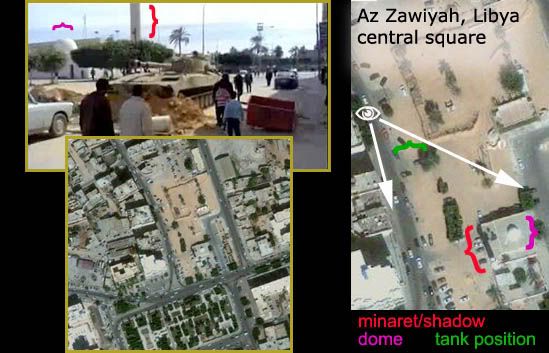
The "protesters" had become well armed somehow, and clearly by the end of February at the latest had come into control of the city, requiring - really, requiring - a government response. Those questions - when and how certain people of az Zawiya came to hold the city and to be an army, will be found in the events of the second half of February. I will draw on the Wiki, a few other sources, and a lot of direct evidence - online videos of the day's events themselves.
Like most, I can't understand Arabic, so my observations of some redordings (especially the ones with addresses and sermons) will miss valuable clues about what was happening between the scenes, and maybe behind them.
Chronology: Feb 18-23
The earliest protests I can find are on the night of the 18th, already three days into the national uprising. This is shown in a Youtube video, and at least one other. (and another gives the same as Feb 19, but I'm going with that one forgetting time zones) There is chanting in the center of town at night, and a few kids loudly striking with metal implements at a 12-foot high metal-framed picture of Gaddafi. The second video has an edit just as something kills their vibe, cuts back to brief chanting again, some other unclear noises, and then cuts for good as they start to disperse.
Protests are shown again on February 20, again at night, and in a different, more permanent mood. They're camped out, not dispersing. There's lively chanting, mellow fires of the toasting marshmallows kind. Many children are present, and it seems pretty nice.
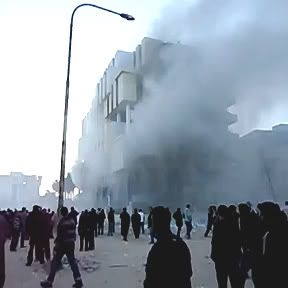
Feb 21-23 shows a strange absence of shared footage or news that I've been able to find. What happened in Az Zawiyah those days? It can't likely be a massacre of protesters, or anything remotely like it, or we'd have seen and heard about it.
The "Battle" Starts: Feb 24
Wikipedia's page says of the events of this day:
The battle began on 24 February, when Libyan troops loyal to Gaddafi attacked a mosque where protesters were holding an anti-government sit-in. The troops opened fire with automatic weapons and hit the minaret with an anti-aircraft gun. After the attack, thousands of people rallied in Martyrs' Square by the mosque shouting “Leave! Leave!” On the same day, anti-Gaddafi forces repelled the attack on the city.Three sources were cited, none terribly useful. But this is the mainstream narrative - a peaceful protest, met with brute force, which only made a limited attack then melted away in the face of chanting. The rebel propaganda site feb17.info posted that day an account with a little more detail:
Zawiya – as we reported earlier army units and militiamen loyal to Muammar Gaddafi attacked a mosque where protesters were holding an anti-government sit-in. Ten people were killed and around 150 wounded, according to a doctor there. Rebels had been camped at Souq mosque for days. Soldiers opened fire with automatic weapons and hit the minaret with an anti-aircraft gun, a witness said.

That report was coupled with the photo inset at left, possibly from the same town and same day, or earlier yet, showing rebels driving at least one tank already. They also held plenty of machine guns at least by this time.
Goheda's video said the az Zawiyah arsenal was formed following an early morning raid on an arms depot - an attack, obviously with a few starter weapons. But the rebel sources and their supporters cite defections, where units just brought the equipment they themselves had "liberated" from the government. While armed raids are well-evidenced in other spots, and it might be a factor here, I imagine the latter is at least partly true in this case. I had seen a video - given as Feb 24 - of apparent defectors, in fatigues, and some jeeps being cheered by rebel crowds, reportedly after joining them. I lost the link, and can't re-locate the video. It seemed to be at about mid-day. (10/16: I just stumbled across a newer Youtube posting of it)
A contemporaneous video shows protesters (but no defectors) returning - from somewhere apparently to the south - to Az Zawiyah's main square in a large mass. They now have many guns - pistols, automatic rifles - and plenty of ammunition seized, judging by the unrestrained celebratory fire and clearly giddy disposition. It's an interesting video, showing lots of life as it wanders around the square, well-filmed, and uploaded on February 24, so it can't be any newer than that. (seems to be early afternoon)
So the peaceful protesters camped out at the square were either already armed as they came under attack in their "sit-in" on the 24th, or managed to get armed quickly despite the injuries and deaths incurred in the brutal offensive that then just faded away and let their weapons go. One dead and bloodied rebel is shown in that video, carried among them as they came back. Obviously he was the one who was just sitting there protesting, and not on a weapons raid to a base outside town. More weapons can be seen in this view of apparently the same procession - at least one grenade launcher amongs the rifles, swords, hatchets, clubs, and fists. There's smoke in background.
At another point in the day, an apparent firefight occurred at the square, with one wounded carried back to the semi-sheltered area the camera was. As usual, the enemy is never seen, and no one else seems terribly worried, many standing fully exposed in the street for no clear reason. At another point (mid-late afternoon), a shrill and emotion-filled sermon with heavy use of "shabab" (youth) is delivered in the central garden.
At the central morgue (as labeled, in Italian), one dead person shown and many, many, others wanting to see. Another video of this date suggests victims on one side or another with long smears of blood on the hospital floor. At night, there are burning vehicles in the square, possible looting and mob violence, seen from a high point and unsteady. It looks insane, much shooting but no battle, shouting and whistling. Most people mill about, some dart between them on mini-missions we don't know. Setting fire to a building along the square - there are people inside (see 5:20). Sound of a tank driving around? (4:40)
Feb 25 to 28
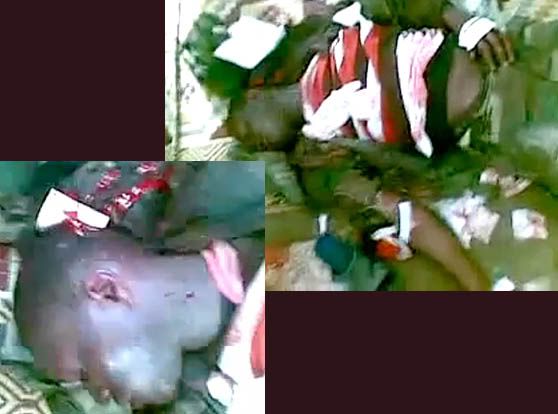 A video posted February 25 shows captive government soldiers ("mercenaries" - see the idiotic description): one black man laying dead (head-shot, see right, and below) and others of Arab complexion injured, tended to and filmed in a makeshift rebel hospital. This suggests the local hospital staff hadn't defected, as was the case in Misrata and Benghazi. Bad sign - the city was not theirs, only the square and certain homes and such.
Also, is it just me, or does it look like the dead soldier - the black one - was injured in the hand and/or upper body, bandaged up, then shot again in the head? And what is that, a business card inserted?
Also on the 25th we have numerous graves being dug by the rebels right in the main square's dirt, shunning the usual routes to get people buried within 24 hours, it seems, keeping it all to the area they control. Later mass graves were found there, as shown in another video - somewhere outside of downtown in a large field - perhaps near where the weapons were secured ... one victim's hand (black-skinned it seems) was left sticking out of the ground in a grotesque gesture. It was blamed on Gaddafi.]
The same day - early afternoon - a smaller number of rebels not armed at the moment that I see were recorded at the burial of the previous day's dead, again in the central garden. After a short and fiery sermon from the Imam, they march out to make more martyrs, shouting "Allahu Akbar!" No security forces are yet seen, but they must be out there. The building burnt on the 20th is again visible here.
The 25th has video of a march, a stationary gathering, smoke in the background, and a night rally. No repression shown, nor detailed notes yet. Recalling the CIRET-AVT/CF2R report of citizens taken hostage, one video of the 25th is of interest: Mercenaries in Zawia: (click "Kadin" to view). I'm not sure what the hell's going on here - the mercenaries may be the guys at the video's end, in a small trashed room in the mosque compound.
February 26 started out with a rousing address at the square's north end (it I have the spot this was shot right, it's shortly after sunrise). The many green banners still hanging from the (residential?) buildings behind the speaker and interesting, and I think he addresses the things. Wikipedia says later in the day:
On 26 February, government forces opened fire on anti-government protesters and Egyptian migrant workers. By this point, most of the city was under rebel control — however, security forces controlled surrounding areas and had set up checkpoints on the outskirts. In addition, some government militia and security forces were still present in the city and at least one tank was seen. 24 rebel fighters were killed during the two previous days of fighting.On Feb 27, the video posting says, heavy weaponry was on display - tanks and anti-aircraft guns. Another video that might be the same day. This looks like the arms bazaar Goheda showed, and nothing earlier really does. Half an army seems to have passed through and just left their stuff. Another video of Feb 27 shows an aggressive still rally, with hundreds holding aloft weapons - swords, clubs, hunting rifles, strictly. All professional gear - that perhaps acquired the same day, and that held for days already, is kept from view. Another is the same, protesters raising swords, sticks, and an axe. Coincidence, or coordination?
The same day, according a LiveLeak video posting, "Libyan youths close the last regime outpost" in the city. A crowd of young men in a building complex are chanting aggressively and throwing rocks at one of the buildings. A door and other debris litter the ground, and at least three cars and a pickup truck are burning fiercely. At the end, semi-automatic gunfire is heard popping just as the video cuts. That the video ends there supports my guess is it was from the rebel side.
The wikipedia article, from a few collected sources, gives this dramatic and illogical narrative for February 28:
On 28 February, government troops conducted a counter-attack against the city with 200 soldiers coming in from the east, supported by snipers, tanks and artillery. The first attack came just after midnight when loyalist soldiers tried to come through the eastern city gate in pick-up trucks. The attack was repelled. In the early evening, a second attack of three more trucks tried to break through the west gate. Two of the trucks were destroyed. At the same time, six more pick-ups again attacked the eastern gate. Two were captured by rebel forces. During the clashes one government tank was damaged by a rocket propelled grenade. After six hours of fighting, government troops were unable to reclaim the city. 10 soldiers were killed in the street fighting and 12–14 were captured, of which eight switched sides and joined the rebels.The video record, as far as I've seen, shows none of that, nor even the aftermath. All that I've noticed is victory celebrations. In the daylight hours, we see jubilant crowds under the new/old (monarchist) flag, showing their temporary freedom from Gaddafi in a nicely varied video. An overview of the main square, looking south to the central garden area, shows one tank among the crowd, described elsewhere as "Captured," in the government-led fighting against the city. Just where their other tanks and arsenal were parked isn't clear.
At night on the 28th, after the alleged second wave attack, a massive crowd fills the square, waving the flag. A child is held aloft in the crowded square shouting Allahu Akbar! Four days into the "battle" and it seems unquestionably won, with only the furtive or overpowered attacks described above - allegedly - slowing them down a little. It would be a few more days before the battle started afresh, now that the rebels had set it up by stealing another city.


