Warning

Warning: This site contains images and graphic descriptions of extreme violence and/or its effects. It's not as bad as it could be, but is meant to be shocking. Readers should be 18+ or a mature 17 or so. There is also some foul language occasionally, and potential for general upsetting of comforting conventional wisdom. Please view with discretion.

Monday, November 20, 2017

Daraya Sarin Attack, Feb. 15, 2015

November 20, 2017

Toxic chemicals were launched in Syria near the Damascus front-lines on Feb 15, 2015, leading to suffocation cases. No one died in the incident, but it seems one victim came perilously close - sarin was later confirmed as the poison, supposedly given up by the regime, and not publicly used since August, 2013's Ghouta massacre.

But the opposition never announced it. The victims were Syrian soldiers, apparently attacked by Islamist fighters they were closing in on. It's not a unique case - Soldiers have been killed by terrorists' chemicals from December 22, 2012 (also in Daraya) to at least August, 2016.

A December, 2015 OPCW report relates allegations brought to their attention by the Syrian government, and the OPCW's own findings upon review. (PDF via Jean Pascal Zanders' blog The Trench, and now via ACLOS, since the UN and OPCW don't make it available, for some reason...) Some attacks also targeted or affected civilians, but the incidents lodged and assessed (12 in total, between April 2014 and February, 2015) primarily used caustic choking agents on soldiers of the Syrian Arab Army, in 4 locations around Damascus, with some seriously affected and a few deaths.

But this unusual incident of February 15, at least, involved sarin, of a kind that local terrorists had. 

It was in Daraya, southwestern Damascus suburbs, near the Sayida Soukayna Shrine. A group of soldiers was spread out near the front-line here, with some inside a certain blasted building around noon. A mysterious munition landed inside one of the rooms and caused noxious smoke with a smell "like burning nylon." Rats died, "shivering and screaming" as the soldiers succumbed to varying degrees and retreated to a medical center some distance away.

As the report says:
"The  affected  soldiers  assisted  one  another  in  retreating  from  the  impact  area  and  received  general  supportive  care  at  a  forward  medical  point  before  being  evacuated  by  ambulance  to  a  military  hospital some distance away (Hospital 601)." 
The path as reported to them is shown on a map in the report (cropped here). They took that red path north, probably on foot, for a total distance of about 880 meters before reaching any help. Considering the extreme exposure (see below), it's likely some couldn't walk, at least needed assistance. In fact, the most heavily-exposed soldier was unconscious and had to be carried. Perhaps they did have a vehicle and drove.  

At least 4 soldiers suffered notable exposure, with symptoms including,  as the OPCW report lists: "blurred  vision, teary   eyes,   runny   nose,   dizziness, headache, breathing difficulties, mild fatigue, and nausea." One badly Original Syrian blood tests at Military Hospital 601 suggested sarin exposure or similar, and the OPCW was later called to have a look.

The OPCW reviewed documents, interviewed the affected soldiers, and obtained DNA samples from each. The DNA analysis "established a link between the blood samples collected and casualties for this incident." Then they sent that preserved blood to a single laboratory on November 9 (transferred  to  a  designated  laboratory (as selected by the Director-General) for analysis), with results back on Nov. 27 "The results of the biomedical testing indicate evidence of sarin (or sarin-like agent, for example, chlorosarin) intoxication." 

So they were exposed, and have this consistent story of how, But the OPCW stops short of confirming that's actually how; they were unable to verify the chain of custody for samples at every step, and were "unable to link the analysis results to the incident described" and note a lack of "immediate notification to the OPCW," hampering their ability to get fuller detail. The pieces are all there, but who knows? It's left open for someone to suggest, and others to blandly accept, that the results were engineered, just to smear the opposition and try to blame them for other uses of sarin.

There's no mention of the delivery device - it's as if they never found it, which is possible for a few legitimate reasons.

The report also spends some time relating discrepancies in hospital admittance records, and questioning the value of some treatments given. The point of this hardly seems worth the space taken up.

Daraya Sarin Results, in (Partial) Detail

The UN-OPCW investigating team (FFM) selected 18 samples from 4 patients (labeled A-D) plus one control sample (E, an unaffected lab worker). Apparently blood samples (frozen or somehow preserved, to be sure) are able to yield results of use at least this span (about 9 months) months after the event.  "The laboratory analysed the blood samples (using) two different liquid chromatography-mass spectrometry techniques ... Then) fluoride regeneration, followed by gas chromatography-tandem mass spectrometry." That's a lot of testing.

The samples "displayed inhibition of AChE activity." A more-detailed Annex 8 of the report the table says this is normally in the range of 5.17-9.15 U/ml blood.* Control person E showed 6.54 (normal), while patients A-D all had lower levels.

*(it actually says U/min/ml, causing some confusion, As Pmr9 helped me understand, U (unit) is already a per-minute measure. (Wikipedia: enzyme unit) This one instance of U/min seems like a mistake - it makes as much sense as mph/hour. So until I learn otherwise, I'll ignore /min and consider this U/ml.

Samples from different "AntiC" (H and E), and different tests on Feb. 15, 18, and 24, showed the following lowest vs. highest levels of AchE activity for each casualty (The lower this number for AchE activity, generally, the higher the sarin exposure was.):
  • patient A 0.83-1.61
  • patient B 1.19-1.66
  • patient C 4.34-5.29
  • patient D 0.48-1.19
The differences over time for the 4 are also graphed at right (from the report). To me, this is surprising: nine days later, all the badly effected soldiers are still recovering and far below normal levels. Patient C with secondary exposure has the effects worsen after three days. That could be less-than-ideal treatment at work.

According to the report, most samples were tested with 3 methods: "MPA adduct (2 techniques), and Fl regen." That's the fluoride ion regeneration test, which now seems standard. The low-exposure patient C had this skipped in most tests, but all other tests (13 of the 18) give this method in addition to the 2 MPA adduct tests.With that, they found as clearly as anywhere "evidence of sarin (or sarin-like agent, for example, chlorosarin) intoxication in all tested samples collected from casualties."

In an interesting Annex 9 of the report, this is correlated to reported locations at the time of the incident. Patient D said he was "in  the  same  room  as  the  impact of the chemical device," while  A  "located himself  on  the  same  floor  as  person  D," while "B was in the same building but on a different floor to the impact zone." "Interviewee A [meaning patent C -ed] testified that he  was  in  another  building  away  from  the  rest  of  the  group  and  helped  affected  persons  to  evacuate." He suffered secondary exposure, as sarin is known to cause. His AchE is the highest among them, close to normal at its lowest. "Moreover,  some  of  the  interviewees  mentioned  that  persons  D  and A were the most affected within the group." (D alone lost consciousness)

Pmr9 tells me "The enzyme activity would be a better measurement to report if you are trying to quantify whether the inhibition is complete, or whether 10% of activity (perhaps enough to keep you alive) remains." That level - an informed guess - is in fact higher than one case here: soldier D, who was closest to the impact,  the level of activity in the first blood sample was only about 7.5% of the normal level (0.48 compared to 6.54 for the lab worker). By this anyway, he seems like a good candidate for dying, but with the help of comrades, he managed to live and recover, as graphed above.

Why This Glimpse?

Why is this freely published while some other cases are not? For one,  as noted, its availability has been quite limited. But to the extent they did this qualitative analysis, which they normally seem to skip ... why? Well, for one difference there's no rebel false-flag with token doses to cover up. Rebels apparently have no story at all about the incident and weren't asked. If there's an issue with high or low or weird sarin levels, for example, it's on the government, who maintained access to its own soldiers and who might stand to benefit from blaming their opponents. There is some room left to wonder that in all the qualifiers the OPCW include and the minor discrepancies they point out.

But if we suppose the government side might fake a sarin attack, then couldn't the same work in reverse in all the other cases? Depending... and don't they hide the details like AchE activity, in  all those cases? Indeed. Hm.

But in the meantime, there's an implied opposition use of sarin nerve agent. There's no good reason a pro-rebel OPCW like this to want to cover this case, but professionally they're supposed to, and did, and they let Zanders at least have a view that perhaps accidentally lets us get a view. But no governments, human rights groups, or corporate-controlled news outlets heralded this report full of other well-illustrated rebel CW attacks. Unlike reports blaming the Syrian "regime," these findings remain buried and barely-known. So in the end, there was little harm to the prevailing narrative in the OPCW simply doing its job here. It doesn't reflect much on the overarching pattern of silence under consideration.

<add 11/29>Daraya...  possible use of sarin or something quite deadly against Syrian soldiers, back on December 22, 2012. A reported seven of them died within minutes. The same district saw the first tentative allegations of CW use BY the Syrian army, two weeks earlier, Dec, 6. As the dominant neighbor of Moadamiya, Daraya would feature in the West Ghouta half of the 2013 Ghouta massacre on August 21. If volunteers were spiked with token doses of sarin there, as it kind of seems, it was by someone there with sarin at the time. 4 days later, August 25, 2013, Syrian soldier on the edge of Daraya (sewage treatment plant north end, 1.8 km SE of the attack spot discussed here) were attacked with what the OPCW later confirmed to be sarin (see entry here under verified sarin attacks). These prior incidents and possibilities add to the 2015 incident to suggest Daraya was one of the hotbeds for terrorist nerve agent use in the Syrian war. Thankfully, that's past tense - the area has been under government control with general security, as far as I hear, for some time now. <end 11/29>

Sunday, November 12, 2017

Idlib Chemical Massacre: Early Hospital Admissions?

Idlib Chemical Massacre
The When and Where
Early Hospital Admissions?
November 12, 2017
(rough, incomplete)

A very important point, or possible point, of evidence against the opposition's narrative of the April 4 Khan Sheikhoun chemical massacre has emerged in recent days. It seems many victims were gassed before the alleged attack, as shown by hospital admission records with patients admitted with symptoms up to nearly an hour before the incident, and continuing over time up to and past the incident. 

This, at least, is a logical reading of the curious findings related by the UN-OPCW joint investigative mechanism in its 7th and perhaps final report of October 26 (see my review here). Recall the opposition narrative has been and remains: jets overflew and attacks at about 6:37 and 6:46 am, by most accounts dropping the sarin bomb first, but in some version in the second run, or in an only run at some other time in about that range (the range for which there's radar evidence for jets nearby but not close enough). So the story is a bit wiggly, but not enough to squirm out of this problem, if the problem proves to be genuine.

What the JIM says: 7th report, final version, Oct 26 (PDF link)
77. Certain irregularities were observed in elements of the information analysed. For example, several hospitals appeared to have begun admitting casualties of the attack between 0640 and 0645 hours. The Mechanism received the medical records of 247 patients from Khan Shaykhun who had been admitted to various health-care facilities, including survivors and a number of victims who eventually died from exposure to a chemical agent. The admission times noted in the records range from 0600 to 1600 hours. Analysis of the records revealed that in 57 cases, patients had been admitted to five hospitals before the incident (at 0600, 0620 and 0640 hours). In 10 of those cases, patients appear to have been admitted to a hospital 125 km away from Khan Shaykhun at 0700 hours, while another 42 patients appear to have been admitted to a hospital 30 km away at 0700 hours. The Mechanism did not investigate those discrepancies and cannot determine whether they are linked to any possible staging scenario, or to poor record-keeping in chaotic conditions
Intriguingly, they acknowledge a possible "staging scenario" (a faked CW attack, as I suspect), for which these too-early victims could be evidence. But then, it could be an honest mix-up. Between too-early admissions and admission after the attack but too far to have traveled, there are 109 cases in trouble. (they say the other 10 are "of those," suggesting of the 57, but they can't be - the 57 were all admitted by 6:40 and these 10 and 42 are coming in at 7. That's "of those" 247, nearly half have implausible times. 

This would be a real seam showing, if true - another among many already known. It seems to stand out as the clearest new twist from this latest report, highlighted as a key counter-evidence by Robert Parry, for example. But such evidence takes extra care that seems in short order on all sides. People get rushed, etc.

Consider the given times: 6:00, 6:20, 6:40 am, and others who must have set out long before 7:00 to reach hospitals 125 km away. 109 victims total, all sent out too early? That would be a sign of a clear and strangely inept conspiracy. I have doubts from the get-go.

First, these times all seem rounded off, perhaps to the nearest 20-minute mark. So that earliest 6:00 am could be anywhere from 5:50 to 6:10, using standard rounding logic.

Next, I notice the times tend to be just about one hour off from reasonable admission times, which might be important. With an attack at 6:37-46 or so, swift first admissions might be expected by around 7am, and possibly even before, depending. 7:20 and 7:40 (rounded) seem like good times for the main crush of victims to be admitted. Exact victim locales, response details, receiving clinics all unknown, this is just a guess.  8:00 at further points makes sense, but they got there an hour early?

So if they started gassing people or admitting fake patients too early for the attack, they did it quite a bit, kept doing it over a span of time and not in one fluke slip-up, with 7 medical facilities involved, and did it just about one hour early for a realistic span of admissions. In fact, if this is the case, it seems a majority and perhaps all of the victims were gassed too early. To me, that seems possible but very questionable. Isn't there a more logical explanation?

Well...

Daylight savings time had just set in 4 days earlier (observed March 31 in Syria). That's long enough most people and certainly a normal hospital will have "sprung forward" by then. But for what it's worth, anyone who didn't would have clocks saying 6:00 when it's actually 7. But If this is a clock error, it's shared by several facilities in the area.

And then there's Turkey time: no changes this year, nor last fall - they sprang forward in 2016, but the next scheduled change is Spring 2019 - in the meantime, it seems, they're on a 3-year trial run of staying on summer time all year round. (Charles Wood on Twitter)

There are a few different ways either or both of these facts could combine to cause regional confusion of about an hour.

Possibility: a script hatched in Turkey before DST, and some forgot to adjust? Turkey-based groups supply most info (Qoppa999) The plan may have been set before 3-31 DST change "and the timing was misunderstood/differently implemented ....?"(Qoppa999)
THE SCRIPT was set in Turkey. And then by main actors in KS implemented according to local time. But the hospitals got orders from Turkey only after March 31, and didn't realise the time difference ...Qoppa999

When would this plan be hatched? Likely before March 25, when mixed chlorine/sarin attack claims in the area began at a cave hospital - see whole campaign considered here at ACLOS.

And other less interesting possibilities also exist. 

So as exciting as this revelation seems or seemed... 
This might be the genuine huge clue it's been taken for, but its resemblance to a time error spoils any kind of certainty. So as I see it, it can't be the kind of clear evidence we need to help over-prove the case against the opposition's story. That's okay. It's over-proved enough as it is. It might be worth pursuing some supporting information for possibility of genuine too-early admissions. But in the meantime, it should be considered a possible and likely time mix-up. 

In fact, it's almost certain the JIM considered this option, but for some reason they chose not to mention that. This leaves it seeming like a good clue that might prove to be false lead. That is, it might be an informational trap we should avoid falling into. Note, they say "records revealed" that 57 "had been admitted to five hospitals before the incident". I wouldn't write it like that, on a good day. Someone at, say, Veterans Today would. I'd say records suggested. But here... the JIM wants us to perceive them as "revealing" something? I mean, why else would they use that word right in the text? When just below that they say it could be mix-up and not a revelation? And they also fail to explain how logical and likely a mix-up would be? Hm...

My suspicion: the wording of this "revelation" like "had been admitted" was bait in a deliberate act of messing with our heads to keep us asking the wrong questions. Would they do that? I don't know. Would they make up a wrong impact angle just to point at the government, or ignore radar records and the true wind and shift the attack site anyway just to keep the blame on the government? They did those things and more in their investigations so far...knowing their reports get mined by people looking for such things, might such shifty people include tainted tidbits like this?

Tuesday, November 7, 2017

Black Sarin?

November 7, 2017
(incomplete)
edits Nov. 8, Aug. 5, 2018, 
big additions Aug. 22-24, 2019... 

With some if not all alleged sarin attacks in Syria, there's been a strange dark fluid  associated with it. From reports, it seems this is the sarin itself, splashing out of rockets and bombs delivered by Syrian government forces. Of course, pure, military-grade sarin is a colorless, odorless liquid, but this stuff is said to smell foul and appear black. That's now an accepted feature of "Assad's" sarin, as used in several attacks since 2013 that, on review, tend to be false-flag events launched by terrorists. French inteligence analysis of samples from Saraqeb, 4-29-2013 found the air-dropped hand-grenades contained sarin of only 60% purity. They don't mention a color, but witnesses there described a "horrible, suffocating smell." 

To start, there are 4 incidents I can list where possible black liquid sarin appears, and on review I may be able to add more. That's not many, but there have only been so many sarin attacks, and a few specifically don't seem to involve the kind of area-splashing that lets us see the color of it. Maybe in comparing this fluid as seen and reported there are clues, patterns, inconsistencies to discover.

Ateibah 3-19-2013
Adra 8-5-2013
Latamnah 3-30-2017
Khan Sheikhoun, 4-4-2017
(and added in 2019: other incidents from June and January of 2013)

Note: this black fluid aspect is something I've seen liot Higgins cover as a likely clue (see here for one example). I'm not sure it is, but there's enough of a case to assemble this post to lay it out and see.

Ateibah 3-19-2013:  a black fluid was said (not seen) to come out of a rocket, have a foul smell, and to cause direct health problems including lung damage. I don't know of any imagery from the site to support that, but given the following, it could be. It may not be what killed seven people. (ACLOS)

The area was under control of Saudi-backed  Jaish Al-Islam, who seem likely suspects in two even earlier alleged CW incidents in November, 2012, that killed one "displaced" child each. This Ateibah attack killed one displaced infant, and 5 civilian men, three of who seem to be from a Christian family, by their rare, Aramaic name. Also, the attack coincided with a sarin attack on Syrian soldioers and largely Shi'ite civilians in Aleppo, and apparently a planned CW attack in Homs cit that was barely reported then forgotten. It was a big day, March 19. There are clues that Jaish al-Islam's sponsors in Saudi Arabia ordered it up.

Adra 8-5-2013: In Adra, East Ghouta Damascus suburbs, a sain rocket attack was blamed for a plume said sicken hundreds, but to kill no humans (Eliot Higgins (Brown Moses) discusses it here). AN ITV News report (August 5, 10:43 PM) explains "Syrian rebel fighters have alleged that the Assad regime launched "a series of chemical attacks" on the Damascus suburbs of Adra and Douma yesterday morning. Residents reported that the attack took place during morning prayers yesterday, and approximately 400 people were showing "signs of exposure to chemical toxic gases." (Yesterday will be Syria time, hours ahead and already in "tomorrow.")

Adra is a large area, some of which was rebel-occupied at the time. Other parts were government-secured and sheltered many minorities, whom rebels murdered and abducted in a huge raid and massacre in December, 2013. Adra is next to Douma, and any "liberated" parts would be under control of the same Jaish Al-Islam mentioned above. They would lead the December massacre, who may have been behind the prior CW incidents mentioned above, and who may well have committed the Ghouta massacre a few weeks later. That incident would use several rockets of the kind that used for this prelude incident.

The alleged sarin apparently splashed all over a wet dog, who already appears abandoned and under-nourished. It's not clear of this fluid is black, at this relative thinness. It appears colorless, but... The poor creature starts  out still as their video begins, but quickly starts twitching and then in seconds, convulsing and kicking about as fast and violently as physically possible. It's quite hard to watch.  With the warning: Adra 5 8 2013 A rocket that was carrying chemical materials and shows around the animals died after the chemical

I've never seen any human victim convulsing remotely like this. The people filming it, breathing the same area (or are they wearing gas masks?) seem to be completely unaffected. That and the apparent sequence suggests the poison was splashed right on this dog well after any rocket impact, and just for this video. Possibly sarin but likely some other liquid nerve agent, it's quite deadly, like what they say came out of the rocket nearby, but here the guys with the cameras seem to have it to splash around at will. 

The video cuts at severe convulsion, perhaps before it got even uglier. Next we see after the animal is dead, and has been moved for some reason to a spot in the middle of an intersection (or it might be a different dog). The supposed sarin rocket laying there, as if just laid there, and a dead cat also laying nearby. The pavement is black here, if not wet-seeming (foreground: dead dog - left distance: a dead cat - left off-frame: the rocket). 
Looking the other way from over by the cat: the dog and the rocket over by the curb. 

The color enhanced composite view above shows that black has a blue-ish hue, but there are also patches with red, and areas where it mixes into purple ... in fact, a strange damage area (seems old, unrelated to the attack) seems to be the reddest. This is over by the dead cat. I don't know what to make of this.
Brown Mosess: "In the case of the 3 videos from Adra on August 5th, they are linked directly to an attack that took place on the same day, with videos of the victims of the attack showing the same kinds of symptoms.  I spoke to a doctor in Damascus who claims to have treated victims from both the August 21st attack and August 5th attack, and he claimed the symptoms where the same in both attacks."

One of his 3 videos is the one with the dog being poisoned. Per the other 2, there were apparently 3 or more rockets used, all of the same "volcano" or "UMLACA" style famously used for the Ghouta attack. The one next to the dog and cat seems pretty straight. Two others are badly bent: #138 and 15x (bad still for that - it's obviously 155 as shown here). Both shown on videos dated August 5, The bent portion of tube that's discolored: that will be inside the chemical tanks. One looks a bit like its stained by motor oil, something greasy and dark. The other looks sort of rusty. It may have landed similarly,  with this being the original down side. How it got what looks like drizzles of chocolate syrup is unclear, but might be the remaining fluid running down the sides and pooling along this bottom edge. A similar case of dark drizzle is examined in this Brown Moses post, that also shows a better view of the rocket by the dead dog: it has the same dark/greasy-looking metal as these in the same area, forward of the payload tank end-plate. As Higgins described it "the tube of metal where the payload would have been looks black and shiny, possibly covered in a black liquid." I tend to agree on that point.

Add 2019: greasy black pavement.


Ghouta 8-21-2013: not an example?
The Ghouta attack a few weeks later and not far away had an alleged 12 such rockets used, with at least 8 or 9 seen manged afterwards. These sites tend to have a clear blackening of the ground with each rocket hit. But it never looks wet, and usually appears scorched as if by fire (see right). A close-up on grass at one impact site is clear on that point (below). 

Besides at the famous field impact 1 (UN-OPCW visit) and 2 (rocket #197), similar burn rings can be seen with a rooftop where rocket landed, and there are circular scorch-marks near the pile of dead sheep and goats. It might even be part of why they're burnt and why some of them seem torn up. Whatever caused that fire, by the way, would destroy any sarin it might have carried. The damage and burn ring patterns suggest these were fuel-air explosive weapons, not sarin rockets. That's still a minority view but I hold to it. The fuel used in those - not sure, but it might be black and oily, like what the Adra rockets held. The Ghouta rockets and dirt tested positive for sarin days later, but that could be after it was splashed there, like it might have been splashed on that poor dog, by some well-connected Islamists from Douma. So this doesn't count. (So does Adra 8-5 count?)


So 2 possible cases in 2013, not so clear. Phase II in 2017, it's clearer. Is it new, or just newly seen?

Latamnah, 3-24-2017: (added 8-5-18) Only 15 months later did this event get mentioned anywhere. The next-day event had been reported as a chlorine attack, but in mid-2018 the OPCW revealed that samples in both cases showed sarin (report PDF link). On the 24th:
Casualties in the vicinity of the first impact point reported not smelling anything before the onset of symptoms. One witness who inspected the first crater described it as being about 1.5 meters in diameter by one meter in depth. Inside, there was a bubbling liquid and metal fragments. Another witness who saw the crater on the first day described the bubbling liquid as similar to water. Days later, the same crater was seen having a black bubbling liquid. According to both witnesses, a burning sensation on the skin was felt when approaching the crater and dead animals and burnt vegetation were found within 200 meters in the direction of the wind.

Latamnah 3-30-2017: When an alleged sarin bomb was dropped in a gully between orchards, some 170 militants and farm workers hanging out nearby claimed sarin exposure, but none died. The blamed device is an air-dropped bomb with some scraps left - one laying in the bomb crater has the same kind of filler cap seen on a scrap in the crater in Khan Sheikhoun days later. (ACLOS, Bellingcat) The alleged jet-dropped bomb caused vegetation to become strangely flattened and blackened over a wide area, but not seeming burnt - as if by a tsunami of black water that was flowing strongly to the north. (below: the area was also coated with dirt afterwards, apparently from a follow-up explosive bomb or shell) Any inherent hue to this black stuff refuses to pop out under enhancement. Below is just contrast-adjusted to clarify the scene.


Khan Sheikhoun, 4-4-2017:
After this alleged jet bombing with sarin killed nearly 100, there's a strange black fluid splash all around the supposed release. Here an enhanced view shows it has a blue-ish hue, like ink, here seeming blue green or cyan. These densest patches are along the south edge of the crater (note one small patch of the same blue on the other side, but mainly it's this thick only on the south side, extending south and southeast, or towards the camera). Here's an enhanced view from the other side. That long thin streak to the south was probably a fatter shape until someone apparently drove right through that spot.

Those blues spots here appear wet, meaning the sarin has not evaporated yet? That would mean it would still be drifting up in molecules - uite a few of them - into the air. But it might be light enough a paper mask and not staying long would suffice to not die. Some reporters and others who visited the site report falling ill. Is this blue stuff something else added later? No. Its splash pattern goes with the general black, with the same directions of greater spread, because it's all from inside the same rocket (see below).

Reporter and propagandist Hadi Abdullah filmed the area with a drone, providing a nice overview of the scene for a clearer than usual reading of the size and shape of this black splash. From an enhanced view, note the shape of the darkest patch around the crater; it extends most to the lower right and least the opposite way. The denser scatter of displaced road fill goes the same way, more or less to the southeast.

Below is a larger view, also enhanced. The broader dark patch extends much further south thatn north. The other directions are less clear: on the left, we can see where it's splashed across the concrete island at a certain angle, across both levels. From there, it's less clear. On the right it surely extends into the soil, perhaps making it look redder? It's hard to say how far it extends - it just doesn't show up as clearly as it does on the asphalt.

The longest direction of spread will be the direction of travel of the delivery device, if it were traveling. That's not clear yet - it could be from right up the highway, from a bit from the right of that or, more likely, a bit or two to the left (note again the darker patch around the crater).

The highway runs about 19 degrees N-NE on the compass, so the firing direction suggested for this sarin rocket is, basically, from the north. It was said to be a non-propelled gravity bomb that fell from a jet, but the radar shows the nearest jet was, at the best moment, about 4km to the south, passing on an east-west flight path. Even if it were possible for that bomb to drift so far on the wind before hitting, it clearly would come in with a northerly heading on a slant from the south. But all that black sarin clearly splashes in roughly the opposite direction. Huh.

In Review
(forthcoming)

2019 additions (August 22-24)
Among the sources I overlooked before is an old Brown Moses blog post by Eliot Higgins. Among his valuable work was collecting visual sources for the improvised rocket blamed for the Aug. 21, 2013 Ghouta chemical massacre. The mystery rocket he dubbed UMLACA and then Volcano was also "reportedly used by government forces in Daraya, Damascus in January, and in Adra, Damascus in June." In perhaps their first known appearances.

"Regular readers of the blog might recognise this device as resembling an unidentified rocket/missile I've written about recently, reportedly used by government forces in Daraya, Damascus in January, and in Adra, Damascus in June." There's also a use of the volcano in Homs mentioned, the only case of that I know of a "volcano" rocket seen outside the Damascus area, and intriguingly placed on the timeline. Let's consider this one first, briefly.

Homs, August 2, 2013: Higgins wrote "in addition to these images from Damascus we also have this video posted a few days ago from Khalidiya, Homs" - Aug 2 video, said to be full of explosives, bent tube, ruptured tank, but unexploded, intact. There's a pale yellow powder fill (his screen-grab - lower left is fill, above that peeled back metal, with more powder perhaps stuck to it?) that looks like high-explosives to Higgins. I'd credit that. He thinks it "didn't all explode." I propose it didn't explode at all, and the missing part is just from mechanical impact that deformed the tank holding it. That yellow stuff looks pretty similar to the smoldering pieces seen in Daraya on 4 January (see below), but it's not clear if that means anything. There's no black oily splash I can see, and no chemical incidents reported, and they claim it's explosives - in all ways, this is not a "black sarin" example - but worth mentioning, showing, but not dwelling on any longer.

Adra, 6-11-2013: First, the later incident more in line with the above cases: 11 June Liwa al-Islam video, said to be in Adra, as with the August incident. It's not clear if this was or was meant to be the same sarin-related black stuff. I know of no mentions of a chemical attack there at this time, but smaller ones were commonly claimed, mostly in a combat context, killing a couple "FSA" fighters here and there across E. Ghouta through mod-2013. Only a few non-fatal alleged incidents will have crossed my radar.

https://www.youtube.com/watch?v=HylX8OiczHk
Islam Brigade (Liwa al-Islam), Junaa al-Tawhid Battalion remnants of the Katim rocket
Original title - لواء الإسلام كتيبة جند التوحيد بقايا الصاروخ الكيم
Original publishing date - June 11th 2013
Original description - None

Here we see no visible splash pattern, raising the question if this its original impact point. But still we see more greasy, dark residue on the rocket tube as seen on August 5, in the same area: what would have been inside the payload tank, whatever it was carrying. Some residue doesn't evaporate, pooled up enough on the underside to trickle when it's rolled over. Another view shows the black shiny character of the metal in the tank area. Higgins noted all these things, and I agree with on all these impressions. I just think it was some part of the Islam Brigade that was firing these things in the first place.

Daraya, 1-4-2013: First, a video of this event was re-posted by Higgins: https://www.youtube.com/watch?v=68YeijuMHec "Important flash one of the rockets that landed this night Daria." Posted 4 January. No fighting group is specified here, but the shared technology (that they claim to be targeted with) suggest an alliance with Jaish al-Islam in Eastern Ghouta, or perhaps its own fighters (I hear they have had a direct presence, not clear when). This shows impact in wet mud that's extra yellow, at least near the rocket. A wide arc around the impact has soil seeming soaked in a black liquid like we've been considering. A very wide area, like a mile off to the right, it seems, is darker than that next to it, maybe for other reasons. Just a narrower arc closer in has a definite black oily character. This should be out ahead of impact normally (in direction of travel), but it looks to be behind it, from how the tailfin points. But in fact, the heavy tail assembly on these flimsy tubes often bend forward after impact. I don't see a bend, but it's probably there way under the mud.

...
That video is filmed in full daylight, likely morning; the rocket is said to have landed this night, overnight, hours ago. But as the video starts near the rocket, at about 0:16 we see faint yellow smoke, rising off the impact area, then thicker, continuing with variances from the breeze, to late in the 1:25 video, which might stop because the smoke seemed to be winding down. The source is apparently from the irregular yellow fragments of various sizes, some pretty large, that otherwise look like part of the impacted soil.

It's possible they were still smoldering from a very slow post-impact process, and the smoke was just invisible for the first seconds because of the breeze. But to me, this yellow stuff seems manufactured for the video. Perhaps something was added to the scene to start a new chemical reaction there? Some dilute acid drizzled on right before he pressed record? It doesn't seem to be very toxic; I'm not sure if the camera operator is wearing a gas mask, but he walks right through the smoke with no sign of worry.

In addition to this scene, Higgins was sent two photographs of another volcano rocket that landed in Daraya the same day, January 4. These show blacktop pavement impacted non-explosively, with a mostly intact rocket lodged in its impact crater, the side-slats of the payload tank peeled back but still connected. There's a serious splash of black liquid on the wall and across the pavement, reflectively wet in spots. Yellow smoke like that seen in the street impact, but even thicker, actively pours out of the crater. Perhaps the same method as the other video, with the yellow chunks invisible down there?

2020 Add: the pavement impact scene is from earlier - on or before 26 December - at most 4 days after the alleged fatal attack on soldiers on 22 December. Bellingcat's early article Volcanoes in Damascus, July 15, 2014
https://www.bellingcat.com/resources/case-studies/2014/07/15/volcanoes-in-damascus/
https://www.youtube.com/watch?v=eYq9p2Ojhgs
داريا خطير - صواريخ نظام الأسد التي تقصف بها المدينة
Darya Danger - Assad regime's missiles bombing the city
uploaded by المجلس المحلي داريّا
Daraya Local Council

We haven't seen a lot of cases, but enough that it might matter this smoldering impact is never seen except in both of these cases on Jan. 4 in Daraya. Is that just the luck of the available views? Or do the chemical volcano rockets only do this in Daraya? It might have been a local specialty in those days; Daraya was also home of this purple smoke bomb blamed for the Dec. 5/6 chemical attack.

The Daraya appearances are important for location and timing.

Location: As partly noted, this is perhaps the only appearance in Daraya, western Ghouta, generally cut-off from Eastern Ghouta, where these appear otherwise. Douma-based Liwa al-Islam seem to be the weapon's usual controllers. LaI may have had a direct presence around Daraya at times. Otherwise perhaps allies had them too - Jabhat al-Nusra springs to mind. They're seen nowhere else in Syria that I know of - and there's a fair amount I don't know of, or knew but forgot - aside from the one sighting in Homs.

Despite the separation, E+W Ghouta terrorists seem to have worked together on the 21 August chemical massacre, though apparently using They agreed on gassing hostages en masse, with LaI providing unclear several hundreds, and whoever exactly in Moadamiya scraped up less than a single hundred. They'd like to use the same weapon to underline the Assad blame and centralized plan, if they could. But different weapons were used - volcanos in the east, some mortar shells in the west, where they apparently didn't have any more volcanos to use. Because this teamwork goes back just as far as this first volcano sighting; the first deadly attacks to emerge in Nov-Dec 2012 happened in what seems like agreed shifts - one attack per week (6-day spans, actually), two near Douma in E. Ghouta, then 2 in W. Ghouta in the weeks before the Jan. 4 volcano impacts there.

Timing: this is by far the earliest appearance of this weapon (AFAIK), besides the only one in its area. There were no toxic gas attack reported at the time I know of, but shortly before this day, in fact ... the second half of those late-2012 CW incidents were in Moadamiya (next to Daraya) around Nov. 28/29, then in Daraya on Dec. 5/6. For what it's worth, one or two of the 4 men killed in the Moadamiya event, and the washroom, appear to be coated and smeared with some kind of black fluid, raising the possibility of an unusual sort of black sarin inclusion. ( incident post) The Dec. 6 reports may link to Dec. 5 video of toxic smoke that's obviously a fake purple smoke bomb or the like, as noted above, and may also to a strangely killed baby they never finished linking (instead, asphyxiated by random smoke from regular shelling). Otherwise, we'd say no fatalities that week, just vague reports and the fake video. ( incident post)

So that 4-attack pattern closed in Daraya on Dec. 6. Then, perhaps unplanned, another incident unfolded there 2 weeks later. On 22 December, 2012, reports emerged of Syrian troops confronting armed "terrorist" groups in or near Daraya being hit with a shell that released a mysterious yellow smoke, effecting many conscripts and causing seven to die in under an hour. If true, that would suggest sarin, which as used in Syria is yellow in color. But it's more of a mist than a smoke... ( incident post shared w/Dec. 6) The reality and full details of this incident (like the weapon used) remain unclear after all this time, but here in Daraya again, another 2 weeks later, they have these rockets landing with black splashes and pouring yellow smoke in a manner not seen elsewhere. If we consider something yellow and real killed Syrian troops, and this yellow smoke were faked ... that could be a coincidence, or maybe their explanation how yellow smoke rockets come from the regime, including these two, probably the one they hit themselves with in December (in case that story sticks - they couldn't know for sure). These views could "show" how that smoke is not fatal, so any soldiers killed in that staged event, well ... surely a conspiracy with Iranians involved. "Defectors" on hand can know all about it on command, etc. (hypothetically - I don't know of such a story being phoned in).

Regardless of that speculation, we have a rater interesting pattern of clues here that seem worth considering in the evolution of the sarin narrative in Syria. These black splashes and volcano rocket link run back at least this close, in time and space, to 12-22-2012, what could be the deadliest sarin attack until the more well-known March, 2013 attack on Khan al-Assal, Aleppo. Apparently launched by Jabhat al-Nusra with a different, smaller and locally made rocket, again targeting SAA troops, sickening many and killing at least one, besides 20-25 mainly civilians killed.

Thursday, November 2, 2017

Did the Saudis Order a 3-City CW Attack in March, 2013?

November 2, 2017
(rough, incomplete)
edits Nov. 3, 11

March 18's Saudi-Commanded Attacks 
The Intercept recently published a leaked NSA document from March, 2013 showing Saudi royal family orchestration of military events in Syria: NSA Document Says Saudi Prince Directly Ordered Coordinated Attack By Syrian Rebels On Damascus (by Murtaza Hussain, October 24 2017, 7:30 a.m.)

The document in question seems to be a bullet-point slide (presented with the article, shown below) describing a particular opposition military attack of March 18, 2013, with several rockets fired into central Damascus. As Hussain describes it, "The attack was a brazen show of force by rebels under the banner of the Free Syrian Army, targeting the presidential palace, Damascus International Airport, and a government security compound. It sent a chilling message to the regime about its increasingly shaky hold on the country, two years after an uprising against its rule began."

Aaron Lund told Hussain, based on video analysis, several rebel groups were involved in the attack, "all identifying themselves as different factions of the ‘Free Syrian Army,’ and all apparently linking back to the same sponsor.”  That would be Saudi Arabia, specifically now-king (Crown Prince Mohamed Bin) Salman (oops), then running Saudi Arabia's operations in Syria. As the article puts the main point:
Behind the attacks, the influence of a foreign power loomed. According to a top-secret National Security Agency document provided by whistleblower Edward Snowden, the March 2013 rocket attacks were directly ordered by a member of the Saudi royal family, Prince Salman bin Sultan, to help mark the second anniversary of the Syrian revolution. Salman had provided 120 tons of explosives and other weaponry to opposition forces, giving them instructions to “light up Damascus” and “flatten” the airport, the document, produced by U.S. government surveillance on Syrian opposition factions, shows.
Here's the slide in question, as shared in the article. Note: The U.S. was warned three days in advance (that is, on the anniversary on the 15th - the attack didn't mark it exactly.)

It sounded good, but apparently didn't cause much thunder. Saudi-owned Al-Arabiya could only report "A statement posted on an opposition Facebook page said rebels groups had fired “a number of 120 mm heavy caliber mortars... in a joint operation coordinated with battalions operating in Damascus.” To mark two years of "revolution of freedom and dignity against the despotic regime of the criminal Bashar al-Assad." They claimed to hit the airport and the presidential palace, but that wasn't confirmed. State TV and the SOHR agreed at least five shells landed, but no deaths or even injuries were immediately reported. 

The NSA noted "Saudis "very pleased" with outcome" of the attack.  But it seems fairly weak considering the occasion and the large investment. It's worth wondering if there was a second motive involved. 

As for the rest of the article, it's standard fare. Hussain follows the revelation with a lot of ill-informed context about the Syrian government's supposed brutal crackdown on dissent, etc. Unwisely, he chooses to highlight  salafist defector and FSA godfather Hussein Harmoush "who had denounced the Syrian dictator after a wave of massacres in 2011." It seems Harmoush personally led the bloodiest massacre yet, in June, 2011, against more than 100 "refusenik soldiers" in Jisr al-Shughour. Some of the executed soldiers were beheaded. It was done with Turkish assistance and oversight. Harmoush was apparently kidnapped and sent back to Syria, by his own Turkish intelligence case officer who was sickened by the crime. That officer was arrested for treason, but is said to have escaped later. Harmoush was probably executed by firing squad, but it was never announced and rumors of other deaths or still being alive persist. I sense no injustice in this case, except that the guy maybe got off too light. (see on-site profile, for Harmoush).

But the main point is this leaked NSA document that adds some intrigue among those battling the brutal dictator. Qatari former Prime Minister Hamad al-Thani, who oversaw Qatar's Syria operations until 2013, recently revealed in an interview how his nation worked with the Saudis and the US. As Zero Hedge explains it, Al-Thani says Qatar was placed in overall charge of which Islamists to arm, and was later left holding the bag as it were, as Saudi Arabia now blames Qatar alone for supporting terrorists in Syria, and maybe of doing it in collusion with Iran and Al-Shaytan himself. But some things were run by the Saudis themselves, like this March 18 attack.

This detail was a little late coming; Julian Assange notes on Twitter the Intercept have been sitting on this information since late 2013, raising questions about the 4-year delay in publishing it. But now we have one more glimpse at the reality behind the desperate peoples' uprising. And I'd like to add a interesting feature that pops out to me, and would have on first  at any time. So I'm asking this question about 4 years later than I might have.

The Following Day's CW Plot and Attacks

On seeing Saudi-directed actions on 3-18-13, it clicks that on the following morning there was an unusually bold chemical attack - no, there were two - no, there were apparently three attacks planned, for one in each of Syria's three main cities: Damascus, Aleppo, and Homs. Wouldn't that sound like some epic, out-sized revenge for an attack on the president's Palace and his possible escape route at the airport? It would cross Obama's red line in a big way, and might require a "no fly zone" over all three cities and everything between.

The three locales are mapped at right. The middle one in Homs apparently didn't come together right and was barely even reported, but the other two seemingly-synchronized attacks  are known and studied, and each claimed Syrian lives (~20 in Aleppo, 7 in Ateibah). Was this Assad's revenge? Done by Scud missile perhaps, from Damascus, risking bad aim as far out as Aleppo? (Syria was daily accused of random scud attacks in these days).

Or was it something else? Of the deadly two attacks, one was small-scale and dubious, and the deadliest one looked kind of like an obvious attack by anti-government forces.

This is explained in fuller detail in this post, but here in some review to re-consider what I've learned in light of this new information and the possibility the Saudis may have ordered this next-day "revenge" campaign as well.

Aleppo Attack in Review
The Aleppo attack is somewhat well-known. The Syrian government announced it first, claiming outrage that terrorists had launched toxic gas into a government-held area near an Army checkpoint, sickening and killing soldiers and civilians alike. This was in Khan Al-Assal, as Alex Thomson of UK Channel 4 News reported, a Shia-majority district rebels had overrun and been pushed back out. Thomson reported Khan al-Assal was “in government hands since 17 March.” They were gassed there around 7:00 or more likely 7:30 am on the 19th. Civilians were just starting to return.

Bashair 3 rocket (non-CW, pres.), fired in Feb. 2013
According to Syrian officials, the attackers – reportedly with Jabhat al-Nusra, although no one claimed responsibility - were about 5km to the north, in Kafr Dael. They used a certain rocket, locally made and dubbed Bashair-3, loaded with chemicals. It landed about 300 meters from an SAA checkpoint, with a deadly plume drifting on the wind into nearby homes to the south, as UN investigators found.
The death toll has been reported differently, but it seems only one soldier died along with a total of 19 civilians, as a UN report issued in December found, with another 124 people seriously effected. (see UN report and ACLOS page for more details and sources)
Syria demanded a UN investigation, but this was complicated and stalled by Western powers (see here) so the work was only done by the December report. In the interim, Rebels overran Khan al-Assal all over again in June and committed a massacre of soldiers and civilians, perhaps emphasizing witnesses to the CW attack, and complicating any visit by UN-OPCW inspectors. Khan al-Assal remains rebel-held into 2017. Also in the meantime, Russian scientific tests showed sarin was used in the Khan al-Assal attack, a "cottage industry" kind, in line with the delivery method. 

Rebels still held somewhat-nearby positions, like the police academy, and the US and allies are clear Syrian military hit themselves on accident while aiming for those fighters. Rebel activists said this at the time, with some claiming to witness a scud missile attack, and others seeing a fighter jet fire a missile or drop a bomb. Do we really buy this?

Noting the issues with blaming Syria for this incident, I earlier wrote "most importantly, Khan al-Assal was not the only alleged attack of the day. It was, and was perhaps meant as, just one part of a bigger picture. And in that bigger picture we might see a more workable logic to the the allegation." In fact, it seems the original plan was three attacks.

Damascus area, Ateibah
fighters recover from and describe the Ateibah attack
One other CW incident on the morning of March 19 is known: Al-Ateibah (alt. Otaybah, etc. - Arabic: العتيبة ) is a ways east of the capitol, at the southeast corner of East Ghouta. It's quite near the airport stricken on the 18th, for what that's worth. It was then occupied by opposition forces, some of whom were affected, they say, when a government rocket or missile landed near their position. It emitted “something like water, but it was dark. It emitted a very foul smell,” and caused serious medical problems. One "martyr" is seen in this clinic, apparently a fighter. (see new ACLOS page).

US-based "Syrian Support Group" claimed early on this and the Aleppo attack both were by the regime, using  pesticide-related Echothiophate, in scud missiles fired from Damascus (one with not very far to fly and the other missing its target). (statement via Twitter) But the US quickly clarified they saw no signs of scuds being fired at the time. (CNN). I forget if I've ever seen a revised version of what happened here. As for Khan Al-Assal, opposition claims shifted onto a regime fighter jet dropping a sarin bomb.

Opposition records eventually reflected seven people killed: the man who looks like a fighter, five civilian men, and an infant boy. Records suggest two of the civilian men men were teenage brothers, and the other three men were also brothers or relatives, with a rare, Aramaic name, suggesting they were from a Christian family. The baby, listed late, seems unrelated, but is said to be from an internally displaced (IDP) family from Harasta.

Saudi Backed Liwa al-Islam, based in the Damascus suburb of Douma but expanding its power over all of East Ghouta, would likely be behind it. They're suspects in two earlier low-key CW attacks in November 2012. These were reportedly in JaI turf and each killed one person, a displaced child from Douma in both cases. 3-19's displaced baby was from Harasta, next to Douma. The dark possibility is these families fled Islamist control in Douma/Harasta, only to have it expand and catch up with them in other areas. Along with the Aramaic name, these odd details support the possibility all these people were  hostages of the Islamists.

Liwa Al-Islam would wind up well-implicated in the August 2013 Ghouta massacre, where there's evidence they fired the associated rockets, and where the victims appear to be several hundred hostages gassed in confined spaces, at several locations across the area dominated by the group. (best sources...) Under their new name Jaish al-Islam, the same group is known to have been behind the genocidal December, 2013 Adra Massacre and mass abduction (ACLOS). They later opened branches outside Damascus, one of which in Aleppo in 2016 admitted some of its weaponized chlorine gas was used (without authorization, charges pending) against Kurdish fighters, killing several. (ACLOS)

Note: Liwa/Jaish Al-Islam (banner, then army of Islam) was founded by Zahran Alloush, who openly espoused stern Saudi-style Islamism, and genocidal rhetoric against Syrians of the Shia and Alawi faith. He was the son of an exiled Salafi preacher living in Saudi Arabia, and enjoyed support from the kingdom. They of all groups would be the ones to approach for any secret plans like this. (Zahran Alloush was later killed in a later Syrian airstrike, but his brother Mohamed Alloush remains the group's political leader and was even chosen to run the Saudi-backed opposition side for "peace talks" in Geneva.)

Homs, Baba Amr
So we have two likely coordinated chemical attacks in one day. The missing link that makes it both bigger and clearer, unfortunately, is not very clear. At an unknown time on the 19th, a third CW allegation was lodged, this time in in the central city of Homs. This has subsequently been missed or ignored by everyone, but was caught and noted here at ACLOS at the time.

The opposition Local Coordinating Committees (LCC) reported for March 19: “Homs: Several cases of asphyxia were reported in Baba Amr due to releasing toxic gases by the regime’s forces on the neighborhood." No further details were given. This could be the same poison as in one or both of the other cases, or not, by the vague description. No one else ever reported any more that I know of.  

The Baba Amr district, at the southwest corner of the city, was the prime rebel hotbed in Homs, but under heavy attack and about to fall. Reports were already calling it a ghost town by March 11. By the 19th, soldiers would have been holding some areas, and rebels others, so both sides were present and either side could have been the targets here. This is somewhat similar to the Khan al-Assal situation.
A same-day Debkafile report cited "extensive preparations" for more chemical use by the Syrian army in Homs city. They cited "Western intelligence agencies" for telling them about a boosted military presence, with forces "issued in the last few hours with chemical warfare gear." These “preparations” quite likely came after the incident reported by the LCC. There's no mention of that from Debka, but this “gear” is quite likely gas masks. The SAA might have just been taking precautions against more terrorist incidents like the one in Aleppo, or that plus an actual gas release in Homs. There were no further toxic gas releases reported, once these "extensive preparations" were in place. There's still only the one faint report from just before...
Otherwise that I've seen, there's no report mentioning such an incident in Homs on this day, either in the following weeks or in the intervening years. It's not clear why it was briefly reported and then never repeated. Quite possibly, something went wrong with this false-flag plan, or with some other plan it was a part of.
Side-stuff to cover elsewhere: fleeing rebels and CW allegations in Baba Amr, rebel retreat and discovery of massacres around Abel to the south ... raising questions if those people had been meant to die in the CW attacks back in Baba Amr, but they couldn't swing that... this exact pattern plays out twice, in the Feb. 2012 and March 2013 government offensives to re-take Baba Amr. The CW link is new to me (2012 claims I didn't know brings this together and raises the possibility of a cennection in 2013 as well). The similarities even carry over to that, with extremely unclear or failed CW allegations in both cases.

The 3-19 Incidents In Review
Where: in or near each of Syria's 3 main cities, as each entry is listed below for simplicity: Aleppo, Damascus, Homs (in order of incident clarity)

When
Aleppo: ~7-7:30 am (UN report  0700, Syrian government says 0730 in same report. Both sound rounded-off. 7:30 is preferable).
Damascus: ~7:30-8:00 am? (first videos appear at 8:11 am).
Homs: unclear.

So note Damascus was likely after Aleppo incident, but not by much, or better yet - they came at about the same time. The vague range so far allows they could be up to an hour apart, but even then "within minutes" is accurate enough, and they might have been coordinated to the minute, say 7:35. Is this a Coincidence? No. Both events will require some planning. The planners will be on the same side, whichever that is.

what (the poison):
Aleppo: impure sarin. Damascus: unclear, likely the same. Homs: unclear, possibly the same. In more detail:

Aleppo: "The  munition  released gas on its impact. The air stood still and witnesses described a yellowish-green mist in the air and a pungent and strong sulfur-like smell." (see UN report) By reports, some people dropped dead or paralyzed instantly, while other suffered difficult breathing, heart problems, foaming at the mouth, confusion, pupil constriction and vision problems, and loss of consciousness, besides a strange itching.
 
Damascus: “something like water, but it was dark. It emitted a very foul smell,” and caused serious breathing problems, and others listed by James Miller as "bradycardia, vasodilation, nausea and vomiting, and bronchoconstriction." It seems likely the civilian fatalities were not killed by the rocket that affected those fighters, but instead gassed separately at the same time with  an unclear poison. One man has yellow fluid from the mouth, and possible cyanosis. The fighter seems to have yellow fluid as well. It's been reported or implied that biomedical or environmental samples from the Ateibah incident tested positive for sarin, but the details remain a little unclear, and any number of shell games are possible.

Homs: it caused suffocation is the only related detail we've found so far (could stand more digging, especially in Arabic-language reports, from years ago now...)

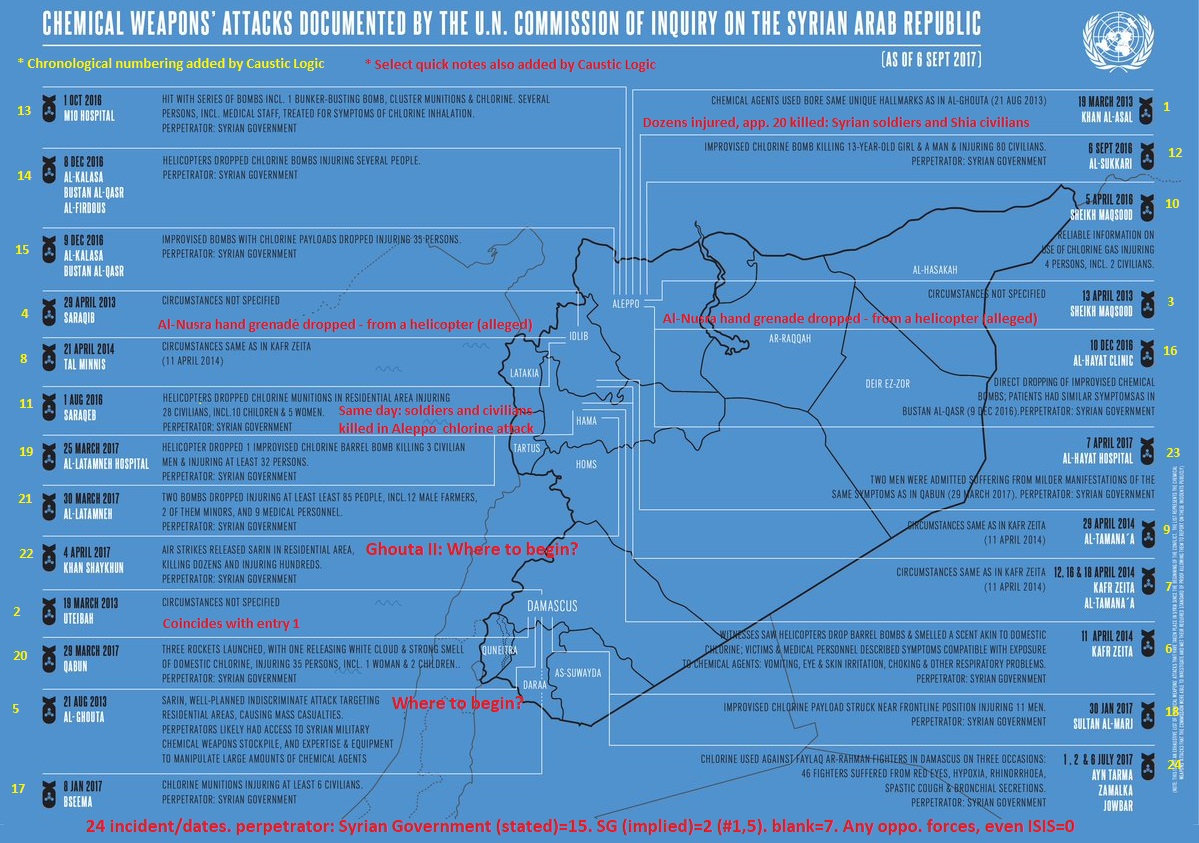
The UN "independent commission of inquiry" lists the Aleppo incident as entry #1 here, where the chemical agent "bore same unique hallmarks as in AlGhouta" - which they acknowledge was sarin (so they confirm the Russians in that regard), but from the Syrian military CW stockpile. By extension, the same was perhaps used in Ateibah (same source has no info, but lists it as incident #2 blamed on the government). Ghouta sarin is also linked to Khan Sheikhoun's sarin, and that to Saraqeb's sarin. It all seems the same: nasty, impure (60% purity, France says), with a foul organic decay-like odor, that burns the lungs and eyes ... it tends to be a dark or even black fluid (seen in Ateibah, in later attacks in Adra, and at least the 3-30 and 4-4 attacks this year), but the gas it puts off tends to be pale yellow or yellow-green, maybe appearing white, or usually not noticed (this part seems less clear). It also tends to have hexamine as some fixate on. 

Western experts first verified this sarin as killing someone in Saraqeb, weeks later on April 29. In that case it was neither a scud nor a jet, but some Jabhat al-Namechange hand grenades full of this stuff ... dropped from a regime helicopter, in glowing cinderblocks - or so the videos and reports claimed. This is what was in the Bashair 3 rocket fired on likely Shia civilians and SAA soldiers on March 19. This is what they mean by the stuff used in 2017 matching with the kind Syria has used before, and not with the kind actually known to be made by the government.  

How (delivery): 
Aleppo: locally made Bashair 3 rocket (vs. scud missile, jet bombing). Damascus: rocket/missile (not scud or anything that shows on radar). Homs: unclear.

Who (if not the regime side as alleged in each case):
Aleppo: Jabhat al-Nusra (Syria blames them)
Damascus: Jaish Al-Islam (educated guess)
Homs: unclear, perhaps Jabhat AL-Nusra, unless the Saudis have a special contact in Homs akin to Alloush on the Damascus front.

This all seems like a unified plan, with different sub-contracted actors using varied means based on their local situation.

Could That Be More Saudi Orders?
Chemical rockets on Damascus and Aleppo, and maybe Homs, just to to blame the regime for crossing the red line on a  nationwide scale - it's got some appeal as a plan. If this was all one plan, it wasn't a very good one, on the implementation end. In fact, it wound up a twisted flop. Opposition supporters has managed to use this, but barely. The US and others claim Syria deployed Sarin on two fronts this day, but it's not their proudest or clearest claim.

But it seems pretty likely, if not proven, this was all one plan. At least the core of incidents that did happen already strain the possibility of a coincidence. That unusual report that bubbled out of Homs just adds to it. It was som eone's badly executed plan. Not-so-good plans are the kinds the Saudis hatch up. "remember that "red line" thing? Yeah. Use the chemicals Turkey will be forwarding..." 

There's no direct and conclusive evidence I know of that this plan came from the House of Saud, but I deem them capable, and it seems possible. If so, it was apparently done by a different and non-monitored channels. Either no such orders were intercepted by the NSA - there are still ways to do that - or the intercept wasn't shared at the same level as this one. It's interesting in fact how the were seen conspicuously ordering the 3-18 attacks that might provoke part 2, but not the other part. It could suggest they didn't order the other part, as no orders were intercepted. 

If this were a unified package with each parts ordered separately, we would see the provocation, and that could be seen as reckless, questionable, but not seeing the other part, the main issue would be the escalation by the regime - gassing a few fighters and hundreds of innocents in every major city in response, especially in Homs, where entire families suffocated in their basement shelters?  Well, that part I imagined, but it might have been planned. But the Christian brothers, displaced babies, Syrian soldiers and likely Shia citizens were all killed, some on accident, with various improvised weapons and impure kitchen-grade sarin, all according to somebody's unified plan.

Motive re-considered: As noted, these events came a few days after the 2 year anniversary of the conflict. That was marked in the US, UK, and France by easing restrictions on financing rebels by individuals and nations. An American from Texas (Ghassan Hitto) was on the 18th elected the head of the Syrian National Coalition (Syria's legitimate government, according to the US). As CNN reported the council "said the decision should assuage the Obama administration's concerns about who would lead Syria should President Bashar al-Assad be deposed." Further, the top U.S. military commander in Europe - Adm. James Stavridis - said that NATO was laying out plans for possible military attacks on Syria, if an adequate reason should surface. Of course, president Obama had already offered one clear-sounding path to make this happen. As I noted in the earlier post:
Considering confluence of other people's decisions, it's clear that the morning of March 19 was an especially poor time for Damascus to cross Obama's red line of its own accord. Conversely, it would be a very opportune moment for any rebel provocateurs to do it for them.
I wasn't aware before that the day before had seen such provocative strikes in Damascus that could help explain the planned "revenge," charging across Obama's Red Line into a trap. That this materialized only makes sense, and that Saudi Arabia made it happen is no surprise. So it's worth wondering if they ordered up the fake revenge as well. I can't prove and don't even believe  that all this and the CW incidents are part of one unified package. But suddenly I can see that possibility, it seems plausible and logical, and it seemed worth sharing at least.