Warning

Warning: This site contains images and graphic descriptions of extreme violence and/or its effects. It's not as bad as it could be, but is meant to be shocking. Readers should be 18+ or a mature 17 or so. There is also some foul language occasionally, and potential for general upsetting of comforting conventional wisdom. Please view with discretion.

Sunday, May 15, 2022

Some Horrors "Russian Troops Left in Bucha" - Burned Bodies

May 15, 2022

(rough, incomplete)

Summarizing points making the rounds in early April, KT "Special Intelligence Operation" would say on Twitter that in Bucha, "Putin's troops massacred hundreds of civilians and raped many women before many were burned in attempt to hide evidence." 

There were dozens of bodies famously left rotting in the streets, maybe with less interest in hiding the evidence. But still... burnies were burnt, though not really as a major theme of the Bucha Massacre. Only two scenes with 8 bodies are really noted, and at least one other not seen. But these are of interest, all considered below with some related episodes, details and issues surrounding the brutality and the reality of the Russia-Ukraine conflict.

A Charred Family 
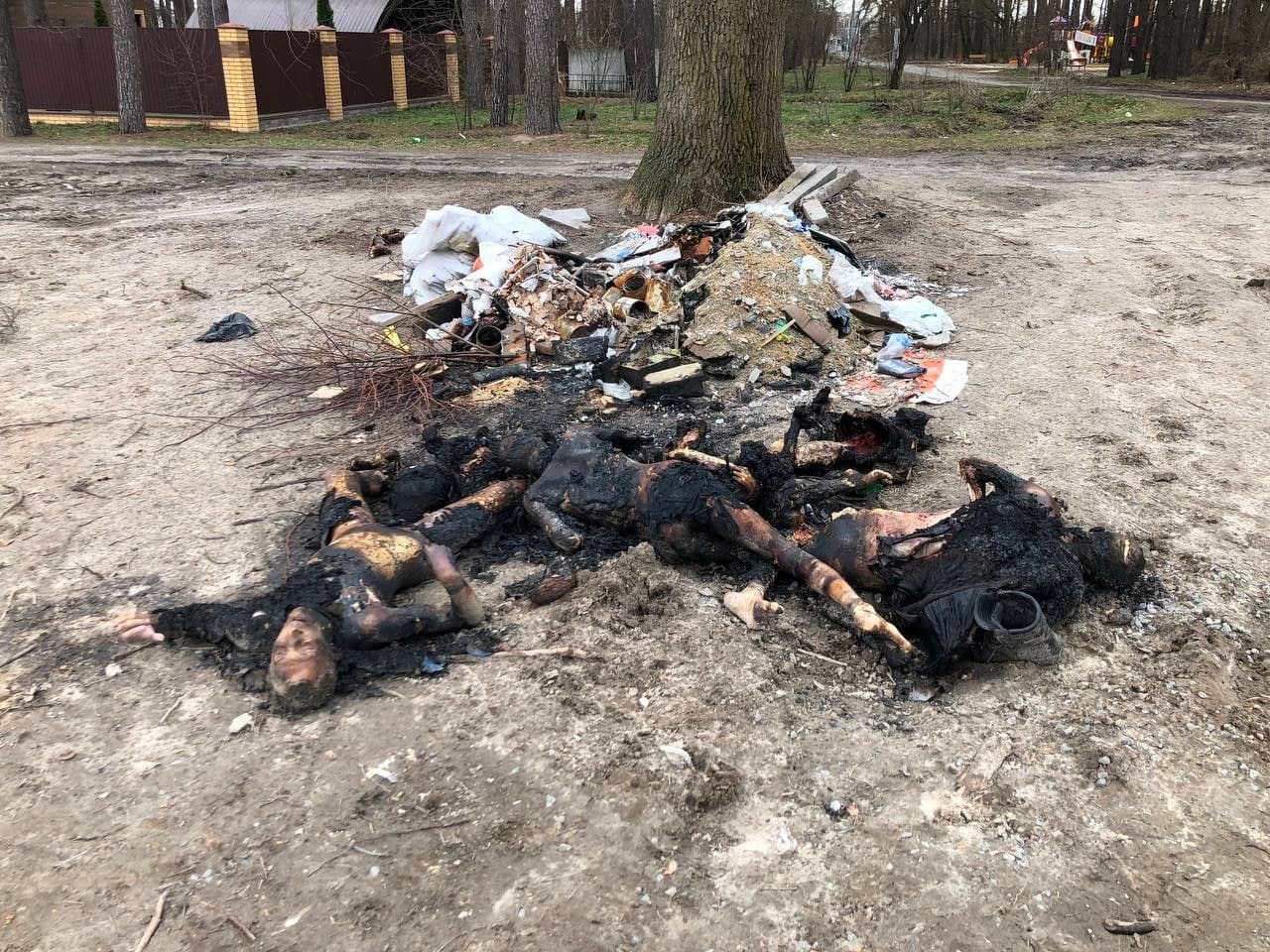
Perhaps the most shocking single image out of the Bucha - shown here in full detail but small size (can be expanded as necessary) - is this view of six bodies piled next to rubbish and badly burned. Discovered later than some bodies, only on April 4, a family of 4 was reportedly included in this pile, including a young child (whose small legs are visible). Incendiary photographs of this scene are widely shared, blurred and not, to expose Russia's brutality. Absent photos, the scene was reported in a widely read AP dispatch (via ABC News). (note: a stray boot is included. I don't suppose that's the kind Russian soldiers wear? There shouldn't be many of them to kill in this area then, but it's an issue in general, as we'll see.)

NPR cites Dymtro Andriv, a Ukrainian National Police spokesperson, saying of these bodies: "We know they were killed by gunfire, because there are many bullet wounds. Then somebody tried to hide this crime by burning the bodies." (NPR) Because of what Andriv said, we should wonder if maybe they didn't die from shooting. They in fact appear more torn up, some in pieces or missing pieces, as if by a moderate explosion - if so, they may be partly burned in that blast, and were presumably peppered with bullet-like shrapnel ("many bullet wounds"). A family of four would die like that, most likely, from being inside a vehicle, as if trying to flee, when it was hit by an explosive shell. 

The burning here seems recent, not exposed to much rain or weathering - probably in April, maybe at the end of March. That burning in turn has solidified some rigor mortis positions, which suggests they were burned while somewhat stiff, or less than 48 hours after death. That is, they probably died in April, after Kiev ran the entire city, or maybe in the transitional days before that, and almost certainly well after they had control of the exact area in question... 

The site of this pile was geolocated to Bucha's southeastern edge, which Ukraine forces had perhaps held for over a week before the last Russians left the city's northwest on the 30th  (March 19 approximate lines traced at right) Now who would want to hide shelling deaths here dating from liberation time and call them Russian shooting deaths? That's probably who burned the bodies. 

In Maxar satellite imagery (low-res preview at right, with control areas & notes added), a massive fire was seen on 3/21 at the SE corner of the city  (see my notes on Maxar's imagery). That's an area filled with truck yards and such at a "back entrance" to Bucha we've seen very little of, including a bridge that may have stayed passable the whole time. That smoke could be from an attack, or it would be a huge evidence-elimination fire. But we can see who would be capable of such fires in this area at this time - as these poor folks were charred to anonymity, by people who remembered to say the 4 had been a family.

A Fire in Mortar Alley

Next in brief: an unseen burning of bodies. Perhaps the first deadly incidents in Mortar alley on Yablunska street came, reportedly, on March 5 and/or March 6. Just as Russian snipers to the northwest allegedly started gunning people down here, what we actually see is shelling from the Ukrainian-controlled southeast that hit at least two spots, including a tree, which it completely severed. A van was set ablaze across the street from the tree, invisible here behind the smoke from its spilled and burning fuel. (Picture source: CNN) These 2+ artillery strikes killed 6 with bodies visible on the street, one maybe having been in a car, along with perhaps another person less visible, and it's said 4 more bodies were inside that van = at least 10 or 11 total killed in that mini-massacre (see mortar alley post). Being a no-man's land, these bodies were left to rot for nearly a month before removal on March 3 and 4. At least one had its hip torn open and chewed away by feral dogs in the meantime. 

"Bucha Civilians"

A second known scene of charred bodies was first shared by Mykhailo Fedorov, Vice Prime Minister of Ukraine and Ukraine's "Minister of Digital Transformation." Here on Twitter he transformed some stuff, as we'll see, saying: "We continue to find out the horrors Russian troops left in Bucha. USA, give Ukraine a chance to stop Russian aggression. Military support we need the most: heavy artillery (152mm; 155mm), armored vehicles, tanks, military trucks, long-range anti-aircraft systems."

Shown, clockwise from top left: a scene with 8 executed men of 13 total, killed sometime between 3/20 and 3/28, I estimate (whereas Kiev forces took control there by 3/24) - 5 men executed, I estimate, late on April 2 (see here - this is 2+ days after Russia left and hours after Kiev began its clearance operation against collaborators) - the column of tanks and trucks famously obliterated at Vokzalna street on the 27th, with the weapons Ukraine already had but was using up fast - finally, boxed in red, the charred corpses of two men in a wet slime around some old railroad tracks. Here is that photo alone. Fullest size seem unnecessary, but it can be expanded in a new tab if you like.

This disgusting photo is not widely used, but sometimes the more extreme anti-Russian commentators use it for the shock value: Censor.net - but mainly by even more extreme Ukrainian politicinas - Emine Dzheppar, First Deputy Minister of Foreign Affairs of Ukraine, because "The world must know the real face of #Russia." 

It's also not the clearest photograph to illustrate the Bucha Massacre. Anyone who took the photo would at least know it wasn't quite in Bucha. They might note the shelling damage to that fence. But no professional journalist gave us this photo: a blurred posting at Wikipedia/Wikimedia cites for original source: twitter of Ministry of Digital Development of Ukraine Mykhailo Fedorov. For some reason, the file was titled "Bucha civilians massacred by Russian soldiers, c. April 2022 - 01.jpg"

Issues: both look like fighting age males, although most massacre victims were - Footwear and most clothing has been removed, usually - some remaining scraps of clothing are military olive drab color - the deliberate charring may be to hide the victims' identity, like that they were Russian soldiers. In fact ... 

At least 4 killed soldiers are shown in a February 27 video posted by Ukrainian Pravda:  "Battle of Irpen: a column of Russian soldiers was shot." A black-and-red flag of the fascist Right Sector has been erected over the scene. Unique details can be geolocated to the south end of "Giraffe mall" in northern Irpin, just a bit south of the bridge from Bucha. The mall and this building across the street are both burning and billowing smoke.

Some graphic views, from a Telegram group message, via Val on Twitter - center image here shows the two on the tracks before they were stripped down. Val followed this discussion, and says the victors "got 2 names (not Chechens) and called families to gloat."


Another video shows these two bodies, stripped of useful items, laid on the train tracks a certain way, described wrongly as members of Ramzan Kadyrov's Chechen forces. Note the damaged fence missing a panel, compared to the damaged panel seen with the burned bodies. 


A Yan Boechat photo for Voice of America showed this scene, accurately captioned: "The bodies of two dead Russian soldiers lays in the no man's land between the towns of Irpin and Bucha, where Russian and Ukrainian troops had been fighting for more than a week. Irpin, Ukraine, March 12, 2022." See the fence panel used to cover the bodies. A plastic tarp helps, weighted with rocks, a "jack" roadblock that remains later in the muck. See the one leg uncovered here in particular seems chewed into later. All those stray dogs will do that. Ukrainian forces ran this area fine, but chose to leave those bodies for 14 days at this point.


Side-notes on the above photo: Giraffe mall is destroyed - heavy smoke in the distance, apparently in southern Bucha - in the background, people are walking south with white armbands, probably crossing over from Bucha, and using the white as a universal sign of peaceful intent. Most or all people crossing this bridge in March - all on foot as it stays blocked to vehicles - wear such armbands. And so far, they were made to walk past these decaying bodies.

Sometime after that March 12 image, the coverings were removed, wood and fuel were added, and the bodies were burned moderately, then left to decay another 19+ days before they were passed off in April as Bucha massacre victims. So this "horror Russian troops left in Bucha" - as the well-funded minister Fedorov called it - is actually a horror Ukrainian troops left in Irpin.  As Val noted, "Fedorov (one of 500 Zelensky "digital advisors") lies."  

This was actually one of those happy spots where the swift Russian offensive to encircle Kiev was finally and drastically halted a bit short. At least once on the 25th and again on the 27th of February, decisive attacks on Russian forces created some handy roadblocks to form a line at Bucha and Irpin. In fact, this seems to be a forward part of the massive column attacked the same day in Bucha - likely headed for this same crossing to Irpin, it seems they had changed their minds and were returning north when they were struck, destroying about a dozen vehicles and just as many civilian homes. How many civilians were killed? Officially, none. But here I show just at one intact house, two men were found dead, though maybe not killed by the shelling. All told it must be dozens. Probably all of them were passed off as killed by the Russians, mainly by shooting. This Vokzalna attack will need its own post.  

The Ukrainian Pravda / Right Sector video shows serious collateral damage here in Irpin too - at least two civilian cars that people had been driving are now burned out, and the Giraffe mall too is damaged and burning, besides at least the building across the street.

Note how one video cited above also shows a Russian armored vehicle marked V is driven away, by Ukrainians, off to the south for possible use (for example, in false-flag events over the coming weeks). 


That footage starts south of the scene at the tracks with possible Right Sector or allies celebrating a victory. To establish the area, note the billboard and the bulldozer. A France 24 video report around March 10 is from the same scene with the bulldozer, "where Russian forces are advancing." Another France 24 video of 3/24 has a Ukrainian fighter explain the graffiti on the bulldozer's shovel says "welcome to Hell." He then throws a bottle of champagne at a stray dog, narrowly missing it. Alcohol had been banned under martial law, but this was just being lifted then.

Strewn with Bodies

Two days before that incident in Irpin on February 25, to the north and east, a bit outside Bucha city limits, the 4-lane E373 highway to Kiev was severed - the bridge over Irpin river was blown out by Ukrainian artillery, seemingly just as a column of Russian vehicles was trying to cross. Some turned back then, only to be shelled along with some civilian traffic. For example, one truck headed NW away from the bridge was struck at the railroad tracks north of the CITY grocery store, while at least 3 cars going back the same way were also hit to varying degrees. 


Ukrainian sources report a Russian officer was killed at the bridge, and make no mention of civilian casualties. (Kyiv Depo) No civilian bodies are seen in later images from April - anyone injured or killed was already removed from the site sometime before that. 

Closer to the bridge are more Russian military vehicles, at least 2 police trucks  intact, then at least 4 trucks (no tanks) twisted and scorched. At least six bodies of Russian soldiers were left visible around the vehicles (at least 3 in the photo at right), most of them charred, left to rot and maybe to feed the miserable stray dogs.  

Prof. Marcello Ferrada de Noli tweeted a Washington Post story header of bodies strewn in Bucha by the Russians ... with just one body clearly visible, and it was a Russian soldier left by the Ukrainians, as they even note. That and other bodies had been there for 37 days already, by this photo of April 3. This one doesn't seem fit for consumption, as dogs look timidly for food only "near" the corpse. 

I had somehow thought it was the same body deliberately lit up and burned after this image, but it's well ahead of that we see a yellow panel hanging across the guardrail. A dark patch right next to that is seen better in a video from the "clearance operation" around April 2 - probably burned in the attack.


(seen better in passing - still can't tell if that round black object might be his or someone else's head, just a helmet, or other)


Add 5/30: video posted by Anton Gerashchenko on Telegram shows that's a helmet, and that behind that truck to the left, there's another charred corpse that was chewed away almost entirely below the waist.  

Going Afield, Then Concluding

Another scene, out of context, had seemed possibly related to Bucha, and helped inspire this article. It turns out it wasn't from the same city at all, but it still seems worth including to illustrate the mentality of Ukraine's front line fighters. Some images showed a killed Russian soldier chained to Ukrainian barricade and deliberately burned on that barricade (see scorching continue onto the metal), or sort of burned on a cross, if not exactly a crucifixion or a cross burning - then left hopefully for the Russians to see. 


"Countertroll" OSINT activist "doppelot" did/compiled some good geolocation work to on Twitter to dispel "Russian propaganda" over this scene. Folks were spreading incendiary rumors that the soldier was chained there alive, tortured and then burned alive. To me as well that doesn't make much sense - this was almost certainly post-mortem mutilation, but the idea had some traction. The people arranging the scene were clearly sick, doing this openly, dubbing the victim "Valera" and joking that he "opened beach season in Kharkiv." "Doppelot" didn't endorse or comment on that, except to note with approval hat the body was later taken back off the barricade. Propaganda tackled, Ukraine stood with, and all was good. 

Another source - Military Informant on Telegram - highlights the underappreciated criminality of this spectacle and those like it including, also near Kharkiv, arranging the corpses of Russian soldiers mockingly into a Z shape. This cites a "report of the Dutch edition "HNL" from Kharkov" which I didn't bother digging up yet, and notes "It is not known how these soldiers died - in battle, or were the next victims of execution after being taken prisoner, however, as Dutch journalists say, both of these incidents with bodies can be considered a war crime."

So that's criminal, and really pretty sick, and it was done openly. Now up in Irpin and less openly ... we have two Russian service members deliberately charred as if for anonymity, left out to rot for over a month, then passed off by Fedorov as civilians in Bucha, murdered by the Russians. These two quite likely are listed among the few hundred massacre victims as unidentified civilian males, feeding into war crimes charges against Russia, and into the basis for increasing collective punishments leveled against Russia's people in general - including the widows and orphans of these killed soldiers. 

That's a much smarter and an even more evil way to leverage corpses than just burning them on a sort of cross. We heard the Russians were burning bodies to hide the clues, so it's only fair that Ukraine get the benefit of the any doubt that's raised. Right? 

Not to say there is a policy of including every burned body as a victim of the Russians, but it seems possible here - for these 2 anyway. Maybe the ones called soldiers too? At just 1-2 per destroyed vehicle, I estimate at least 50-75 whose bodies and bits had to be left behind like this, just between 4 attack areas on February 25-27, though presumably far fewer after that (a 4th area in city center hit 2/26 is covered here for now, although I had the Irpin attack wrongly dated 2/25). Even with none of these counted in, the likely dozens of civilians killed along Vokzalna on the 27th and some traffic fatalities on the 25th will be included. Compared to some 400 or so total massacre victims as reported, this might be a significant portion. Considering the rest are mainly killed by shelling from the southeast in no-man's land, and several executions, new shelling and tank-crushing deaths just about when Kiev force came back ... there isn't much of this "massacre in Russian-occupied Bucha" left to go around.

Wednesday, May 11, 2022

Who Killed Karina Yershova?

May 11, 2022

Karina Yershova is one of the more famous victims of the Bucha Massacre - a bright beauty of 23 who managed a sushi bar as she saved for college, until she was brutally killed under unclear circumstances. 

Incendiary early reports appeared on April 13, saying Yershova was only 16 years old when she was abducted, raped, tortured and killed by drunken Russian "orc" occupiers. The photograph at right was one of a few widely used.

Her case was one illustration of an alleged system of rape with genocidal intent. Ukraine's ombudsman for human rights Lyudmyla Denisova says they're documenting several such cases, just in Bucha during its one-month occupation: "About 25 girls and women aged 14 to 24 were systematically raped during the occupation in the basement of one house in Bucha. Nine of them are pregnant," she said. "Russian soldiers told them they would rape them to the point where they wouldn't want sexual contact with any man, to prevent them from having Ukrainian children." (BBC)

"Kharkiv Human Rights Protection Group" (KPHG) would report: Russian troops "raped and shot her dead, flinging her body into one of the mass graves that these ‘soldiers’ brought with their so-called ‘Russian world’." Alternately, they say her body was "hurled into the mass grave."   

Bucha's City Council posted an account on Facebook that was long on grisly details of what the Russians did. Like the rest, it was short on evidence the Russians actually did it: 

"The girl was caught on the street, tortured and raped, eventually shot in the head." ... "most of her fingernails were missing, as if she was trying to protect herself," even though "her hands were burned to the bone, with the silver rings on her fingers that she always wore" - they cite her stepfather Andriy Derenko as interviewed for the UK Daily Mail to add that her body was covered with cuts.  "A tourniquet to stop bleeding was found on her leg, presumably from an earlier gunshot wound." 

KHPG: "Karina was buried in Bila Tserkva [some 90 km south of Kyiv], with her mother stopped from trying to open the coffin at the funeral.  The Council reports that the police told Karina’s parents that she had been tortured and killed, but omitted some of the most horrific details.  Karina’s stepfather says only that they believe it possible that she was raped, and that they had only been allowed to see the upper part of her body."

Rape sounds assumed, but with signs of struggle supporting it - an apparent gunshot in the legs and cuts all over could both result from shelling and shrapnel - issues with her hands sound relevant but unclear - some victims' fingers and hands shrivel up and appear "burned" somewhat black by frostbite after being left out in the cold, sometimes after a lonely shelling death. But a struggle using the fingernails doesn't fit so well with that.  Whatever the full story, it seems that abuse and likely rape were part of it.  

KHPG wrote "Karina Yershova fled with her parents from the Russians who seized control of Donetsk in 2014." They're ethnic Russians who fled Donetsk - which Russians never seized - either because they didn't approve of the votes for independence cast by their fellow citizens, or to avoid the violence Ukraine perpetrated in response to that vote. 

Still the family had the audacity to keep speaking Russian until Karina was killed. Now her stepfather Andriy Derenko tells Ukraine 24 (via DW - name given wrongly as Dereko) "I'm ashamed to speak Russian. I will learn Ukrainian." 

To KHPG: “We hate them”, Andriy Derenko, Karina’s stepfather, says. “We are from the Donetsk oblast where almost everybody speaks Russian, however I hate Russians for killing a Russian-speaking girl.  I’m now ashamed that I speak Russian [and] hate ‘Russian world’.  The Russian soldiers are not people, they’re beasts.” 

DW: "[Karina's] parents still don't know exactly what happened to her" and have been "left in horrendous uncertainty." Mr. Derenko for one sounds quite sure Russians did it, to the point of rejecting his own Russian identity. But the actual basis for that is not so clear from the outside. It's probably not clear from their "inside" view either, informed as it is by Kyiv's police, in cooperation with the anti-Russian neo-Nazis of the Azov Battalion. 

Chronology

Sources agree pretty well that Ms. Yershova was last seen voluntarily leaving her home, on March 10, in a civilian car, and that there is not a single known fact as to where she was for the next six days. Then a woman thought to be her was brought by Russian soldiers, wounded but alive, to another spot on the 16th. There, in front of witnesses, she was executed, there along with an elderly couple dragged into the picture for unclear reasons. 

In more detail now, let's consider the later killing first.

Kyiv Independent: "Bucha resident Mykola lives nearby. He told the Kyiv Independent that he knows how Karina died. He asked to be identified by his first name only for safety reasons. According to him, on March 16, Russian soldiers brought the already wounded Karina to the house of his neighbors, an elderly couple, Viktor and Natalya Mazokha." 

“They brought a wounded girl to them. I don’t know what happened next, but a soldier unleashed a volley of machine gunfire at the ground, then an officer came and shot all three of them,” Mykola told the Kyiv Independent. 

"Mounting allegations of sexual violence in Ukraine" DW News, May 3, reporting by Rebecca Ritters - short version on Twitter

DW witness Valerii (also just using a surname) says a soldier set down a wounded Karina at his apartment building's entrance, then he took her in his arms and carried her over there (to a small dirt lot across the street, to the north as it turns out) and "then another soldier shot her." He and DW are careful to maintain Valerii wasn't sure if this really was Karina Yershova.

The other executions aren't mentioned, but a shallow grave, perhaps 3 bodies wide, is shown, where "police told Karina's parents they found her body." That should clear up doubts about the murdered woman's identity, assuming this spot really is just north of Valerii's building (it's not easy to geolocate and confirm, like the apartment building was - see below)

Note the sandbags on both sides weren't dug up from the grave. Who buries sandbags? These suggest this wasn't dug as a grave but as a weak foxhole for soldiers to shelter in and fire from. I couldn't say whose side that would be or when, except that implicitly, it was there by March 16.

Next, let's look at the home where Ms. Yershova was last seen before that. KHPG noted "Social media reports asking for help in finding the young woman say that she disappeared on 10 March." The DW report shows a stairwell: "this is the last place we're sure Karina was seen alive - the stairs outside her flat. It was March 10th."  

Her neighbor Vyacheslav Chumak told the Kyiv Independent the last time he saw Karina was in "early March," over a span of days, starting with her on the stairs on the 8th or 9th, and ending on the 10th. 

"He found her sitting in the stairwell. Karina said she couldn’t enter her apartment as she had no keys. Chumak invited her home. He and his wife fed Karina and asked her what happened. She told them that Russian soldiers had stopped her on the street during curfew and detained her. She had to stay overnight in their barracks... In the morning they let her go but took away her phone, Karina told Chumak." Perhaps they also took her keys? 

"Karina’s neighbor went on" with some confusing details about the night: “She told us that they had gotten drunk. One of the soldiers had his leg shot near his ass, the other one was run over by a tank or an infantry vehicle, she said.” The soldiers were drunk after the injuries? Did she get drunk with them? (presumably not, but use of "they" allows for that.) There's no mention of rape at this point, but they took her phone and she seems to be lacking her keys. 

As this story goes, Karina took a short nap at Chumak's place, then somehow "managed to get into her apartment." Then, he told the Kyiv Independent:

In a day or two, a light blue car with the letter “V” – one of the symbols Russian troops put on vehicles in their war against Ukraine – arrived to pick up Karina.

According to Chumak, the driver was an acquaintance of the owner of the apartment Karina rented. 

“She packed her bags into this car and waved my wife goodbye,” Chumak said. 

“We never saw her again.”

That's an interesting detail. She agreed to be driven off by "an acquaintance" of her landlord - maybe put in contact by her landlord who was out-of-town, maybe to help get into her apartment without keys the other day? He (or she?) drove Karina off in a suspicious car that kind of points to Russian evil. 

Questions and Possibilities

DW relates her disappearance on March 10 and adds "after this, everything becomes unclear." Indeed, and that's actually a problem. 

Why would she agree to get in a Russian-marked car, or why was someone she knew and trusted driving one? Maybe he (or she?) said they could get Karina's phone and/or keys returned? Packed bags suggests otherwise, like she was going somewhere else to stay for a while, as if Bucha were now a war zone, which it was, and many people were evacuating in those days, as corridors were first opened on the 10th. FWIW, white armbands are often worn by people escaping in any direction, but a V might help for someone, civilian or otherwise, headed north to pass Russian lines or into Russian arranged corridors. 

Was this acquaintance allied with the Russians, or possibly with the other side, or just with himself? Who in that mix would then abuse her for days, before a couple of apparent Russian soldiers would finish her off in semi-public 6 days later?

Russian links in review, and all just alleged/assumed, based on varying evidence: 

- arrested overnight in early March, swift release 

- a V on the civilian car driven by a civilian of no known link to Russians, except for that implied by a painted letter 

-  Russian soldier and officer placed at her awkward semi-public killing on the 16th. 

- For six days we have no direct evidence where she was, being harmed by whom.

The landlord's acquaintance could be: 

- a Russian accomplice who delivered her back to the Russian soldiers (hence the V)

-  some creepy acquaintance of Karina's landlord who took advantage to kidnap and rape the poor woman - an obvious possibility in general terms, but let's not leap to conclusions (the V might be to help blame his crime on the Russians)

- someone trying to help her evacuate the city and he too was a victim as they were stopped on the road and Russian soldiers detained them (the V worked to their disadvantage)

- or maybe they happened on a Ukrainian force that didn't like that V and opened fire on their car, then maybe rescued her from the scene, stopped the bleeding so she wouldn't die, and then proceeded to abuse her before finally killing her.

- or hey, maybe the above except the Ukrainian saviors then got ambushed by Russians who again detained Karina. But probably not, and the above scenarios seem like the ones to chose from.

Mapping

The DW report from the scenes of the crime allow some geolocation of relevant sites.

First, where she was living until March 10, when she agreed to be driven off 

coordinates: 50.5507567, 30.2268343 - 8, Energetykiv St., northwest corner - pretty well in the center of Bucha, less than one block east of the City Council building. Hat tip to Friedrich for the actual find


Next, where she was killed - 50.5507567,30.2268343 - unique arrangement of buildings with same style and color schemes (2 visible in Google maps street view), wrapped around a big parking lot and a consistent cluster of smaller homes - red circle for the entrance where Valerii spoke - grave/foxhole site not clear, but implicitly somewhere north of that building entrance, possibly even off the upper edge of this map. 

Both sites together on the map with areas of control notes:

Control areas are especially unclear in these days around March 12 "when the Russians arrived" suddenly to the city's north - when they had been occupying it already. The reality may even be acknowledged - belatedly, on the 15th - as where Kiev's forces had recently arrived and re-established control over nearly every bit of Bucha (some time between March 9 and 15). Then Russia is shown suddenly back in charge of the entire city on March 16. 

So even with these spots established, the map shows Russia in charge on both relevant dates. But that's just the kind of literal reading you can't do with these maps. It's hard to say just how this fits in the unclear TRUE situation in those days, except we can say it's quite possible the Russians were not in charge. And even if they were, the relevance of that is unclear to one civilian car driving to a selected locale.

It's worth noting 4 alleged executions 2 days later, almost due south on Yablunska street, previously reported as 3/23 but now said to be on the 18th (and likely so, although execution vs. shelling isn't so clear) - Ukrainian prosecutors say by "Russian officer" Sergei Kolosei - who seems to be a Belarussian guy who hasn't left Belarus in 2 years and has never been in the Russian or military or anyone else's military ... but executions are reported, by whoever, allegedly Russian/allied, 2 days after Karina and the Mazokhas. on-site executions by supposed Russians in these few days. Per my inexact information, Ukraine had access to the southeast part of Bucha (including the Yablunska execution site) perhaps the whole time, and to all of the whole east, including Yershova's execution site, by the 19th, with local presence likely enough from 16th forward.

Wednesday, May 4, 2022

Bucha Massacre Victim: Zoreslav Zamoysky

< Bucha Massacre

May 4, 2022 

One of the more "ironic" Victims of the Bucha Massacre is Zoreslav Zamoysky, a Jewish journalist and activist and to some minds a "supporter of the "Russian World"" - killed by Russian invaders at an unclear time after last contact on March 4, and before his death was publicized on April 12 - ironically on what would have been his 44th birthday (NSJU statement 4/13). 

The city council of Irpin, not Bucha, may be the first to report Zamoysky's death April 12 on Facebook: "It was known about the death of a journalist from the Priirpínia, Zoreslav Zamoyskyi. His body with signs of violent death was found on B. Khmelnytskyi Street in Bucha. Condolences to family and loved ones!"

UkraNews: "As the network user Sergey Melanchenko told the NUJU, now the body of Zoreslav Zamoysky is in the Ivankovsky morgue. According to Melanchenko, the photos taken by forensic experts leave no doubt that the death of the journalist was violent." I haven't seen any story relating just how and when he died, citing any witnesses or other evidence. It was violent, then his body was found, and it happened sometime during the Russian occupation. 

Where? This street his body was found on - Bulʹvar Bohdana Khmelʹnytsʹkoho - runs NW-SE in city center, near the Bucha City council building and next to St. Andrews Church, where the central mass grave was begun around March 10. A video Zamoysky posted on March 3 (the first one here) was filmed from that street, looking at some large fires to the southwest. Perhaps he filmed that scene from his home, and was killed - or found - in the street right in front of it. (see analysis below)

When? CPJ reported "In Zamoysky’s case, local residents in Bucha found his body on a street in the city in early April, according to statements by the Ukrainian National Union of Journalists (NUJU) and the Irpin city council. Those sources did not state the exact date his body was found." 

However, no time frame, not even early April, is specified in either source. It's a decent guess, as that's when most people were found, some laying out on streets - especially along the exposed no-man's land of Yablunska street - and more yet were already buried at the central mass grave or elsewhere. But his body was found on a central street in the managed part of Bucha, in fact very close to the mass grave. His body would probably not be laying there in early April if he were killed much earlier. Perhaps it was found earlier, and then buried, with the latter going unmentioned. Or maybe he was killed just then in early April, as Russian forces retreated and Ukrainian forces arrived. 

A dramatic and probably deceptive video adds little, unless that's his body and hand shown at 0:40, as the video edit suggests. Зореслав Замойский — МЕДИА МЕМОРИАЛ - YouTube

If so, and the image is from anywhere near April 3, he has been dead in the wet and cold for many days or a few weeks. That might have been in the mass grave, if he were wrapped to keep most soil off - might be just left in this central street so long, but that seems strange - or also strange but precedented, his body was left somewhere else before it was found back near his home to find (IF it really was found there).

Why? 

NSJU; "Iryna Fedorov, founder of the news website Hromada Priirpinnya, told the NUJU that Zamoysky covered the activities of local authorities in the region around Bucha and the city of Irpin as a freelancer for his outlet and other local media groups. The NUJU statement also said that Zamoysky worked as an activist, but did not describe the nature of his activism." 

Covering local authorities could have earned Zamoysky some enemies. For one example I found: a December 2020 article from Hromada Priirpinnya, uncredited, perhaps by Zamoysky himself: "Deputies of Buchan district council illegally put into power – court decision"  

Other things that might also have made him enemies. The Russians might hate him just for being Ukrainian, as is generally assumed for all those killed. But then again...

https://apostrophe.ua/news/society/accidents/2022-04-13/v-buche-pogib-adept-russkogo-mira-foto/265804

"In Bucha, where the Russian occupiers killed and tortured hundreds of civilians, journalist Zoreslav Zamoyski died at their hands. The cruel irony of fate is that during his lifetime he was a supporter of the "Russian world". ... As Viktor Glushchenko wrote, Zamoysky was a classic "cotton wool man" and a fan of the Russian world. He was often nostalgic for the USSR, was part of the "victory" and supported Russian theses about the events in Ukraine. Glushchenko published the corresponding screenshots."

It's not clear where Viktor Glushchenko wrote this or who he is: the same "unknown" man reported here in 2019? If so, troubling - that Viktor Glushchenko was arrested on suspicion of premeditated murder, 3 years after he - or someone with the same name - reported Regions party leader Alexander Efremov for treason and supporting terrorism ("supporting the Russian world"), which charges landed Efremov in prison for 3 years. Glushchenko was jailed just as Efremov was released by order of Ukraine's constitutional court, in a strange reversal of fortunes. (IF that was the same man, and the same name appears as a Ukrainian police chief, and a fitness club owner, among whoever else.)

Scanning Zamoysky's Facebook page, there are a lot of (to me) obscure historical references, largely Soviet but stretching way back. But he doesn't seem obsessed with modern Russian memes about Ukrainian Nazis, and he wasn't so bold as to publicly approve of Russia's invasion to "De-Nazify" Ukraine - in fact:

3/1 "It was unfair that Kharkiv was not given the title of a hero city for the contribution of Kharkivians in the defeat of Hitleriv Nazis. Now the whole world has seen and understood that Kharkiv is a hero city!" It's a common thing now to call the invaders Nazis, especially if one had been kind of pro-Russian before and wanted to avoid a lynching now. But it seems odd to specify this largely pro-Russian city resisted Hitler's Nazis (гітлерівських нацистів) rather than Putin's Nazis. And it's the former he was already concerned about - in 2020 posting that "Journalists claim that the Verkhovna Rada house sells literary work in which the author approves of Adolf Hitler." 

Zorelsav Zamoysk was an observant Jew, who once re-posted his picture with a blue "I stand for Israel" ribbon (May, 2021) and to the end tried to adhere to the sabbath. In the new conflict, on March 1, he posted "Jews in Israel, USA and other countries! Babin Yar is being hit by direct infiltration missiles. This is an attack on Jews worldwide!" He wasn't clear about who had attacked the memorial. 

Rabbi Moshe Reuven Asman spoke at Zamoysky's funeral, blaming Russia for his death: According to the rabbi, Zoreslav Zamoyski was a Jew and just a nice person, but he was killed by the Russian occupiers in Bucha, who allegedly came to denazify Ukraine ... [Asman] called on Russian troops to come to their senses and repent of their crimes." 

As for "Russian world" type positions Zamoyski held that might irk the ultra-nationalists - from what I can see and understand, it's fairly mild, but existent: 

Commemorating the May 2, 2014 Odessa massacre in 2021: "7 years since the tragedy on the Kulikovy field in Odessa. The culprits of the arson have not been found. society is still divided... Condolences to family & friends. May 2 was destined to be one of the most tragic days of modern Ukrainian history." (screen grab from Apostrophe article)

He marked this annually - in 2020 for example:  "6 years since the tragic events in Odessa. Remembering and mourning." He obviously didn't mark it in 2022, and never will again.

Another unsolved crime he took interest in, marking the anniversary just before the current invasion, on February 14: "It's been thirty years since the tragic death of the People's Deputy of Ukraine and the famous journalist Vadim Boyka. The circumstances of his death are not investigated to this day." Boyka was killed 2/14/92 in a suspicious explosion, as Zamoysky relates it, and it went uninvestigated, as with Odessa. 

A comment there lamented: "Unfortunately journalists are not protected, and every day are under a threat, if not physical then morally." Zamoysky replied "exactly like that, unfortunately."


Chronicling the Russian Invasion on Facebook:

CPJ: "Zamoysky regularly covered the war on his personal Facebook page, where he had about 1,000 followers. His last post was published March 4." 

Зореслав Замойский | Facebook

The following relates his posts from Feb. 24 to March 4, using auto-translation, only fixed where it's clear how - some gibberish included.

2/24 Podol.Mother fucker! What has been going on .... (photo: smoke rises over Kiev - as posted by others

2/27 It turned out to be almost at the epicenter of the fighting. I have never seen anything like this in my life and I do not wish anyone to experience it.

It is very likely that the connection will soon disappear (and for a long time).

Health and God's intercession to all.

3/1 5:00 p.m. Buzz. Finally have a cell phone service.

Peace is still a long way. Explosions could be heard from time to time. Sort of like an air defense.

3/1 My television has stopped working.

They write that a TV tower in Kiev has been attacked.

March 1  https://www.facebook.com/zoreslav.zamojskij/posts/2602722873205302

My understanding is that communication will be lost again soon

Posting photos I took yesterday morning. Station Street of the city of Bucha. Broken Armour Column. These are the aftermath of a fight that happened in my neighborhood on Feb 27.

Request to FB friends (especially from Israel, since you are more familiar with this topic) to share these photos. Let people see what is happening in residential neighborhoods.

Photo not sorted, no time. Putting it all out there. Say a prayer for us.

(36 photos, many of the same scenes - like he said, unsorted - a good view of the lethal Ukrainian overkill at right)

3/2 new cover photo, young girl looking at damaged building

3/3 "A strong snowstorm from the very morning. And most importantly, it is unclear where the fights are taking place: from Irpen, Vorzel, the center of Bucha? 

Such a tense situation. Curfew 5 p.m. - 8 a.m. But even during the day, given this thunder, people are unlikely to point out on the street.

Lets see what happens next."

3/3 "Fire elimination at ZAEU is reported. No damage and radiation were recorded." (Chernobyl?)

3/3 It's Friday morning. Shooting since early morning. Very powerful at times. Reported about a breakout of air alarm.

3/3 "A 5:00 p.m. curfew is now in effect.

We ourselves have been sitting in a cellar for two hours now due to constant automatic queues (gunfire?) on the street near the yard and explosions far away. God forbid to get out until the night. Just now I stumbled into a cemetery atrium.

It's Kanonada on the street, it's not clear who and where is fighting."

3/3 7:52 PM https://www.facebook.com/zoreslav.zamojskij/posts/2604465963030993

"This is what happened in our city during the day." (videos) "There were intense street fights in parallel. I don't wish anyone to go through this."

Map break: I've seen 3 of the 4 videos here analyzed and geolocated, but not the first one that I recall. The others show Russian tanks parked in residential areas in the southwest of Bucha. This one looks across the same Khmelnytskyi street Zamoysky's body would be found on, so likely filmed by him, from his home. Across the way is Ivana Rudenko St, #2 with some shops - Two large fires are visible a ways to the southwest.

Lining up some distance features, it seems one should be at or behind a truck yard just outside town, and the other less clear (maybe the "pit stop" gas station?). These are both a bit outside city limits, a ways northwest of where the tanks are parked in those other videos, and just about at the front line with Russian forces on the 3rd, per this map, which had to pull back by the 4th (no Russian control in frame at all on the 4th). Those parts added in orange to this mapping of some other early killings atop approximate areas of claimed control (which are especially ambiguous in these days).


Back to Fecebook:

3/4 Passed the beat. Saturday is coming soon according to the Jewish calendar. Shabbat shalom in this difficult time!

3/4 3:07 PM "Tanks are in the street. As the fortress commander from "The Captain's Daughter" said: "Hold on guys, there's a seizure."

March 4 may be the day Russian-marked tanks were seen driving north by cathedral (Church of St. Andrew and Pyervozvannoho All Saints, filmed passing Zamoysky's probable home, but from a different spot, a few blocks NW. Ivana Rudenko St, 2 is plainly visible, with the church just to the east.

Mapped below (view is from NW, upper left corner). This raises some questions if Ukraine ran the city, why is such a column of Russian tanks just retreating peacefully so close to city hall? By agreement, by authorities who had already wrecked enough of Bucha? Likely enough. The route makes sense to both get north and to make an attack on them extra costly. It also seems possible these are captured Russian tanks, or fake Russian tanks (how hard is it to paint a V?), or just some in a mix with Ukrainian captors ... I don't think the view is clear enough to make out the markings on any but the first few. 


The photo is most widely seen and dated as 3/14, including by the Bucha city council, but they paired it with two photos of a different, tankless scene also dated the 14th, showing bullet holes in the windows (somewhere SE of either location) and suggesting the tanks did that. The photo is older, included here by 3/6 - elsewhere it's been dated 3/4, as someone noted but couldn't find the source for, but it's likely the same column Zamoysky saw on the 4th. By sunlight, diffuse as it is, I'd say the photo was taken roughly mid-day, maybe a bit on the afternoon side - maybe 1-2 PM or just as Zamoysky was posting at 3 PM.

Final post - just 5 hours later, March 4, 7:59 PM https://www.facebook.com/zoreslav.zamojskij/posts/2605249642952625

"At 20.00 the darkness outside is full. And the light is out. During the day, all the electrical appliances were burned to the damn grandmother because of the strong tension in the network. Including a refrigerator.

In the house right now . It's quiet in the street. Only sometimes lonely explosions in the distance. Tanks and other equipment have long gone in an unknown direction. What will happen at night only God knows, I can only assume...

Tomorrow it may happen that there will be no Internet or communication. Maybe for a long time. As they say, we live by circumstances."

"in an unknown direction" = pulling back to the north. Kiev had declared control of the city on the 3rd, even solidifying this on the 4th, but they have Russia back in charge by early on the 5th, maybe with earlier advances shortly after that last message. Allegedly.

Zamoysky noted and predicted earlier, temporary losses communication, and it seems they did go out more fully on the 5th. Some were back online eventually, but there was no more word from Zamoysky. Something probably happened to him in the hours or days after that post - likely killed or possibly abducted, either by re-invading Russian forces or by retreating Ukrainian ones.   

Sunday, May 1, 2022

Bucha Massacre: "When the Russians Arrived"

< Bucha Massacre {Masterlist} 

< Basement Executions in April - "When the Russians Arrived"

May 1, 2022

rough, incomplete ... finished on...

Intro: Who Abducted Five Aid Workers Three Weeks Before the Ukrainians Murdered Them at a Former Russian Base?

My earlier post "Basement Executions in April" introduces this case, where the tortured and executed bodies of five men were found in a cellar of a former children's camp apparently used as a base for Russian forces. That included my initial geo-confirmation of the site at camp Promenystyy (trans. radiant, shiny), noting the white armband on one victim, and more. My most important addition there was to observe strong indications that these men were probably killed late on April 2 or just hours before or after that (faintly wet blood in a dry environment on April 3 at an unclear time, and fading but present rigor mortis as seen early afternoon on the 4th - this usually fades away in ~36 to 48 hours). That's not a real expert view, but it is reason to realize we should get one.

Dan Rivers, for ITV video report, had this basement execution as one of three "senseless" crimes they sought to reconstruct (seeing it as senseless, BTW, suggests one will not be sensing the truth, which is never truly senseless). "Forensic experts are investigating the date of the shooting and haven’t yet made their results public." The results probably won't be published or they won't be truthful. That's because late on April 2 or any time close to that is after Russian forces had left the entire city "as early as" March 30, and no later than the mayor concurring on the evening of the 31st, and they had the wrong color of armbands. 

The Russians could have left "sleeper cells," I suppose, active into April. But in contrast, the Ukrainian and foreign-backed, mercenary-staffed Neo-Nazi Azov Battalion was there and has openly published radio communications of midday on April 2 seeming to approve, and perhaps record, their own summary execution of locals who were found without the approved blue armbands ... people just like the five men executed in that basement, it seems, some hours after that audible evidence. (see here for now, but this subject still deserves more attention - Meduza piece etc. f/c...)

It was also on April 2 that Ukraine's security services publicly announced an operation targeting Russian collaborators, besides booby traps, unexploded shells, etc. The special forces regiment credited with this is called "SAFARI," like they were shooting game, and said it was already underway (for hours? for days?). That may not be the same exact thing as what Azov was running, but whatever the case, these are the crews known to be cleaning the streets and maybe basements of Bucha when these five men were killed.

Here I'll mainly cite three reports - the ITV one, which heard from the sister of one of those killed - plus Ukrainian Mother Relives Horror of Son's Execution in Bucha Basement by James Longman, Oleksiy Pshemyskiy, Tatiana Rymarenko , and Haley Yamada, for ABC News - and the most detailed report hearing from several sources: The last brave acts of the five Ukrainian men found dead and bound in a Bucha basement by Nathan VanderKlippe, for The Globe and Mail. The latter gives the names, ages and occupations of the five men: 

Viktor Prutko, 24, installed doors and dabbled in advertising. 

Volodymyr Boychenko, 35, worked with a blacksmith. 

Serhii Matiushko, 41, was a labourer. 

Valeriy Prutko, 47, did plumbing work. 

Dmitriy Shumeister [ITV gives Shulmeister], 56, had just started a cleaning company.

The same report adds "none [of the 5] had any military affiliation, friends and relatives said." But for what it's worth, ITV shows Viktor Prutko in a military uniform, presumably regular Ukrainian. That must have been past, but if so, at age 24, he might be expected to serve again in 2022, with martial law and conscription for men aged 18-60 announced February 24. But instead he was stuck behind Russian lines, not escaping to join the fight but helping others to evacuate the city - perhaps to the north, perhaps in conjunction with Russian forces (see below). 

ITV heard the men stayed - at some point when others were leaving over some worsening danger, like approaching Russians, perhaps - to "help organise the evacuation of other civilians," but "Their activities soon attracted the attention of occupying Russian forces who eventually captured them, tortured them and killed them" ... over their staunch opposition to anyone evacuating? Maybe Mr. Prutko's failure to report for service helped set them off? 

Key here: the men had gone missing, presumed abducted by the Russians, back on March 12, In my initial reading of fewer reports, it seemed like they were trying to get people out ahead of Kiev's forces returning in April, when they were perhaps swiped off the road on the 2nd, dragged to the vacated Russian based, murdered, then filmed as Russian victims after a 36-48-hour wait. 

But if they were abducted 2-3 weeks earlier ...this was when the Russians were firmly in charge - or so it would seem, as far as most of us know. And their remains were found at that terrible camp that served as a Russian base.

some oddities in the reporting ... to ITV, Tatiana Shulmeister speaks of her brother Dmitryo being held for a time - and other reports are clear the men vanished weeks earlier, on the morning of March 12 - as they helped people flee the city. I wasn't aware of any specific cause to flee that occurred anywhere near March 12, but maybe ... the city had been and would stay dangerous, and many evacuations were long overdue. It seems agreements on "green corridors" was only achieved by around the 10th, and there were two parallel routes - a Ukrainian one to the west and a Russian one to the north (see below)

VanderKlippe's report for The Globe and Mail relates how hundreds of people from Hostomel and Bucha were sheltering in a bunker beneath a prison. Then "On March 10, authorities" - presumably Russian -  "emptied the bunker, evacuating some people to other parts of Ukraine and sending others home" in the Russian-occupied cities. But the 5 men continued helping people, operating partly from "Campa, a tennis club serving as a staging grounds for people fleeing." An evacuation corridor had been opened “and they were taking people away,” said resident Victor Petrovich. 

Campa is at the far northern edge of Bucha and its municipal park in the north, according to Google Maps labels. The likely Russian  base at camp  Promenystyy is just south of this, in the west middle of the park. 


Globe and Mail's report says the men "set out again on March 12. They told different stories to different people. Ms. Stupnyk heard that they planned to deliver medicine. Mr. Shumeister, an accomplished cook who enjoyed singing Soviet pop songs, told his spouse Victoria Verde he wanted to retrieve documents left in a car he had abandoned during heavy shelling early in the Russian invasion." This isn't a contradiction, of course; a single true mission might have several reasons. 

Viktor Petrovich watched the men arrive at Campa in a blue Peugeot van, and leave again "in the direction of Bucha’s council buildings" - that is, south - "on a route that passed the Shiny [promenytsyy] children’s centre, located less than a kilometre away." “They left with the car at 9:30 a.m.,” Ms. Stupnyk said. “They were going to deliver medication. But they never came back.”

Interestingly, when Galyna Matyoshko spoke to ABC News, she "said her son Serhiy was helping evacuees when the Russians arrived. “They came like a hurricane, causing so much pain. For what?” said Matyoshko." ... "According to Matyoshko, her son was helping evacuate women and children from the houses near the Bucha summer camp when he disappeared along with a friend who was doing the same on March 12." 

To ITV, the Russian occupiers "eventually captured" the men operating under their noses, smuggling people out, for a while. Here, the Russian marauders swoop in with cruelty, like some non-occupiers. By the clinical signs, these men died shortly after Ukrainian forces arrived - you could say like a hurricane. But when they went missing at about the same spot on the 12th ... who might be arriving there and then? 

Long Thoughts on Who Ran Bucha Around March 12

It turns out this is an odd spot in the maps I've been citing, compiled by Ankara-based freelance journalist Dr. Abdullah Manaz, a supporter of Ukrainian forces. These are surely not exact or definitive, and it's not clear just what they are based on, but it seems like claims from Kiev, reflecting some of their own revisions and omissions - and the details at the town and district levels are vague, needing scaled up hugely to compare, and even then only giving some idea who had more influence over what areas on or near these dates. 

The image below compiles some cropped parts of Manaz maps for the relevant time span, some of the Kiev area in detail, and some nation-level, each with Bucha's outline sketched roughly in white. Purple is Russian-held "yesterday," and the red line shows changes by "today." According to this, the Russians steady, full Russian control of Bucha from March 5 on, same between 3/9 and 3/14 - but a strange and total one-day takeover by Ukraine appears on the 15th, extending to just where the men vanished ... March 10 map (link) -  skipping 11 because it's reflected 3/12 - all the same -  3/13 and 14 I didn't grab the links for (and my list of them all isn't handy), but as I show, they're the same.

No Manaz maps were published for March 15 and it - or maybe previous day's map - missed something that appears mysteriously with the 3/16 update (link). This shows Russia in full control again on the 16th (red line), after somehow holding only the northern and western oputskirts on the 15th. Both developments seem unexplained but of great interest. 

A similar thing happens in reverse with the maps of March 5 and 6 as Russia's reign of terror over Yablunska street was said to begin on the 5th, according to the map of the 6th. But on the 5th, Dr. Manaz heard Kiev still in control of the city as they nhad been from the 3rd. That traces official statements as related in the Wikipedia article Battle of Bucha: On March 3 it was "announced that Ukrainian forces recaptured Bucha." Russians were still resisting, but were "pushed into the city's outskirts." On the 4th "the city remained under Ukrainian control, despite Russian forces continuously launching attacks" and on the 5th the same; "Russian forces continued to attack Bucha." Then "Later, Arestovych stated that Russian forces had captured both Bucha and Hostomel, and were not allowing civilians to evacuate." 

It seems like Kiev had been denying progressive losses, then admitting total loss at the end of that. But it's interesting how officials seemingly decided late on March 5 that they had lost control earlier that day, and just didn't notice it at the time. Also, an insane killing spree had begun just then at the no-man's land of mortar alley on Yablunska street. (It's widely reported, based on verbal claims, that nearby snipers to the northwest started killing locals this day. But the visual evidence suggests most were killed with mortar shelling from southeast of Bucha, from outside the Russian-controlled area. As seen in a video dated March 7, and said to show aftermath of 2+ strikes on March 5, some 11 people were killed along Yablunska - most of those we'd first see strewn on the street plus 5 we couldn't see. Just one crater and one body were added later, sometime before the 12th. See mortar alley post. That is consistent with their being excluded from the area, for what it's worth.)

In fact the definition of the purple areas in the Manaz maps isn't so clear. Maps by the Institute for the Study of War employ a different criteria and show Bucha and everything around it as a vague, mostly  unchanging area of Russian "advance," not Russian "control" for the entire time, perhaps reflecting the mixed reality in which Kiev's forces could never really be excluded. 3/18: https://twitter.com/TheStudyofWar/status/1504950017542533131 - crop from this below, Bucha traced on:

3/12 seems the same: https://twitter.com/TheStudyofWar/status/1502767739722768396 - maybe ISW just don't track details that fine in these maps. The ISW daily report 3/12 doesn't mention Bucha, but says "Russian forces did not conduct offensive operations northwest of Kyiv for the second day in a row." They didn't hear about them arriving anywhere at this time, but didn't hear of them losing any ground either.

Okay, so ... Was there a mid-March re-conquest by Ukraine somewhere in here, maybe with progressive gains over days that couldn't be published at the time? There's some evidence for this happening and then being admitted on the 15th, as some previously unseen footage surfaced "of abandoned Russian equipment reportedly in Bucha, northwest of Kyiv" that "can now be published" ( Telegram - Twitter) The scene has been geolocated as near Bucha Passage Mall - pretty much in the center of town (spot labeled in green on the map below) - well inside the vast areas mapped by Manaz as Ukrainian-held on or by the 15th


This might be old video from around the 3rd that "can NOW be published" but it was used to boost new claims: "The area has been cleared by our defenders" and it's implied that happened recently. (the weather seems too ambiguous to call) Maybe the same could "now be published" with no explanation on the Manaz maps, as it was, suddenly and with no explanation.

A Ukrainian news account on Twitter used a different photo of a long-ago charred AFV to report, on the 16th, "#Bucha - Russian scum is knocked out. Work to free people is underway. Special operation #APU continues." (assuming it's a new photo, it would be worth geolocating ... anyone want to do thart?)

A March 12 video: "Soldiers of the Azov Regiment showed what happened to the city of Bucha near Kyiv after the arrival of the occupiers" - filmed among the wrecked tanks on on Vokzal'na street, well inside the area of control mapped on 3/15, dated "March" and only appearing March 12. But this is most likely from around the 3rd. The extreme overcast weather, traces of snow, and snow actually falling supports that. 

Still... it seems Ukrainian forces, Neo-Nazi or otherwise, were operating over quite a bit of Bucha by March 15. Manaz maps re-traced to scale by highways, etc. - areas of interest noted. Again, this isn't certain or gospel, but it's based on something, and crucially, this shows a front line right at the Promenystyy camp and any checkpoint outside it, as well as everything one would pass if they made it any further south. It has that existing only by the 15th, but it was probably established earlier. All considered, I propose this fairly reflects the reality, and it was a brand-new fact, unknown to most, on the morning of March 12. 
 

Russian Arrests at City Council?

Add May 2, a detail I forgot about: https://interfax.com.ua/news/general/814280.html

"On Tuesday evening, March 15, the Russian occupants wreaked havoc in the administrative building of the Bucha city council and captured our employees and volunteers, who helped the residents of our city to the last under shelling," the Bucha city council on Facebook. The council itself had evacuated long before, but lower employees and others were operating there Who was shelling? Why wreak havoc? Good reasons to remove them would be to protect them from shelling, or from a massacre that would be blamed on Russia - Postulating a March 12 presence near camp Promenytsyy vs. UA attcak or RU "rescue" at city hall on the 15th ... seems plausible enough. They might be focused on different axes on different days. 

Sim cards removed from phones so the people couldn't be contacted, maybe so they could be killed, or taken to Russia - the Russians might say that was to prevent Ukrainian ops including rescue or drone attacks that use cell phone signals. All agree the captives were released the next day unharmed, as things calmed down and Russian control seemed clearer for the moment.   

Areas of Control and Different Evacuation Efforts

The reported evacuation point at Campa is still Russian-held this whole time. Russia says it was allowing, and was perhaps arranging, evacuations to the north, maybe with some civilian help... (see here, bottom) "The exits from Bucha were not blocked. All local residents were free to leave the town in northern direction, including to the Republic of Belarus." They said routes to the south were too unsafe; "the southern outskirts of the city, including residential areas, were shelled round the clock by Ukrainian troops with large-calibre artillery, tanks and multiple launch rocket systems." 

The bridge to Irpin passes through the described horror show, and it was used (adding after I've seen images of evacuation, all by foot, on March 12 and 24). But Kiev's arranged evacuations, beginning on the 10th or 11th after some earlier tries, was mainly to the east "through a pedestrian crossing on the blown-up bridge in Romanivka between Irpen and Novoirpinskaya highway (it is from there that the world's media have those sensual illustrative photos). Sometimes under fire." (Suspline) This rickety plank bridge would bring them, with just a few bags and often wet, to Horenka and then Kiev itself. Who was shooting or shelling the people crossing there is, of course, disputed, but it was Kiev that had blown up the bridge portion of this 4-lane highway suddenly, on February 25, to block the Russian advance. 

A northern, Russian-organized evacuation was also running, with actual roads and vehicles, perhaps in the face of a Ukrainian re-conquest, with people headed away from Kiev's forces. They call this sort of evacuation a kidnapping by the Russians, stealing people mainly to Russia for later use, or here in Belarus. They won't like accomplices to that. It's illegal for conscription-worthy Ukrainian men aged 18-60 to cross any border by free will. That's treason. So benefit of the doubt, they assume it was at gunpoint...

A Scenario: Brought Back to the Kidnapping Site

Any civilian helpers in an evacuation effort might wear white armbands as they drive around Russian forces, since that's a commonly-used IFF (identify friend or foe) sign. It's said everyone was forced to wear them, but what good is it to know who everyone is? 

One of the five victims wears this as seen after the murder - other might have worn them earlier but had them taken off, or took them off when they saw Ukrainian forces. Or they may have never worn the things, as they ducked back south to do some last heroic thing. 

Again, their group included a former solider freely operating in a Russian area, installing doors and helping people out instead of killing Russians - along with his uncle - another man who "enjoyed singing Soviet pop songs" - one or more in white armbands. I could maybe tell by the names, but some of them might ethnic Russians, maybe with matching sentiments the Western news reports have glossed over. And they got nabbed at or near this sudden - or eventual - temporary front line with the yellow-and-blue armband crew. 

And we can be fairly certain Ukrainians, likely Azov Battalion, eventually murdered the same volunteer aid workers; So logically, their kidnappers should be the same people, wherever exactly that happened. 

Or ... Since they hate people being evacuated so much, it must be the Russians who took the men? They just noticed these efforts only right there at the edge of their control at its lowest point, likely as they came under direct attack themselves? The Russians ran that camp and surrounding areas the whole time? Well,  ... that's not so clear at the time when the men were arrested there ... and it was definitely not the case when the same men were killed there. 

In between, the Russians did (or should have) run the camp, presumably the entire time. It would make a great base, and there's plenty sign of their presence. But how do we know that's where the men were held? It seems more like the other side who detained the men and later executed them. But they probably couldn't keep their prisoners at someone else's base in the interim, so that adds a wrinkle.

In the scenario I propose, the 5 men would be nabbed in what amounted to little more than a raid at the front line, letting the fact of their disappearance there become a recorded fact. Then they - again, probably being the neo-Nazi Azov Battalion or some criminal allies of theirs - would cart the men off and hold them in some other location, probably nearby in some corner of no-man's land they had made their own. 

They could let the Russians expend more effort reclaiming the city again, but then take it back again, starting right away (Manaz maps have full Russian control regained by 3/16, but the eastern half re-taken by Kiev as of the 19th). 

Finally, when the kidnapping scum (in this scenario) get back to this camp around April 2, they would simply haul the men back, kill them on-site, and let that magic work itself out. Hopefully no one would notice that the killings were committed after the Russians had left, when Ukraine was in charge, or that their kidnapping may have come amid an earlier Ukrainian encroachment, or that either way, their Ukrainian killers must have abducted them as well. 

Re-considering the photographs, it does seem the victims' clothes and hands are too grubby to be recently at liberty. It seems they had no basic hygiene, wherever they were held, were likely underfed and were possibly tortured.

At least three cars, scuffed and sideswiped and spray-painted V, were seen on the camp grounds - it's not clear how these relate. Are they from the March 12 arrest and left since, from other arrests in April? I haven't seen a blue Peugeot van, as the men were reportedly in at last sighting. Most logically, they would have been carted away in it, and wherever it wound up, the killers torched it if they were smart.

Questions are raised. Galyna Matyoshko said to ABC of her son Serhii Matiushko: “I don't know how long he was there, he lost half of his weight. I don't know if they fed him or not." Three weeks plus, they probably fed him a bit. But who were they?

Tatiana Shulmeister, to ITV, of her brother Dmitriy: “They were kept in that basement, got tortured and brutally abused, and after all that they got executed." They may have been kept in a different basement most of the time. 

Natalia Stupnyk to The Globe and Mail: Those responsible “are worse than animals,” Ms. Stupnyk said of Valeriy and Viktor Prutko. “I curse their entire family line for all of their abuses toward my husband and my nephew.” Fair enough. They may be the same people feeding us our news reports, providing witnesses speaking under extreme threat and from  confusion and ignorance engineered by the killers.

Galyna Matyoshko - who by the way was told her son had suffered far worse injuries than the official autopsy reported - said “I didn’t want to delete [the photos of his body]; I wanted the whole world to see it and know that it’s a fact,” she said. “I'm not holding on to them to hurt myself, I want everyone to know that this isn’t fake. That this is my son, that this happened to me and my son. ... You can’t even imagine this pain. My soul is crying. God forbid this happens to anyone.” Nothing to add to that except that real does not necessarily mean Russia did it, and that even if Russia didn't do it, his murder still deserves a real, truthful investigation and a semblance of justice, as do the others.

In Context
That might sound like a crazy scenario, but it really is crazy times. Consider the brutal "Russians" didn't just arrive at Bucha's north once at mid-month. They have reportedly swooped in on the city to murderous effect in consecutive waves, leaving different kinds of devastation in their wake, often closely filmed but not attacked by Azov Battalion drones:

* March 25-27, genuine and sizeable Russian military movements are halted - Russian forces caused unclear numbers of citizens injures and deaths, by heading to a bridge or by getting massively attacked right next to homes and in occupied vehicles. (that is, there was some pretty massive unacknowledged collateral damage from Kiev's desperate first moves to halt the Russians at Bucha and Irpin, and no reliable evidence I've seen for any Russian brutality then - admitting I've seen far from everything).

* They arrived again on March 3, from the west as they might, with a column of tanks turning north, towards city hall, where Kiev had or would announce control and raise the flag this same day (time frame unclear) - only a few seem to be marked V, while others aren't and others are unclear (that is, they might be Ukrainian with some captures, of which they had many) - a lead tank seeming to stand guard is watched by an Azov drone firing its cannon at a bicyclist on Yablunska street - the earliest reported killing there (but it looks like a car was already crushed at the same intersection)

* Again with the torture center, rape cellar, and high-rise snipers the Russians were back on mortar alley on March 4, reportedly sniping locals from the morning of the 5th and forward - but all we can SEE is shelling from Kiev way - https://libyancivilwar.blogspot.com/2022/04/the-bucha-massacres-mortar-alley.html

* They run the town from this ruthless fringe to the north and the west, pretty fully and with an iron fist up to the 14th, or so, ...

* then they're back again on 3/16 after a mysterious UA offensive retook and lost almost all of Bucha in the span of 1-2 days ... or some conquest, perhaps around the 12th, was left unreported.

* Again the Russians arrived, or got extra brutal with torture and executions, in one area after the next across the south of Bucha, generally a bit after Manaz maps have Kiev's forces back in control, or whatever that is not shaded purple - killings on 3/20 and 3/25 in areas taken by 3/19 (eastern outskirts and mortar alley), tortures-killing of 11 men around the time of a 3/24 (or earlier) taking of the southwest quadrant. The more populous NW 1/3 was only taken after Russian forces withdrew on the 30th following talks and also under attack, and that included these 5 men killed probably on April 2.

* And maybe the Russians arrived again just after they left, maybe with some white-armband sleeper cells, to take credit for any of the early April clearance operation, or anything earlier, that simply cannot be back-dated enough. We'll see if that too emerges and becomes accepted newsfact.